10
Loading video...


By Jason Lemon and Anna Commander
0
Share
Newsweek is a Trust Project member
See more of our trusted coverage when you search.Prefer Newsweek on Googleto see more of our trusted coverage when you search.
Democrats have spent much of the past decade watching Iowa move steadily toward the GOP. But less than a month before Election Day, the state's governor's race is raising an increasingly serious question: Is Iowa beginning to shift back?
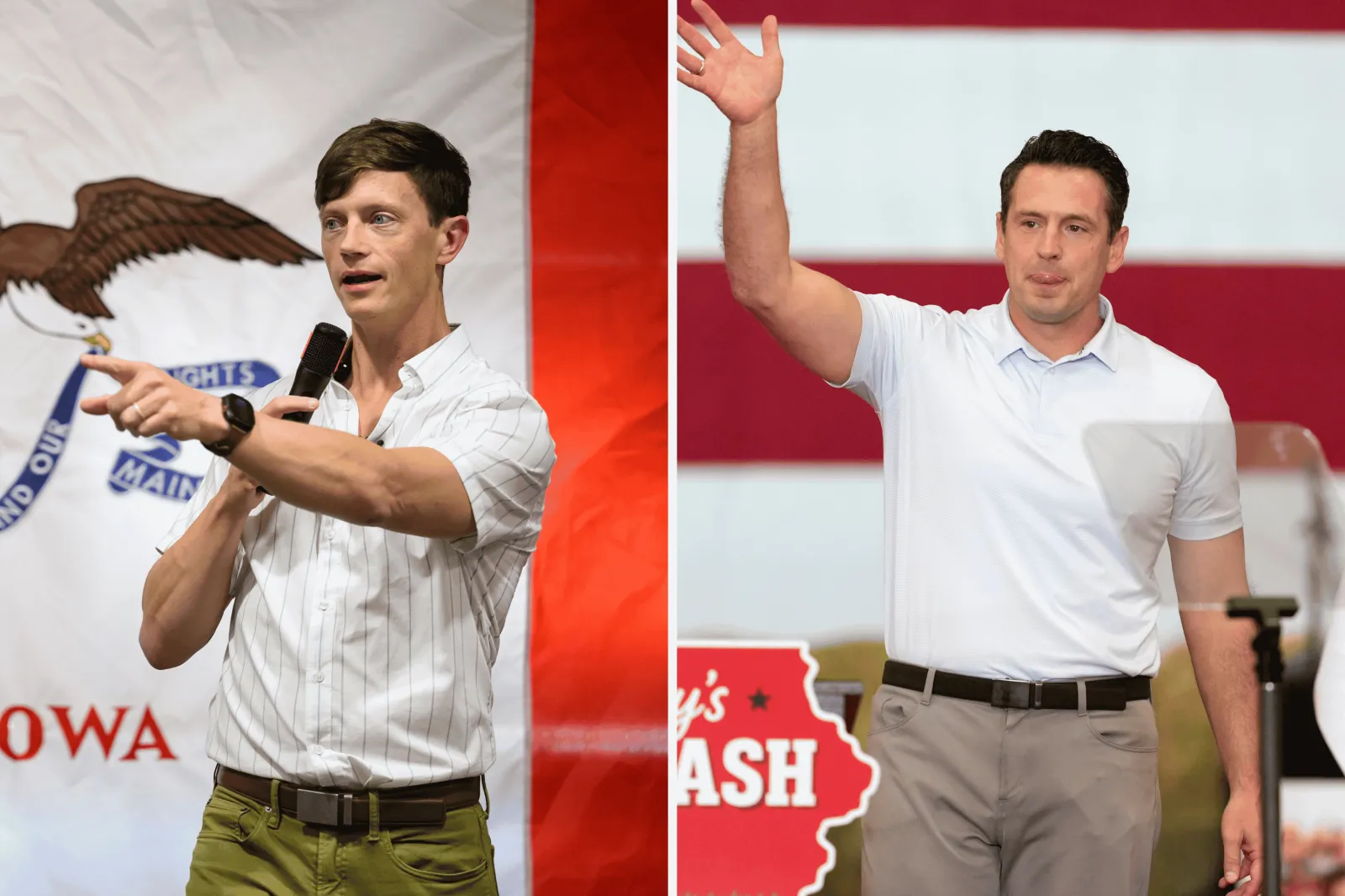
Democratic State Auditor Rob Sand headed into Tuesday night's first gubernatorial debate against Republican Zach Lahn holding a clear lead across the latest public polling, while prediction markets and several major election forecasters now make the Democrat the favorite to win.
A Sand victory would be a significant breakthrough for Democrats in a state that has become increasingly difficult terrain for the party since former President Barack Obama carried it twice. President Donald Trump won Iowa by more than 13 points in 2024, and Republicans currently dominate its congressional delegation and state government. Iowa has not elected a Democratic governor since Chet Culver in 2006.
Read More on Politics
Yet the race to succeed retiring Republican Governor Kim Reynolds has emerged as one of Democrats' strongest pickup opportunities anywhere in the country—and Tuesday's debate gives Lahn one of his biggest remaining opportunities to change its trajectory.
“The polls and prediction markets are wrong, just like they were in the primary," a Lahn campaign spokesman told Newsweek, calling the Democrat a "fraud" who Lahn looks forward to "exposing."
“From day one, Zach has run on solving Iowa’s cancer crisis and fixing our water quality issues, keeping Iowa’s kids in Iowa, saving our family farms, and making public education #1 in the nation again," the spokesman said.
Newsweek reached out to Sand's campaign for comment via email.
...
Key Moments From Gubernatorial Debate
In Tuesday night’s debate, Sand and Lahn clashed over taxes, education, affordability and more, with several exchanges growing heated. Below are highlights from the discussion:
- Funding in Iowa Public Schools
Sand said teachers need to be compensated adequately and that relief should be given to public schools in the state by increasing their funding 5 percent. "I'd like us to give them a boost after having funded them below the rate of inflation for years now," he said.
Lahn said that he'd like to see innovation zones open up in the district, while pointing out "cultural issues" taking up teachers' time. He proposed "non-punitive off-ramps" to get students one-on-one help or small-group assistance. He added that parents deserve more say in where their kids go to school.
- Lahn's Time in Kansas Questioned
Sand took repeated jabs at Lahn over his time spent in Kansas, a consistent theme throughout the campaign cycle.
"This has been the central lie of Rob Sand's campaign," Lahn said while addressing the jab. He said he won't be intimidated by Sand's family wealth while noting that he has a blended family and his children split time. He said that he travels for business and family, accusing Sand of traveling between his family's network of properties.
Sand pointed to reports of Lahn's voting record in Kansas, an account detailed by the Kansas Reflector, saying the state needs a "full-time Iowan" to be governor.
- Combating Rising Cancer Rates in the State
Lahn said that he'd like to look at nitrate levels in the state's water and fertilizer. "We have the ability here to bring real solutions to stop these products from getting in our streams in the first place, working alongside farmers to make real change for the people of Iowa, and have that be our goal to lower our cancer rates as far as humanly possible," he said.
Sand said he appreciated Lahn highlighting the IWill program aimed at funding clean water, productive soils and prosperous wildlife. He said he voted for it in 2010 "because I lived here, you didn't," sparking another back-and-forth about Lahn's time outside of the state.
Sand called for expanding conservation programs, and a "massive" restoration of wetlands and grazing lands for water quality concerns regarding the cancer crisis in the state.
He added that residents smoke and drink at higher rates while also not exercising as much, adding that if that state wants to tackle the problem, it needs to look at those factors as well.
- Lahn Calls Out Data Centers
When discussing the economy, Lahn took the opportunity to rip into data centers—a hot-button topic nationwide amid midterm election season.
He said Iowa needs to grow through homegrown businesses, "and not prioritizing big out-of-state projects that are not employing people, like data centers." He added that he's called to eliminate all tax breaks from the centers. This notably breaks with Trump, who has pushed for more development into artificial intelligence and for communities to embrace the data centers.
Ultimately, Sand said it's time for change in Iowa and that residents have the choice. Lahn in his closing remarks said there is a lot at stake in the election and his goal for the state is to be the best place to raise a family and hand down something to the next generation.
Following the debate, Democratic Governors Association Communications Director Sam Newton said in a released statement to Newsweek, “It wouldn’t be surprising if Zach Lahn is already flying back to Kansas after losing tonight’s debate. Rob Sand won by outlining how he’ll be an independent voice who tackles corruption and protects taxpayers, while lowering costs and addressing Iowa’s cancer crisis. That’s a huge contrast with Lahn, who is not only an out-of-touch carpetbagger and career political operative, but will also continue the failed status quo of one-party rule in Iowa. The bottom line: Iowans are ready for change, and that’s exactly what Rob Sand is going to deliver.”
In a released statement on X following the debate, Iowa GOP Chair Jeff Kaufmann said in part that Iowans got a real glimpse at Sand on Tuesday night: "For months, Rob has worked hard to portray himself as something he's not, while dodging and disguising his real positions."
He added that Republicans will ensure Iowans know the "real Rob Sand" from now until Election Day.
Iowa Governor Polls Show Rob Sand Leading Zach Lahn
The most recent public polling has been remarkably consistent in showing Sand ahead.
A New York Times/Siena University poll conducted from September 22 through October 1 among 606 likely voters found Sand leading Lahn 52 percent to 41 percent, an 11-point advantage. Meanwhile, a Fox News poll conducted by Beacon Research and Shaw & Company Research from September 24 to 28 put Sand ahead 53 percent to 44 percent among 1,008 likely voters.
Marist found an even larger gap, 12 points, in its September 17-20 survey of 1,050 registered voters, with Sand at 54 percent and Lahn at 42 percent. Independents broke for Sand 57 percent to 33 percent in that survey. While a Republican-aligned co/efficient survey conducted September 14-16 showed a considerably closer race, it still had Sand ahead 46 percent to 42 percent among 831 likely voters.
Earlier polling has pointed in the same direction. YouGov gave Sand a 10-point advantage among likely voters in early September, while an Emerson College/Nexstar survey conducted August 31 to September 1 showed Sand leading by a narrower 49 percent to 46 percent.
The important caveat for Democrats is that polling margins have varied significantly—from three or four points to double digits—and Iowa has moved decisively Republican in recent presidential elections. But the absence of a recent poll showing Lahn ahead is nevertheless notable this close to Election Day.
Iowa governor: latest polls
Reported voter support · Field dates in 2026 · Updated Oct. 6
■ Rob Sand (D) ■ Zach Lahn (R)
NYT / Siena
Sep. 22–Oct. 1 · 606 likely voters
52%
41%
Fox News
Sep. 24–28 · 1,008 likely voters
53%
44%
Marist
Sep. 17–20 · 1,050 registered voters
54%
42%
co/efficient (R-aligned)
Sep. 14–16 · 831 likely voters
46%
42%
0%50%100%
Individual polls, not a forecast. Samples and methods differ. Other responses and undecided voters are omitted. Bars use a 0–100 percent scale.
Sources: NYT / Siena · Fox News · Marist · co/efficient (R-aligned)
Iowa Governor Prediction Markets Favor Rob Sand
Prediction markets have moved even more decisively toward the Democratic contender.
As of Tuesday morning, Kalshi traders were pricing a Democratic victory in Iowa's governor's race at roughly 89 percent, compared with about 11 percent for a Republican win.
Polymarket was similarly bullish on Sand, giving him approximately an 85 percent chance of winning and Lahn around 15 percent. Those markets fluctuate as traders respond to polling, campaign developments and other information and should not be treated as conventional forecasts, but they provide another measure of how expectations surrounding the race have changed.
Major election forecasts have also shifted toward Democrats.
The Cook Political Report rates the contest Lean Democratic, while Inside Elections has it at Tilt Democratic. Sabato's Crystal Ball also moved the race to Lean Democratic in September.
That represents a striking position for Democrats in a state Trump carried 55.7 percent to 42.5 percent just two years ago.
Why Iowa Could Be Shifting Toward Democrats
Sand's apparent advantage cannot be separated from the broader national political environment.
Trump's standing has deteriorated nationally ahead of the midterms, while economic concerns, high energy prices and the war with Iran have become significant liabilities for Republicans. Those pressures are particularly relevant in an agricultural state where fuel costs, tariffs and trade policy can have an outsized impact.
A September Marist poll found just 41 percent of Iowa registered voters approved of Trump's job performance, while 58 percent disapproved. Nearly half—46 percent—said their family's finances had worsened during the previous year. The same survey gave Democrats a five-point advantage on the generic congressional ballot in Iowa.
Vice President JD Vance traveled to Iowa in September to rally alongside Lahn as Republicans sought to address soaring diesel costs affecting farmers and truckers, underscoring how closely the state's elections have become intertwined with the national economic debate.
There is also a candidate-specific dynamic. Sand is already a twice-elected statewide official and the only Democrat currently holding statewide office in Iowa. Lahn, meanwhile, emerged from a competitive Republican primary and has had less time to establish himself with the broader electorate.
Sand has attempted to cultivate an image separate from the national Democratic brand, emphasizing government oversight and bipartisan appeal, an approach that could be particularly valuable in a Republican-leaning state.
Related Story
Hinson and Turek’s Voting Records Compared as Iowa Candidates Take Swipes
What's at Stake in the Governor Debates
Tuesday night's debate at St. Ambrose University in Davenport was the first of four scheduled debates between Sand and Lahn before the November 3 election.
Tonight's faceoff started at 7 p.m. CT (8 p.m. ET). The hourlong debate aired live on COZI 6.3 and KCRG 9.2. The event was closed to the public. For those unable to watch live, KWQC says the full debate will be available afterward on its smart TV app and YouTube channel.
For Sand, the challenge is largely defensive moving forward: maintain his advantage, avoid a damaging mistake and continue presenting himself as an acceptable alternative to nearly a decade of Republican control.
For Lahn, the stakes are higher. With the latest polling and prediction markets moving against him, the debates offer a high-profile opportunity to redefine the race, consolidate Republican voters and make the case that Iowa's recent political realignment remains intact.
Democrats should also be cautious about declaring a new Iowa political era before votes are counted. A single midterm election held during an unfavorable national environment for the president's party would not necessarily erase a decade-long Republican trend.
But if Sand wins, particularly by margins close to those shown in some polls, it would be hard to dismiss the result as an isolated anomaly. Iowa went from voting for Obama by nearly six points in 2012 to backing Trump by more than 13 points in 2024. Twelve years later, Democrats now appear to have a realistic chance of reclaiming the governor's mansion.
Tuesday's debate could help determine whether that is merely a midterm backlash, or the first evidence of something more lasting.
Contact Newsweek editors on this story: Sam Wilson, Edward T. Cummins
View 0 Comments
Submit Correction
View Editorial & AI Guidelines