
...

By Shane Croucher
Senior Editor
0
Share
Newsweek is a Trust Project member
See more of our trusted coverage when you search.Prefer Newsweek on Googleto see more of our trusted coverage when you search.
Before the Oval Office meeting of February 2025 blew up on camera, there was a question about clothes. Why, a reporter asked Volodymyr Zelensky, wasn’t he wearing a suit?
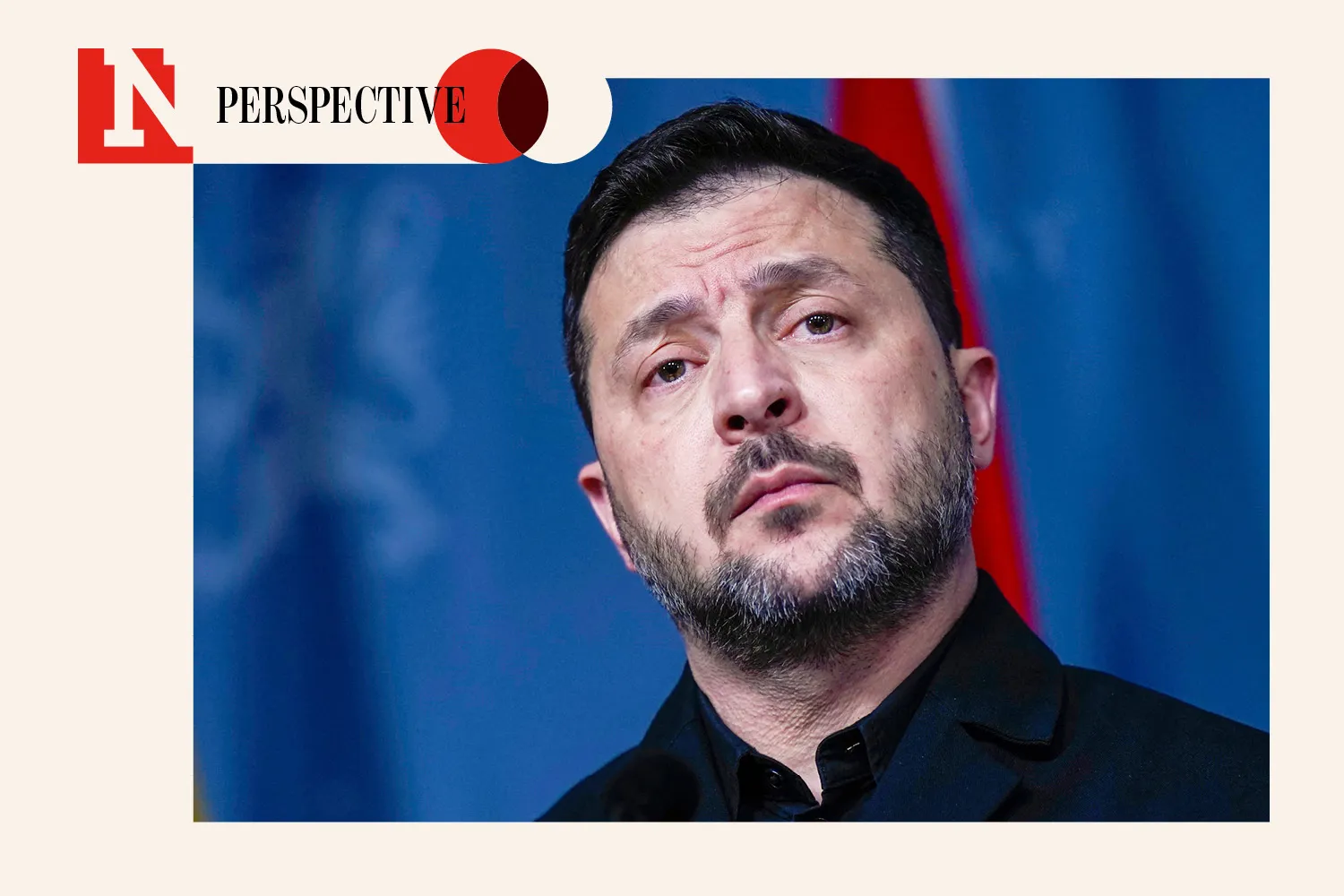
He would wear "a costume," Ukraine’s president replied, once the war was over. The war was not over by August when he came back to the White House, but he wore something close enough: black, cut with military lines by a Ukrainian designer.
The same reporter told him he looked fabulous. Donald Trump chimed in that he’d said the same. Zelensky got the last word, noting the reporter was wearing the same suit as before: "I changed, you did not."
Read More on Analysis
Fourteen months on, the suit has bought Zelensky nothing.
On October 10, a day after announcing a diesel deal with Vladimir Putin, Trump said it was "time for Ukraine to get a new president." He later told Newsmax he finds Zelensky harder to deal with than Putin, and then said someone else should negotiate for Kyiv.
The Kremlin said it "fully" agrees. Naturally.
Zelensky should take them up on it. Not because his critics are right about him, but because they are almost certainly wrong, and his departure is the only experiment that can prove it.
Close to Zero
Of course, Zelensky can be abrasive. He can be, to many eyes, ungrateful. He fights in public: he called the diesel deal "a weak decision by our strong partners." He can be defiant of allies, too. Zelensky kept striking Russian refineries despite, by one U.S. official’s count, half a dozen requests to stop.
At home, corruption investigations had worn his standing thin. In Kyiv International Institute of Sociology (KIIS) interviews on October 8 and 9, before the diesel deal, more Ukrainians distrusted him than trusted him, 52 percent to 43 percent.
Still, Zelensky has become a prism through which Washington and Moscow refract their frustration with a war that will not end on their terms.
Related Story

The Future of American Power Runs Through India
Oleksandr Kraiev, who directs the North America Program at the Ukrainian Prism think tank, told Newsweek he sees the rift with Trump mostly as "personification" of a bigger clash between Kyiv and the administration than just their relationship.
If the problem were Zelensky himself, Kraiev argued, officials in the administration would be trying to rebuild ties with Ukraine, especially military ones, by working around him. He sees no such effort.
Instead, he noted, some Republicans are supporting Ukraine by backing Zelensky.
The difference a new leader would make, Luke Cooper, director of the LSE Ukraine Programme, told Newsweek, is "close to zero," because Kyiv has been willing since spring 2025 to freeze the front line, leaving just under a fifth of Ukraine occupied.
Three Obstacles
Three obstacles operate independently of Zelensky and would outlast him.
The law is a good place to start. Ukraine’s constitution says its territory can be altered only by an all-Ukrainian referendum, and bars amendments under martial law. Zelensky has said any deal ceding land must go to a referendum.
But wartime law bans referendums and elections alike, and he says one would need 60 days and a real ceasefire. Yet Putin demands the rest of Donetsk as the price of any ceasefire.
No vote without a truce, no truce without the land, no land without a vote. Zelensky didn’t write the Ukrainian constitution. And just like any other Ukrainian citizen, he must follow it.
Then there are the voters. In KIIS polling from October 8 to 16, 61 percent of Ukrainians called withdrawing from the rest of Donbas, Kramatorsk and Slovyansk included, in exchange for Western security guarantees categorically unacceptable; 35 percent could accept it. KIIS found the pressure campaign had not shifted opinion.
Related Story

How Trump’s Hero Winston Churchill Would Handle Putin and Ukraine
Ukraine’s resistance is not built on "the mindset of one man," John Lough, a senior research fellow at the NEST Centre, told Newsweek. It comes from below, from elites and society alike.
Trump warns that Zelensky’s people won’t "stand for it any longer" unless he makes a deal. But the evidence runs the other way: among Ukrainians interviewed after the diesel deal, trust in Zelensky stood at 57 percent, a rally-around-the-flag effect in KIIS’s reading.
Oleksiy Haran, a professor of comparative politics at Kyiv-Mohyla Academy, told Newsweek that if a snap election were held under Trump’s and Putin’s pressure, Zelensky would be the likeliest winner.
And there is the map. Those two aforementioned Donbas cities anchor the "fortress belt," Ukraine’s main defensive line in Donetsk since 2014. The Institute for the Study of War has warned that ceding it would give Russia a launch point into far less fortified ground in the Kharkiv, Dnipropetrovsk, and Zaporizhzhia regions.
Haran argues that abandoning it would repeat Munich, the 1938 deal that stripped Czechoslovakia of its fortified borderlands. Within six months, the rest of the country had been carved up.
Smile and a Sorry
So suppose Zelensky resigned. Under the constitution’s Article 112, parliament’s speaker, Ruslan Stefanchuk, would act as president until an election that martial law forbids.
Stefanchuk, a law professor who has known Zelensky since their college days in competitive comedy, arrives with a Kremlin endorsement of sorts. In 2024, Putin called the parliament and its speaker "the only legitimate authorities in Ukraine."
Moscow would have its interlocutor, and the same answer, from the same constitution, the same voters, and the same fortified cities. Nor would an election change it. "Realistic Ukrainian candidates to the presidency will not agree," Haran said.
"I can’t" is still "I can’t," even said with a smile and a sorry.
Related Story
The Only Thing More Dangerous for Ukraine Than Putin Is a Defeated Trump
There are, of course, objections to Zelensky walking. For one, resigning under pressure would let two foreign capitals pick Ukraine’s leader, hardly an exercise in Ukrainian democracy that Trump and Putin claim to be interested in.
And Lough warns that power in Kyiv is so personalized, from the army chief to the prosecutor general, that a president’s exit could strain the state and its war effort. Anything that risks undermining Ukraine’s position is perhaps best avoided.
Both risks are real, but a constitutional exit also hands the office to a party ally, not a rival, and Zelensky would surrender nothing except his job. Not a kilometer, not a clause. He has offered to step down before, for peace or NATO membership.
This trade is smaller. The prize is the end of an enduring excuse for Ukraine’s antagonists and foes against their own stubbornness to do what is needed.
Blame the Ghost
Zelensky, who has trouble sleeping for the burden he has carried all these years, and still carries, has earned the exit.
This is no cowardly retreat. He has proved his bravery, repeatedly. On February 25, 2022, with Russian forces bearing down on Kyiv, Zelensky filmed himself in olive green outside the presidential office to show Ukraine’s leadership had not fled.
Lough calls Zelensky’s stamina extraordinary, but says the strain of nearly five years takes a toll. Zelensky has given more than anyone could reasonably ask of one person.
The proof of the move would be in the pudding. If a successor secured a deal Zelensky could not, his critics were right, and Ukraine would be better off without him as a blocker to progress.
But if talks stalled on the same questions of territory and guarantees, as is highly probable even without Zelensky, the problem was never the difficult man in the black suit.
Putin has already shown how the goalposts move. Less than a year after calling the speaker legitimate, he floated a temporary administration for Ukraine under U.N. auspices.
Moscow, Lough notes, has never made Zelensky’s exit a formal condition, perhaps knowing it would never fly. Its aim is to be seen removing Zelensky’s people, not just Zelensky. An acting president from his own party would hardly count.
Then what? Washington and Moscow might have to do something more meaningful to end the war. But as the same problems surfaced with a different face attached, more likely, they would just resort to blaming Zelensky’s ghost anyway.
View 0 Comments
Submit Correction
View Editorial & AI Guidelines