...

By Tom Howarth
Science Reporter (Nature)
0
Share
Newsweek is a Trust Project member
See more of our trusted coverage when you search.Prefer Newsweek on Googleto see more of our trusted coverage when you search.
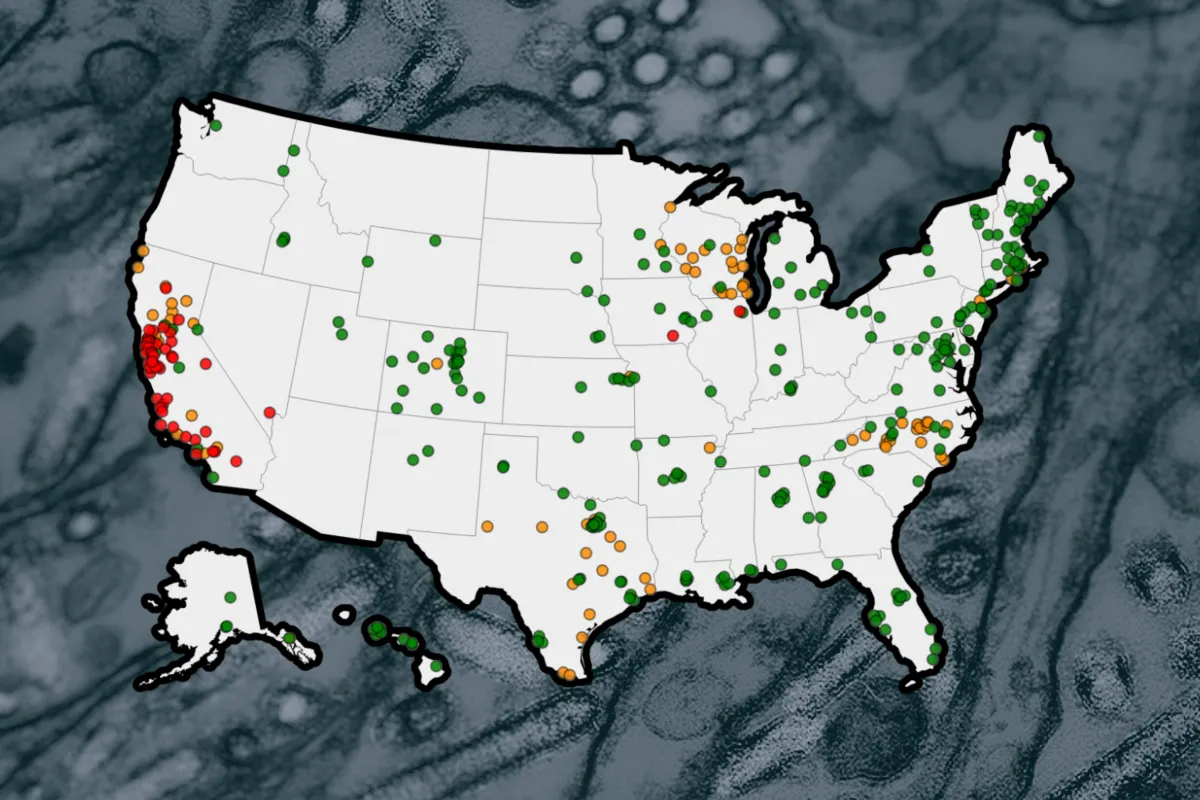
A new map created using data from the U.S. Centers for Disease Control and Prevention (CDC) has revealed the locations across the country where bird flu has been detected in wastewater samples.
Updated on December 26, the data is from November 10 to December 21. Each dot on the map represents a testing site, classified as "H5 Detection" if samples tested positive for the avian influenza A (H5) virus, or "No Detection" if none were found.
California stands out as the epicenter of the outbreak, with 49 of the 52 positive detections nationwide occurring in the state. Governor Gavin Newsom declared a state of emergency on December 18 in response to the crisis.
Read More on News
The situation has been compounded by the CDC's announcement of a severe human case in Louisiana, with mutations in the virus raising concerns about potential adaptation to human hosts.
Why It Matters
The rise in bird flu cases poses significant threats to public health, livestock and food supplies. After the CDC confirmed the mutations detected in the Louisiana patient's virus samples, experts warned of the dangers this could pose as the outbreak develops.
"These types of mutations are the exact types of mutations we worry about in infectious disease epidemiology and pandemic preparedness," Michael Mina, a physician-scientist, previously told Newsweek.
Beyond health risks, the outbreak has heavily affected the agricultural sector. In California alone, hundreds of cattle herds and poultry flocks have tested positive.
Wastewater monitoring is a critical tool in tracking the virus's spread and identifying emerging trends early.
What To Know
Bird flu detections in wastewater have been confirmed in California, Nevada, Iowa and Illinois, with the West Coast state the hardest hit.
California has reported 36 human cases, 697 infected cattle herds and 127 poultry flocks testing positive for the virus.
In Nevada, no human cases have been identified, though one cattle herd and three backyard poultry flocks have been affected.
Iowa has seen one human case linked to poultry farming, along with 13 infected cattle herds and 62 poultry flocks.
Illinois, while free of human and cattle cases, has reported 10 poultry flocks testing positive.
The CDC's National Wastewater Surveillance System monitors the virus's spread across 45 percent of the U.S. population. Over 15 million people live in areas with H5 detections in wastewater, according to the data.
However, wastewater testing has its limitations. It cannot determine whether the virus comes from humans, animals or animal products like milk from an infected cow.
Nor can it determine what subtype of bird flu has been detected, meaning it is not possible to differentiate between H5N1, which is responsible for the widespread outbreak, and other H5 types.
Despite this, this testing provides an essential early-warning system for understanding trends in the outbreak.
What People Are Saying
Jonathan Yoder, deputy director, CDC Division of Infectious Disease Readiness and Innovation, told Newsweek: "Testing for influenza A (H5) virus in community wastewater can provide a signal that animals or humans may be infected with the virus in the contributing community. Wastewater results for avian influenza A (H5) virus provide an additional source of data to complement and inform public health planning and response efforts."
When a detection is made, the CDC notifies relevant jurisdictions, Yoder said, and it reviews other data to ensure there is no "unusual activity in people."
"Given the ongoing outbreak of influenza A (H5) in dairy cattle and detections showing up in some poultry flocks, the recent detections are not surprising," he said. "Detections in many areas are likely related to wild birds or known poultry outbreaks. At this time, there is no indication that H5 detections in wastewater are associated with human-to-human transmission of H5."
What's Next
The CDC continues to monitor the virus's spread and evolution through its wastewater surveillance system, with updates weekly.
Public health agencies and agricultural partners are investigating detections to better understand their sources and take necessary actions.
The CDC maintains that "current public health risk is low" and that no cases of human-to-human transmission have been detected.
Update 12/31/24, 5:28 a.m. ET: The article was updated with comments from the CDC's Jonathan Yoder.
Do you have a tip on a science story that Newsweek should be covering? Do you have a question about bird flu? Let us know via science@newsweek.com.
View 0 Comments
Submit Correction
View Editorial & AI Guidelines