10
Loading video...

By Anna Skinner
Associate News Editor
0
Share
Newsweek is a Trust Project member
See more of our trusted coverage when you search.Prefer Newsweek on Googleto see more of our trusted coverage when you search.
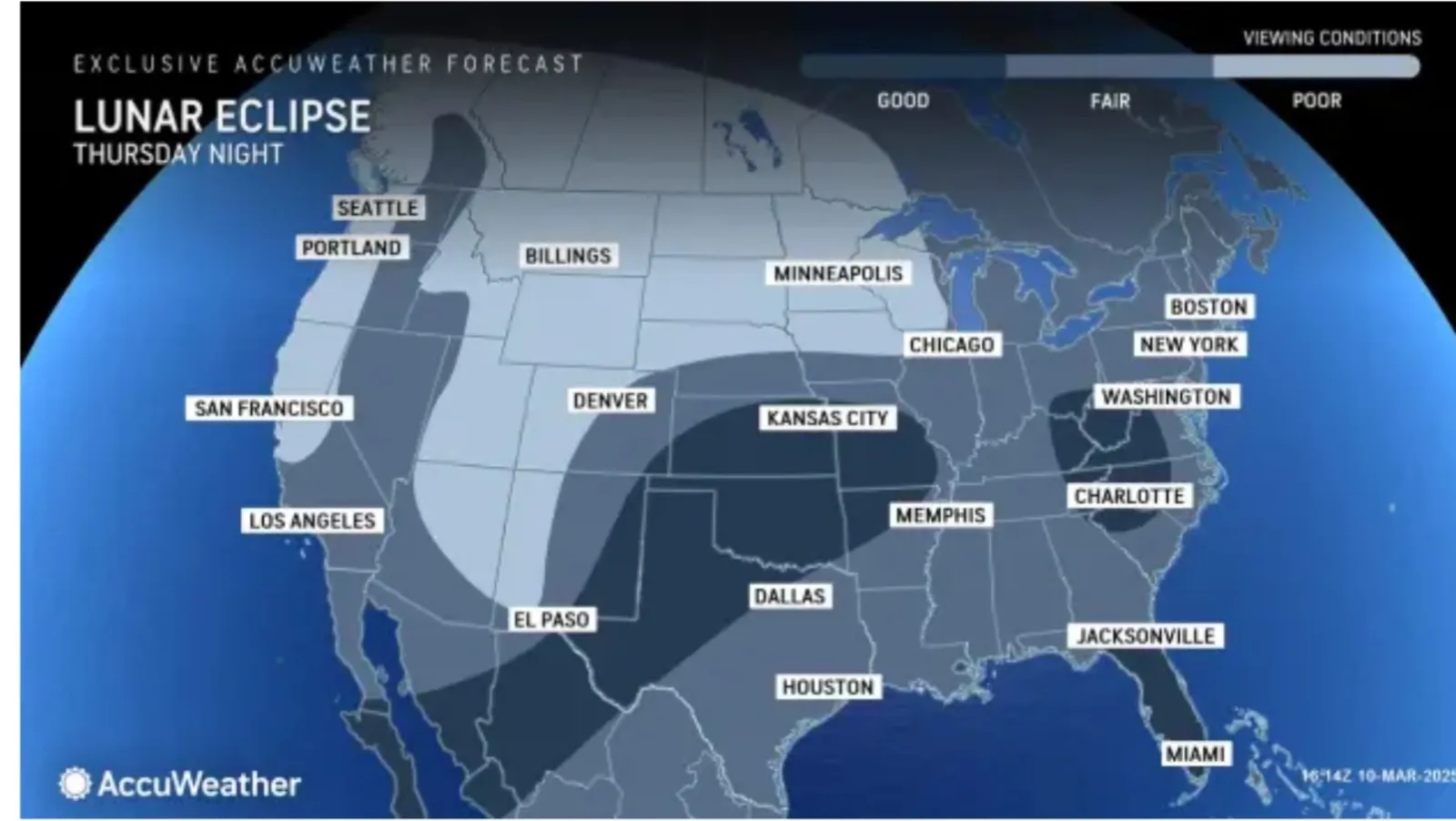
Several states will have good viewing conditions for the lunar eclipse on Thursday night, according to a map from AccuWeather.
Why It Matters
The only lunar eclipse visible in North America this year will take place on Thursday night, March 13. Meteorologists anticipate that people living in 15 states will have good viewing conditions for the astronomical event, also known as the Blood Moon, which will make the moon appear red.
Read More
How to See the Blood Moon Lunar Eclipse This Month4 min read

Awe at Nature Phenomenon Captured on Side of the Road: ‘Had To Pull Over’3 min read

Why Did SpaceX’s Starship Explode? Musk’s Company Issues Statement4 min read

What To Know
While a solar eclipse involves the moon passing between the sun and the Earth, casting a shadow across our planet, a lunar eclipse involves the Earth passing directly between the moon and the sun.
This alignment prevents sunlight from directly reaching the moon, so the moon appears darkened or takes on a reddish hue. Lunar eclipses are, therefore, sometimes called "blood moons."
The upcoming event is the first total lunar eclipse since 2022. The eclipse will start at different times across the country, with the earliest occurring on the West Coast. Los Angeles viewers will experience the total eclipse beginning at 11:26 p.m. PT, whereas viewers in New York will not have the chance to see it until 2:26 a.m. ET on Friday.
The total eclipse will last over an hour, with the partial eclipse visible for several hours.
...
A map from AccuWeather shows that the best viewing conditions will be in:
- New Mexico
- Texas
- Oklahoma
- Kansas
- Missouri
- Arkansas
- Tennessee
- Kentucky
- Ohio
- West Virginia
- Virginia
- North Carolina
- South Carolina
- Florida
- Colorado
Poor viewing conditions are expected across much of the West, except for eastern Washington, Nevada, southern California, western Idaho and eastern Oregon, which can expect fair viewing conditions. The Great Lakes Region and the Northeast will also have fair viewing conditions.
What People Are Saying
AccuWeather senior meteorologist Bob Larson told Newsweek: "The big weather feature which will have the greatest impact on all of this will be the large system coming out of the west, moving west to east across the country later this week."
Larson added that the storm system would block the view of the lunar eclipse, particularly for the Rocky Mountains.
"If you're underneath this snowstorm, you're not going to see any of it. It will completely obscure the lunar eclipse," he said.
NASA Langley Research Center on X, formerly Twitter: "On March 13, the Moon, Sun and Earth align for a stunning display known as a 'Blood Moon'...You won't need any special equipment to see the eclipse, just a dark environment away from bright lights."
View 0 Comments
Submit Correction
View Editorial & AI Guidelines