...

By Ellie Cook
Senior Defense Reporter
0
Share
Newsweek is a Trust Project member
See more of our trusted coverage when you search.Prefer Newsweek on Googleto see more of our trusted coverage when you search.
President Donald Trump and his administration have given several reasons for the White House's unrelenting quest to control Greenland, saying the U.S. must safeguard its national security and secure vital resources.
Washington must also ensure it bats away any possible Russian and Chinese interest in the ice-covered Arctic expanse, according to the government. Observers add another factor to the list: Greenland slots into the administration's apparent desire to assert American influence over the Western Hemisphere and revive a 19th-century doctrine grounded in spheres of influence.
On Wednesday, Trump gave another reason, writing on Truth Social that Greenland "is vital for the Golden Dome that we are building."
Read More on World
...
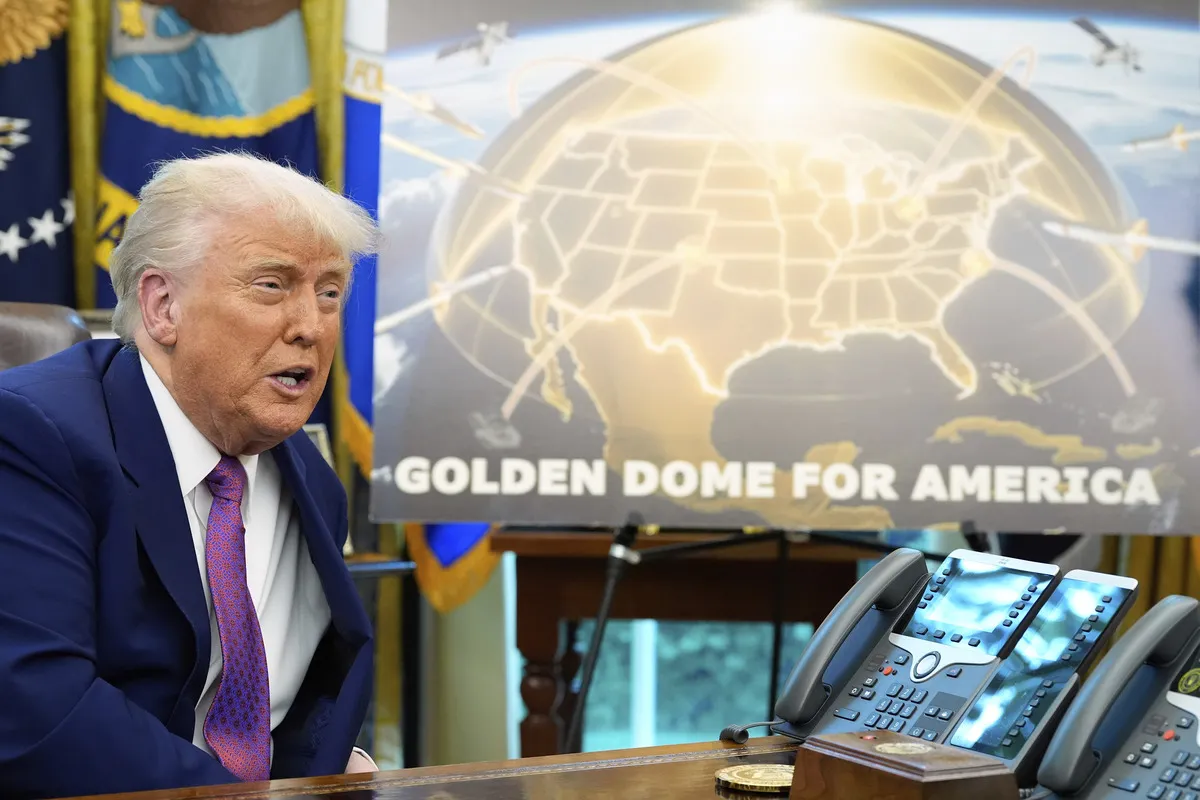
What Is the Golden Dome?
The Golden Dome project is ambitious and likely to be enormously expensive. It will, according to the administration, shield the U.S. against "next-generation" threats—such as ballistic, cruise and hypersonic missiles.
The U.S. does not currently have a joined-up way of fending off these types of threats. The Golden Dome concept is partly based on Israel's vaunted Iron Dome—which the U.S. had a hand in developing—although the Israeli system defends against short-range rockets, rather than barrages of long-range, fast-traveling missiles early on in their flight.
Trump has framed the Golden Dome system as the result of a program kicked off by President Ronald Reagan in the 1980s, popularly known as "Star Wars." The Golden Dome will use space-based sensors and interceptors to knock out missiles "even if they are launched from space," Trump has said.
Defense Secretary Pete Hegseth said in December that the Golden Dome would offer "tangible protection" for the U.S. before the end of the current administration.
Does the Golden Dome Need Greenland?
Greenland is critical for ballistic missile defense—on that, experts agree. The Pituffik Space Base, perched on Greenland's northwestern coast, is vital for picking up missile launches toward the U.S. mainland, monitoring space and watching out for submarines. Without this air base, there would be a "glaring gap" in U.S. ballistic missile defense, William Freer, a research fellow with the U.K.-based Council on Geostrategy think tank, told Newsweek.
"Today's missile defense and warning architecture heavily relies on Greenland and its strategic location," said retired U.S. Air Force General Glen VanHerck, who previously served as both the commander of the U.S. Northern Command and the North American Aerospace Defense Command, or NORAD. The joint American and Canadian command oversees both states' Arctic and early warning operations.
The Golden Dome, as it stands, will hinge on some of the architecture already in place, meaning the U.S. would need to adjust its plans for the missile defense network if Canada or Greenland were taken out of the equation, VanHerck told Newsweek.
"With that said, we, the United States, along with our allies and partners, would be far better off to partner on a solution that allows access to Greenland by NATO nations to conduct missile defense, warning, and air and maritime campaigning and defense, and to secure the national resources," VanHerck added.
Under NORAD, American and Canadian collaboration on missile defense is close. However, Ottawa's place within the Golden Dome is still up for debate, and it is not clear how Canada will slot into this way of defending North American airspace—although Trump has said the two countries are working closely on the project.
Trump has suggested Canada could pay tens of billions to be under the Golden Dome's protection. Republicans' offer to include Ottawa for free if the U.S.'s northern neighbor becomes the 51st state has been firmly and repeatedly rejected.
Canada is "not for sale," Prime Minister Mark Carney has said, echoing the sentiments of Greenlandic and Danish officials staring down the administration's overtures toward Greenland.
The Greenland Threats
Denmark's foreign minister said on Wednesday there was still a "fundamental disagreement" on Greenland after a high-level meeting with the administration and Greenlandic officials in Washington.
Many Greenlanders are in favor of the territory eventually separating from Denmark, but opinion polls show the vast majority of Greenlanders do not want the island to become part of the U.S.
Greenlandic Prime Minister Jens-Frederik Nielsen said on Tuesday that the territory's inhabitants would choose Denmark, NATO and the European Union over the U.S. Trump, hitting back at the remarks, said he disagreed with Nielsen and "that's going to be a big problem" for the Greenlandic leader.
Republican Representative Randy Fine of Florida this week introduced a bill that would pave the way to the U.S. annexing Greenland, which legal experts rebuked as heralding a violation of international law. A competing bill from Democratic Representative Jimmy Gomez of California seeks to block federal funds from being used to pursue U.S. control of Greenland and altering the U.S. military presence there.
"The problem is, there's not a thing that Denmark can do about it if Russia or China wants to occupy Greenland, but there's everything we can do," Trump told reporters on Wednesday.
Eyes have increasingly turned to the Arctic as climate change opens up new trade routes and previously inaccessible resources—a siren call to major players beyond those with Arctic coastlines. China has declared itself a "near Arctic" state, and Russia—the dominant Arctic power—has been heavily investing in its footprint in the region.
But there is no evidence to suggest Russia or China would take control of Greenland, nor of Trump's previous claim that the territory is "covered with Russian and Chinese ships."
A NATO military official from an Arctic nation, who was granted anonymity because they were not authorized to speak publicly, told Newsweek earlier this week there was no factual basis for Trump's statement.
On Wednesday, Danish Foreign Minister Lars Løkke Rasmussen said China and Russia did not pose an "instant threat" to Denmark and Greenland that the NATO territories "can't accommodate."
Update 1/15/2026 at 7:02 a.m. ET: This article was updated with additional information.
In a polarized era, the center is dismissed as bland. At Newsweek, ours is different: The Courageous Center—it's not "both sides," it's sharp, challenging and alive with ideas. We follow facts, not factions. If that sounds like the kind of journalism you want to see thrive, we need you.
When you become a Newsweek Member, you support a mission to keep the center strong and vibrant. Members enjoy: Ad-free browsing, exclusive content and editor conversations. Help keep the center courageous. Join today.


View 0 Comments
Submit Correction
View Editorial & AI Guidelines