...

By John Feng
China Editor
0
Share
Newsweek is a Trust Project member
See more of our trusted coverage when you search.Prefer Newsweek on Googleto see more of our trusted coverage when you search.
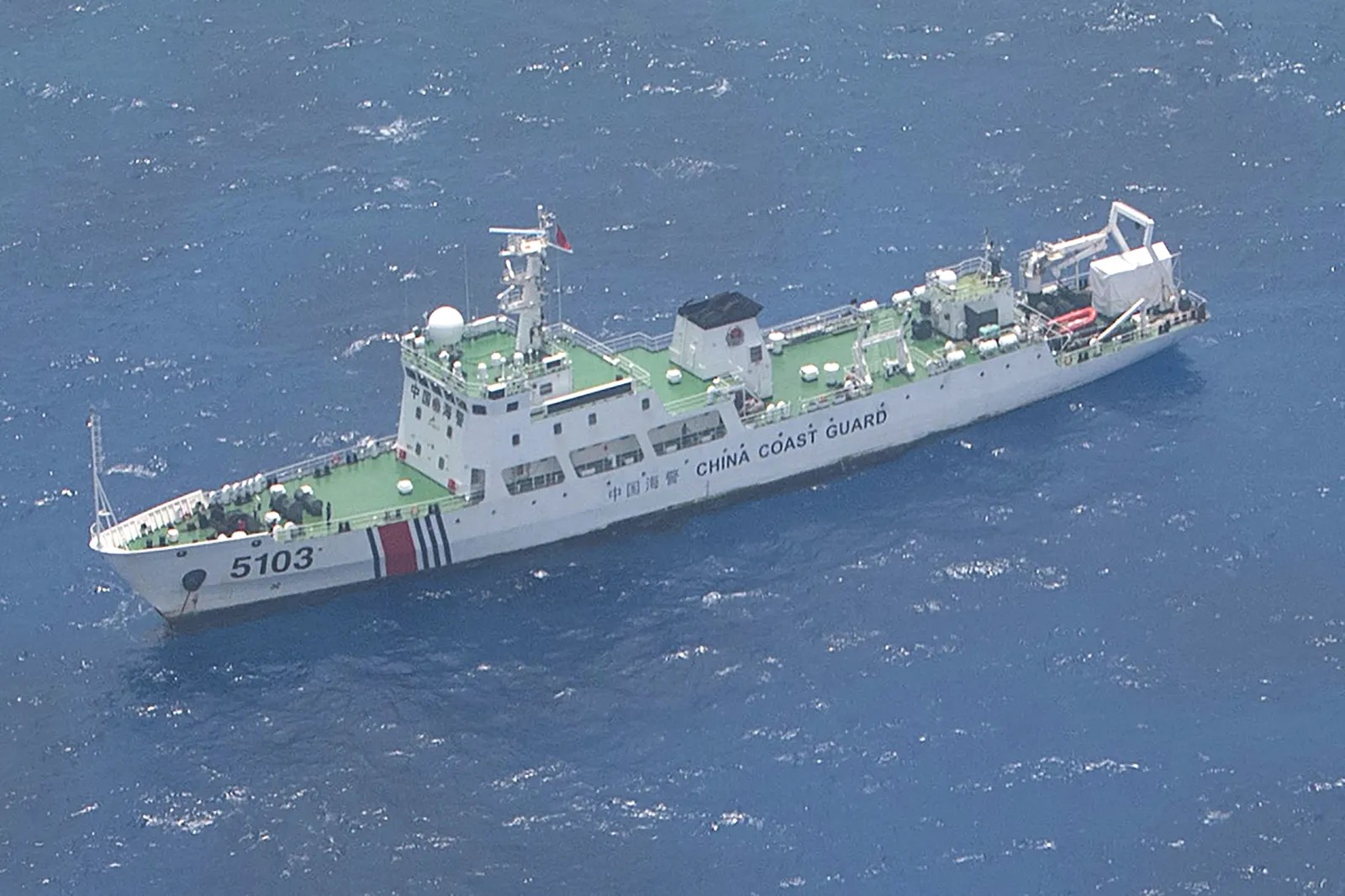
China on Monday dispatched a coast guard flotilla to waters east of Taiwan as Japan and the Philippines prepare to formalize maritime boundary talks in a move Beijing says undermines its territorial claims.
A Chinese statement said it was “a necessary operation” in response to the negotiations, which would seek to delimit neighboring exclusive economic waters and continental shelves in the Philippine Sea, without Beijing’s participation.
Beijing said the decision undermined its “territorial sovereignty and maritime rights and interests,” referring to its longstanding claim to self-governing Taiwan as well as the maritime claims that derive from it.
Read More on World
Why It Matters
The deployment highlights how quickly maritime disputes in the Indo-Pacific can escalate as regional powers move to formalize boundaries without Beijing’s involvement.
China's sweeping “nine-dash line” claim includes Taiwan and most of the South China Sea, and its claimed exclusive economic zone, or EEZ, overlaps with those of Japan, the Philippines, and at least five other governments in the region.
The Foreign Ministry in Taipei said it welcomed the move and rejected Beijing’s sovereignty claims.
China Condemns Japan-Philippines Maritime Talks
The leaders of Japan and the Philippines announced the sea border talks last week in a joint statement that also “reaffirmed the need to further promote peace, stability, and mutual trust through maritime cooperation underpinned by respect for international law.”
The negotiations would take place under the U.N. Law of the Sea Treaty, according to the statement. China, Japan and the Philippines all are states parties to the agreement, which grants a coastal state the right to exploit underwater resources including fish stocks, energy reserves and mineral deposits within a 200-nautical mile (230-mile) zone.
China’s Foreign Ministry said on Friday: “The so-called delimitation talks are completely illegal, null and void, and will have no effect on China’s claims to rights in the area east of the Taiwan island or exercise of China’s lawful rights.”
Coast Guard Deployment Near Taiwan Waters
The Chinese coast guard fleet is the largest in the world and rivals that of most Asian navies. It regularly dispatches vessels to enforce territorial and maritime claims—particularly against Japan and the Philippines in the East and South China seas, respectively.
China said the latest patrol was being led by the 5,000-ton cutter Daishan, while Taiwan said it also detected a second ship, the 3,800-ton cutter Baita, in its southeastern waters.
A Taiwan coast guard statement said the pair of Chinese ships was being monitored by the Changbin, a 600-ton offshore patrol vessel.
The agency said it “strongly condemns” the attempt to undermine Taiwan’s sovereignty and accused China of “political manipulation and cognitive warfare.”

...
Japan and Philippines Push Ahead With Maritime Delimitation Plan
Minoru Kihara, Japan’s chief cabinet secretary, said at a press conference in Tokyo on Monday that any subsequent Japan-Philippines consensus would not be legally binding on third parties.
Boundaries talks involve extensive legal and cartographic work, as well as a high degree of mutual trust, which U.S.-allied Manila and Tokyo increasingly share and Beijing does not.
The maritime area targeted for settlement lies between Japan’s southwestern islands and the Philippines’ northernmost Batanes islands.
The two governments have never clashed publicly over their overlapping claims and Japan is a vocal supporter of the Philippines’ 2016 legal case against Beijing’s sweeping claims in the South China Sea.
China claims an EEZ that includes Taiwan and the Japan-administered Senkaku Islands, a cluster of uninhabited islets in the East China Sea.
Collin Koh is senior fellow at the Institute of Defence and Strategic Studies, a constituent unit of the S. Rajaratnam School of International Studies, based in Nanyang Technological University, Singapore.
"In the case of unresolved disputes, or yet to be, there are various ways for parties to manage their differences," Koh told Newsweek.
"Of course, it’s all down to their negotiations on how to proceed with managing the disputes, though common ways include joint resource development, provisional fishery zones, or generally some collective approach that can tackle environmental issues.
"In fact, Northeast Asia is a venue with some notable examples, especially concerning joint fishery management," Koh said. "Taiwan just lately responded to the Japan-Philippines plan to negotiate delimitation of their maritime claims by suggesting cooperation in sustainable ocean or marine resource development.
When boundary disputes are still pending resolution, claimant states typically seek collective measures to manage the waters and build up political trust.
"Common ways include joint resource development, provisional fishery zones, or generally some collective approach that can tackle environmental issues," said Koh.
"In fact, Northeast Asia is a venue with some notable examples, especially concerning joint fishery management. Taiwan just lately responded to the Japan-Philippines plan to negotiate delimitation of their maritime claims by suggesting cooperation in sustainable ocean or marine resource development," Koh said.
Update, 06/02/2026, 7:14 a.m. ET: this article has been updated with comment from Collin Koh.
View 0 Comments
Submit Correction
View Editorial & AI Guidelines