...

By Micah McCartney
Reporter
0
Share
Newsweek is a Trust Project member
See more of our trusted coverage when you search.Prefer Newsweek on Googleto see more of our trusted coverage when you search.
Xi Jinping was given a lavish state welcome for two days of talks with North Korean leader Kim Jong Un on the Chinese president's first visit to North Korea visit in seven years.
Upon arriving in the North Korean capital at noon on Monday, Xi was received by Kim and his wife, Ri Sol Ju, Chinese state media reported. Kim's teenage daughter—widely viewed as his most likely successor—was also in attendance, according to photographs released by Chinese state media.
Kim Rolls Out Red Carpet
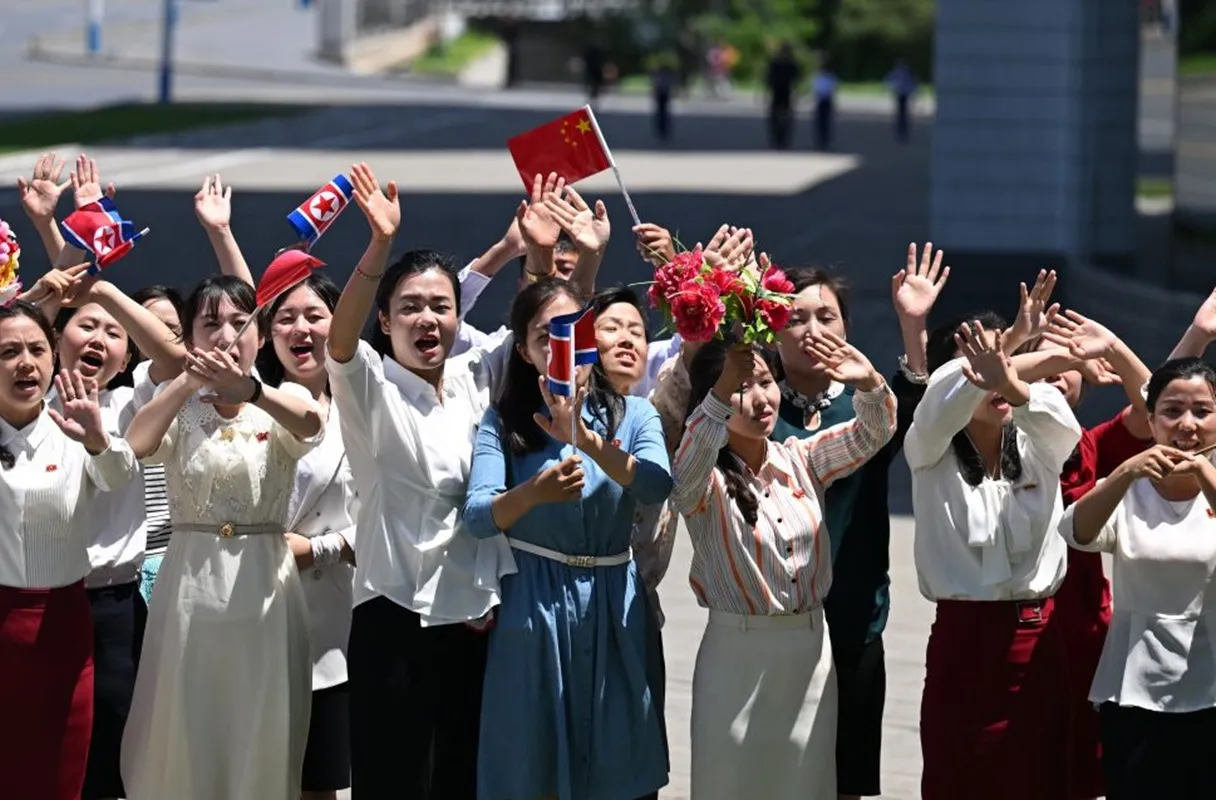
Throngs of citizens in festive dress enthusiastically waving the flags of both countries lined the route to Kim Il Sung Square, where more flag-wavers awaited alongside an honor guard that the two leaders reviewed.
Named after Kim's grandfather and the founder of the communist state, the square is the principal stage for North Korea's choreographed mass performances, military displays and other propaganda events designed to reinforce state ideology.
Read More
How China Could Help Solve Trump’s Iran Nuclear Problem7 min read

Trump Says He’ll ‘Blow the Hell Out of Them’ if Iran Deal Not Reached6 min read

How 100 Days of Iran War Exposed US Vulnerability9 min read

The ceremony also included a 21-gun salute as a military band played the Chinese and North Korean national anthems.

...

...

...

...
1 of 4
China is Pyongyang's only treaty ally and by far its most important economic partner, having for decades helped sustain North Korea's heavily sanctioned economy.
"Relations between the two countries stand at a new historical starting point, facing new development opportunities and shouldering new missions of the times," Xi wrote in an op-ed published ahead of the trip on the front page of North Korea's state newspaper, the Rodong Sinmun, according to a translation by the Korea Times.
Newsweek reached out to the North Korean Embassy in Beijing by email with a request for comment.
The geopolitical landscape has shifted significantly since Xi's last visit to North Korea—and the trip comes just weeks after the Chinese president hosted his Russian counterpart Vladimir Putin and U.S. President Donald Trump. They followed a succession of European and Asian leaders this year as Beijing seeks to burnish its credentials as a global diplomatic power.
Kim has greatly strengthened military ties with Moscow, furnishing ballistic missiles, artillery munitions, and 11,000 troops to support Russia's ongoing invasion of Ukraine, according to South Korean estimates.
The U.S. believes Pyongyang has likely received Russian technical expertise in return, potentially benefiting its expanding missile and nuclear weapons programs.
Pyongyang insists its nuclear arsenal is an essential deterrent, citing U.S., South Korean and Japanese military exercises focused on a potential conflict on the peninsula. Last year, North Korea's rubber-state parliament enshrined the capability in the nation's constitution.
Pyongyang's Signaling
North Korea's continued expansion of its U.N.-sanctioned nuclear weapons program has further stoked tensions with Seoul and brought U.S. and allied attention to China's doorstep.
Xi and Trump agreed they were committed to a denuclearized North Korea, the White House said in a readout following the Beijing talks.
Kim Jong Un's powerful sister, Kim Yo Jong, on Sunday dismissed this goal as a "complete fabrication."
"The DPRK's status as a nuclear weapons state is the line of no retreat and it is a stark reality whether anyone recognizes it or not," she said in a statement carried by the state-run Korean Central News Agency. The Democratic People's Republic of Korea (DPRK) is North Korea's formal name.

...

...
1 of 2
Pyongyang's rhetoric in recent months appears to be part of a "dual-track strategy" aimed at shaping the agenda ahead of Xi's arrival, Rachel Minyoung Lee, a senior fellow at the Stimson Center, wrote in an analysis for the think tank's North Korea-focused publication, 38 North.
On one "track," Kim has taken greater care to make statements aligned with what China regards as its core interests, including voicing full support of Beijing's position on Taiwan—the self-ruled island China claims as its territory—during Chinese Foreign Minister Wang Yi's April visit.
At the same time, North Korean officials and state media have continued to stress that the country's nuclear weapons are non-negotiable.
"Together, these signals suggest that Pyongyang is seeking not merely improved ties with Beijing but a relationship aligned with its own strategic priorities, above all Chinese acceptance of North Korea's nuclear status," Lee wrote.
Update, 6/8/26, 10:55 a.m. ET: This article has been updated with additional information.
View 0 Comments
Submit Correction
View Editorial & AI Guidelines