...

By John Feng
China Editor
0
Share
Newsweek is a Trust Project member
See more of our trusted coverage when you search.Prefer Newsweek on Googleto see more of our trusted coverage when you search.
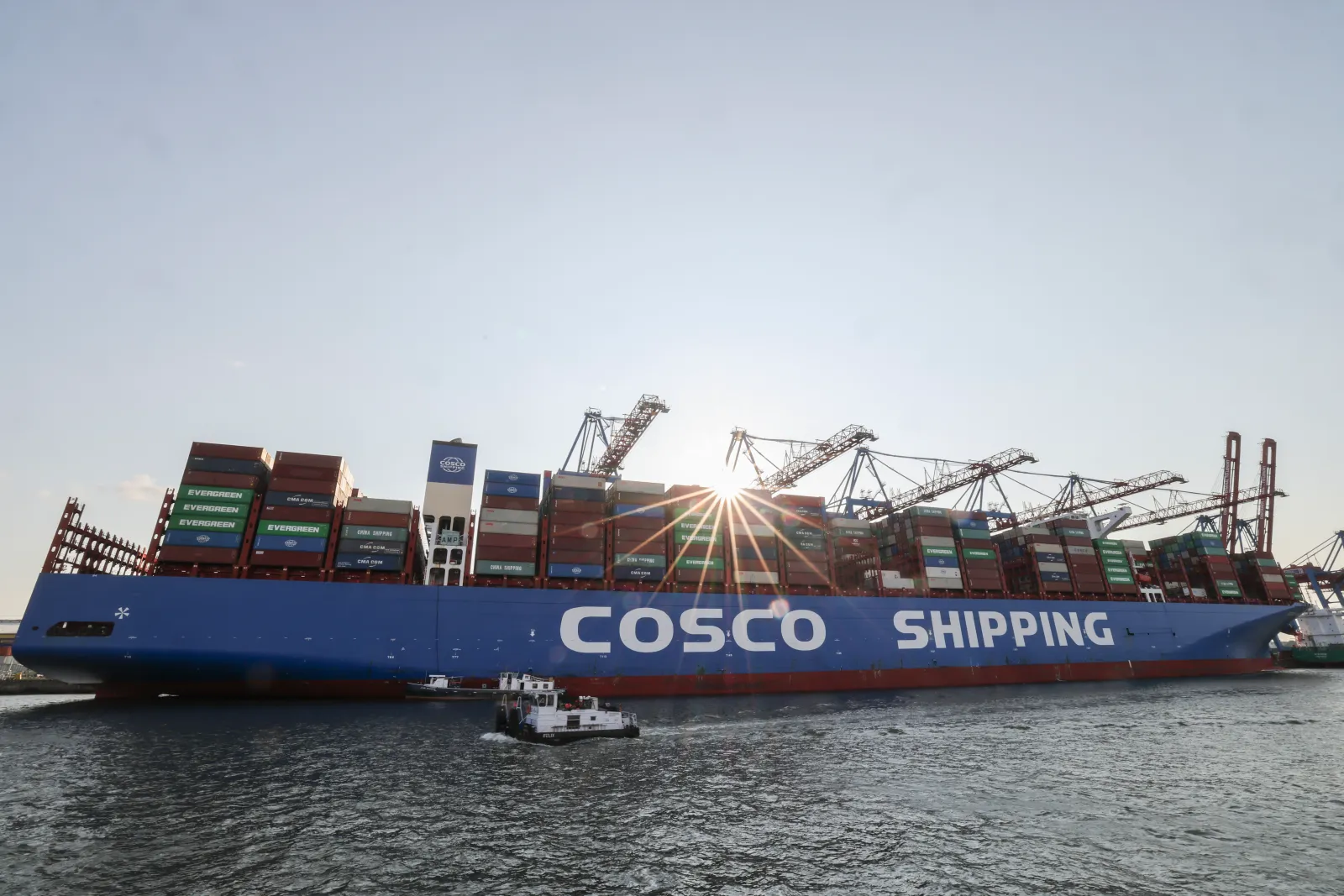
Three Chinese ships, including two owned by China’s biggest shipping company, were turned away from the Strait of Hormuz on Friday after attempting to exit the Persian Gulf, ship-tracking data showed.
Iran’s Islamic Revolutionary Guard Corps, or IRGC, said later in a statement that the strait was shut, directly contradicting an earlier claim by President Donald Trump that Tehran had agreed to let some ships through.
The CSCL Indian Ocean and the CSCL Arctic Ocean, two Hong Kong-flagged container ships belonging to a unit of China’s COSCO Shipping, had identified themselves as Chinese-owned and -crewed while sailing toward the waters between Larak and Qeshm islands, where Iran has been running an unofficial “toll booth” for pre-approved ships.
Read More on World
Both ships made abrupt U-turns near the passage at approximately 3:20 a.m. and 3:50 a.m. universal coordinated time, according to the ship-tracking service MarineTraffic, which captured signals transmitted by the vessels’ automatic identification system, or AIS.
It was COSCO’s first attempt to send ships through the strait since the company resumed bookings for Middle East-bound containers this week, “indicating that safe passage could not be guaranteed,” MarineTraffic said.
“This marks the first attempted crossing by a major container carrier since the start of the conflict,” it said. COSCO, the world’s fourth-largest shipping line, handles about 10 percent of the world’s seaborne freight.
A third ship, the Marshall Islands-flagged, Hong Kong-owned bulk carrier Lotus Rising, also turned back from the strait in the early hours of Friday while broadcasting its destination as “China owner,” its AIS data showed.
All three vessels remain in the gulf, west of Hormuz, where COSCO has at least six crude oil tankers stuck in the waters, according to Bloomberg.
Shanghai-based COSCO could not be reached for comment after hours.

...
Vessel traffic in the strait has fallen over 90 percent since the outbreak of war in the Middle East and the IRGC has attacked around 20 civilian ships with drones and missiles in a warning and apparent show of resolve.
In a statement on their Sepah News website, Iran’s Guards said three ships of different nationalities had been warned to turn back from the strait after attempting to use the “designated corridor for authorized vessels” without permission.
“The Strait of Hormuz is closed,” the statement said. "The passage of any vessel to and from ports belonging to allies and supporters of the U.S. and Israel, to any destination and via any corridor, is prohibited.”
The IRGC has escorted foreign tankers through the strait’s northern reaches, via Iran’s territorial sea, as part of a safe passage guarantee that users are meant to negotiate directly with the Iranian government.
At least one Chinese ship, the Panama-flagged Newvoyager, took the route on Monday, the Chinese financial magazine Caixin reported the following day, and at least two vessels have paid a fee of around $2 million in equivalent Chinese yuan to use the corridor, according to analysts at Lloyd’s List.
While energy and container exports from the gulf remain stalled, Iran’s oil empire is still running. Around 55-60 crude oil tankers have departed via the Strait of Hormuz in the last 28 days, nearly half of which were linked to Iran and its Kharg Island oil terminal, according to the monitoring group TankerTrackers.com
The Shanghai Securities News daily newspaper reported on Friday that shipping costs from China to the Middle East had more than doubled compared to prices before the war.
View 0 Comments
Submit Correction
View Editorial & AI Guidelines