

By Shane Croucher and Amanda Castro
0
Share
Newsweek is a Trust Project member
See more of our trusted coverage when you search.Prefer Newsweek on Googleto see more of our trusted coverage when you search.
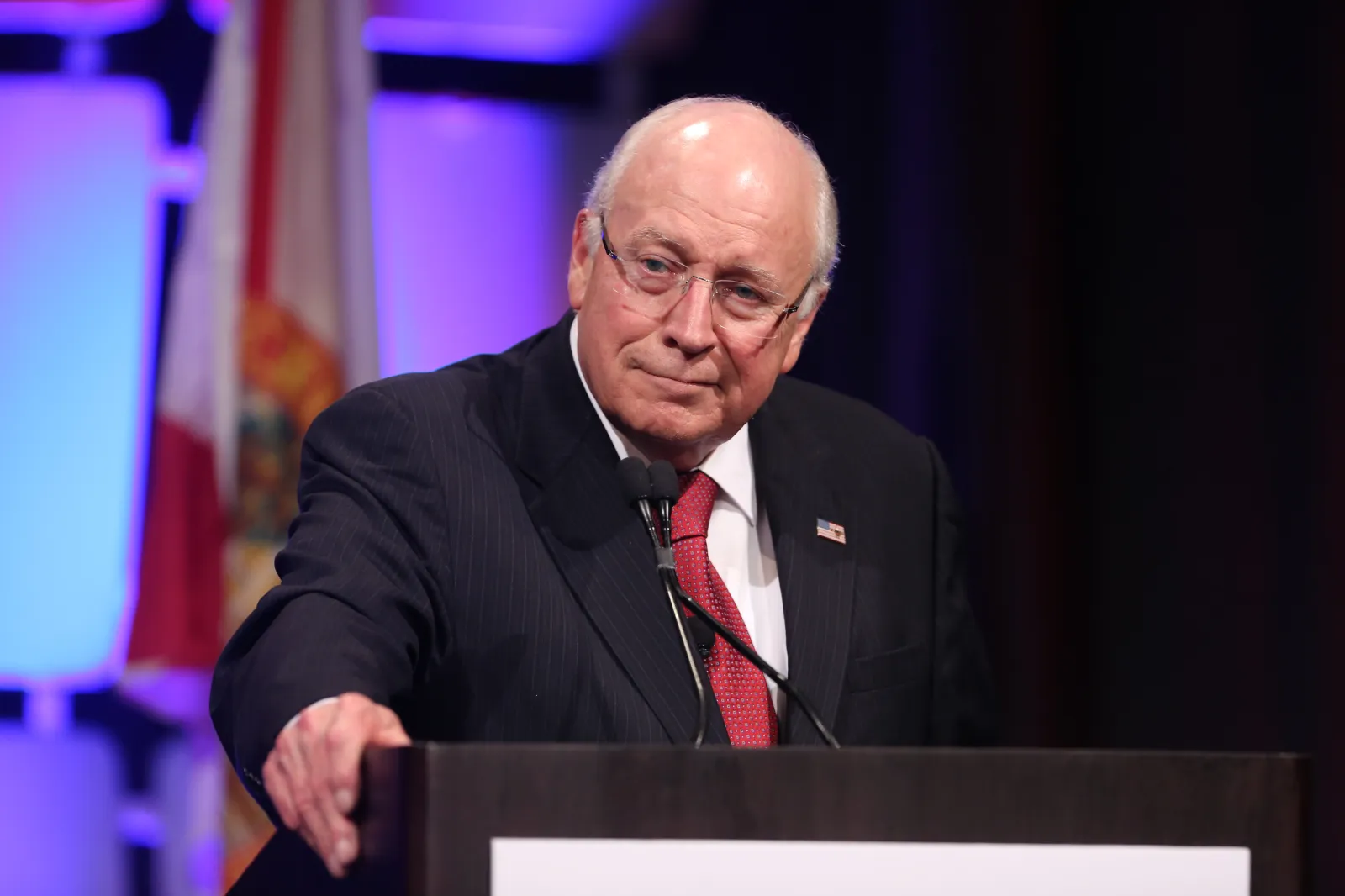
Dick Cheney, the U.S. vice president under George W. Bush, a highly influential and polarizing figure in the post-9/11 "War on Terror" and the American invasion of Iraq, has died at the age of 84, according to a statement from his family. Cheney, a Republican, died on the evening of November 3, his family said, "due to complications of pneumonia and cardiac and vascular disease."
“For decades, Dick Cheney served our nation, including as White House Chief of Staff, Wyoming’s Congressman, Secretary of Defense, and Vice President of the United States," the family statement said. “Dick Cheney was a great and good man who taught his children and grandchildren to love our country, and to live lives of courage, honor, love, kindness, and fly fishing. We are grateful beyond measure for all Dick Cheney did for our country. And we are blessed beyond measure to have loved and been loved by this noble giant of a man.”
What To Know
- Dick Cheney was a powerful Republican figure for decades, holding several high-profile roles, but Cheney broke with the Republican Party under President Donald Trump's leadership
- Cheney's Iraq War, War on Terror legacy under scrutiny over WMD claims, use of torture, and expansion of surveillance
- Health issues dogged Cheney for years, though he survived five heart attacks
- Cheney served in the administrations of both President George H.W. Bush and his son President George W. Bush
- His daughter, former U.S. Rep. Liz Cheney, became a vocal Republican antagonist of Trump
- The White House has lowered its flags in honor of Cheney
Newsweek's live blog is closed.
Nov 04, 2025 at 05:01 PM EST
WATCH: Dick Cheney dead at 84 – A legacy of power, influence and controversy
Nov 04, 2025 at 04:36 PM EST
Cheney targeted in deadly bombing during Afghanistan visit
On February 27, 2007, a suicide bombing outside Bagram Airfield in Afghanistan killed 23 people and injured 20 others during a visit by Cheney. The Taliban claimed responsibility and said Cheney was the intended target, alleging Osama bin Laden oversaw the operation.
The explosion occurred near the base’s front gate while Cheney was inside, roughly half a mile away. He later confirmed hearing the blast and was quickly briefed by the Secret Service. Cheney had traveled to the region to urge Pakistan to strengthen its stance against Taliban forces.
Nov 04, 2025 at 04:01 PM EST
Cheney served a second term, declined 2008 presidential run
Former Vice President Dick Cheney was re-elected alongside President George W. Bush in 2004, defeating Democratic challengers John Kerry and John Edwards. During the campaign, public attention focused on Cheney’s daughter Mary, who was pregnant and openly lesbian, amid national debate over same-sex marriage. Cheney expressed personal support for marriage equality but said states should decide the issue individually.
In his second term, Cheney’s staff included Chief of Staff David Addington and National Security Adviser John P. Hannah. I. Lewis “Scooter” Libby held both roles until his 2005 resignation following an indictment.
Cheney briefly assumed presidential powers on July 21, 2007, while Bush underwent a medical procedure. Despite speculation, Cheney consistently ruled out a 2008 presidential bid, and the Republican nomination ultimately went to Senator John McCain.
Nov 04, 2025 at 03:22 PM EST
Cheney’s role in post-9/11 security and Iraq war strategy
After the September 11 attacks, Vice President Dick Cheney was kept physically separate from President George W. Bush for security reasons, spending time at undisclosed locations including Camp David, his Wyoming home, and the vice presidential residence. His daily commute to the White House involved a motorcade of up to 18 vehicles.
On June 29, 2002, Cheney briefly assumed presidential powers while Bush underwent a medical procedure, marking a rare invocation of the 25th Amendment.
Cheney played a central role in shaping the Bush administration’s case for war in Iraq, repeatedly asserting that Saddam Hussein had ties to al-Qaeda and weapons of mass destruction. Intelligence reports and the 9/11 Commission later contradicted these claims.
Despite mounting criticism and public skepticism, Cheney remained a vocal defender of the war, dismissing opposition as politically motivated. His unwavering stance and controversial remarks, including a blunt “So?” when asked about declining public support, drew backlash from both political allies and opponents.
Nov 04, 2025 at 02:51 PM EST
Cheney joined GOP ticket after leading VP search
In early 2000, while serving as CEO of Halliburton, Dick Cheney was tapped to lead George W. Bush’s search for a vice-presidential running mate. After reviewing potential candidates, Bush ultimately selected Cheney himself, announcing the decision on July 25.
To comply with constitutional rules preventing electors from voting for two candidates from the same state, Cheney changed his residency from Texas back to Wyoming ahead of the election. He campaigned against Democratic vice-presidential nominee Joe Lieberman in a race that remained undecided for weeks.
During the transition period, Cheney established a privately funded office in Washington to prepare for a potential Bush administration. He played a key role in shaping the incoming cabinet, advocating for Donald Rumsfeld as Secretary of Defense and attempting to install Paul Wolfowitz at the CIA.
Nov 04, 2025 at 02:20 PM EST
Cheney joined think tanks and leads Halliburton before vice presidency
...
Between 1987 and 1989, Dick Cheney served on the Council on Foreign Relations board during his final term in Congress. After leaving government in 1993, he joined the American Enterprise Institute and returned to the Council’s board until 1995.
Cheney became chairman and CEO of Halliburton in 1995, serving until July 2000, when he resigned to join George W. Bush’s presidential ticket. His tenure included a controversial merger with Dresser Industries and changes to accounting practices that later drew shareholder lawsuits and international scrutiny.
Though Cheney was not personally named in litigation, Halliburton settled a Nigerian corruption complaint for $250 million. Cheney maintained that his resignation and financial arrangements eliminated any conflict of interest during his vice presidency. His wealth, estimated between $19 million and $86 million, largely stemmed from his time at Halliburton. He also served on the advisory board of the Jewish Institute for National Security Affairs before entering office.
Nov 04, 2025 at 01:49 PM EST
Cheney oversaw U.S. military operations in Panama, Somalia, and the Gulf War
As Secretary of Defense, Dick Cheney directed several major U.S. military operations, including the 1989 invasion of Panama to remove General Manuel Noriega. The action followed Noriega’s nullification of Panama’s presidential election and the killing of a U.S. serviceman. U.S. forces quickly gained control, and Noriega was later convicted on drug charges.
In 1992, Cheney oversaw the deployment of U.S. troops to Somalia to support humanitarian relief during the country’s civil war. The mission aimed to secure food distribution amid growing instability.
Cheney also played a central role in the Persian Gulf War. After Iraq invaded Kuwait in August 1990, Cheney coordinated with international allies and led planning for Operation Desert Storm. The campaign began with an air offensive in January 1991, followed by a swift ground assault that expelled Iraqi forces within 100 hours.
Though some later questioned the decision not to advance to Baghdad, Cheney defended the limited scope, citing risks of regional destabilization and higher casualties. He viewed the Gulf War as a model for future U.S. involvement in complex Middle Eastern conflicts.
Nov 04, 2025 at 01:07 PM EST
Cheney warned of nuclear risks and backed NATO expansion after Soviet collapse
In the wake of the Soviet Union’s collapse in 1991, Defense Secretary Dick Cheney voiced concern that unstable regimes—including Iraq, Iran, and North Korea—could gain access to nuclear materials. He urged vigilance amid shifting global dynamics and advocated for a reassessment of NATO’s role.
Cheney supported keeping NATO as the cornerstone of European security and pushed for greater support to emerging democracies in Eastern Europe. He was skeptical of the Bush administration’s optimism toward Soviet reformers, including Mikhail Gorbachev and Boris Yeltsin, and reportedly favored further fragmentation of Russia.
During the Gulf War, Cheney secured Saudi Arabia’s approval to host U.S. troops and aircraft. This later fueled backlash from Islamist groups opposed to Western military presence near Islamic holy sites.
Nov 04, 2025 at 12:34 PM EST
Cheney was Secretary of Defense under President George H. W. Bush
Dick Cheney was nominated as Secretary of Defense in 1989 after the Senate rejected John Tower for the role. Confirmed unanimously, Cheney served until 1993, overseeing major military operations including the U.S. invasion of Panama and Operation Desert Storm.
During his tenure, Cheney worked closely with senior defense officials and focused on external strategy while delegating internal management. He implemented significant budget cuts, reducing military personnel and scaling back spending on weapons systems amid shifting global dynamics after the Cold War.
Cheney received the Presidential Medal of Freedom in 1991 and later described his time at the Pentagon as the most rewarding period of his public service career. Despite downsizing, he led efforts to maintain U.S. military superiority in a changing geopolitical landscape.
Nov 04, 2025 at 12:01 PM EST
Cheney served as Wyoming congressman and GOP leader
Dick Cheney served as Wyoming’s sole representative in the U.S. House from 1979 to 1989, winning six consecutive elections after succeeding Democrat Teno Roncalio. His decade-long tenure included key leadership roles, culminating in his brief stint as House Minority Whip before being tapped as Secretary of Defense in 1989.
Cheney chaired the House Republican Conference in 1987 and previously served as the Republican Policy Committee's chairman. He was also the ranking member of the Iran-Contra investigation and a vocal advocate for Wyoming’s energy industries.
His voting record reflected a conservative stance: opposing the creation of the Department of Education and early funding for Head Start, though he later reversed his position on the latter. He initially resisted the establishment of Martin Luther King Jr. Day but supported it in 1983.
Cheney also drew criticism for opposing sanctions on apartheid-era South Africa and a resolution calling for Nelson Mandela’s release, citing concerns about the African National Congress’s ties to violence and communism at the time. Throughout his House career, Cheney was known for his strategic positioning within the GOP and early support for Ronald Reagan’s presidential bid.
Nov 04, 2025 at 11:28 AM EST
Cheney began political career in Nixon and Ford administrations
Dick Cheney’s ascent in national politics began in 1969 as an intern for Congressman William Steiger during the Nixon administration. He soon joined Donald Rumsfeld’s staff at the Office of Economic Opportunity, marking the start of a close professional relationship that would shape his career.
Throughout the early 1970s, Cheney held several key roles, including serving as a White House staff assistant and assistant director of the Cost of Living Council. By 1974, he was the deputy assistant to President Gerald Ford, where he advised on sensitive national security matters, including damage-control strategies following a New York Times exposé on Operation Ivy Bells.
In late 1975, Cheney succeeded Rumsfeld as White House chief of staff after Rumsfeld was appointed Secretary of Defense. He later managed Ford’s 1976 presidential campaign, solidifying his reputation as a trusted Republican strategist and senior aide.
Nov 04, 2025 at 11:11 AM EST
Kinzinger offers condolences to Liz Cheney after father’s death
Former Congressman Adam Kinzinger shared a public message of sympathy for Liz Cheney following the death of her father, former Vice President Dick Cheney. In a post on social media,
Kinzinger expressed his family’s “deepest condolences,” describing Cheney as a man who “deeply loved his country,” much like his daughter.
Nov 04, 2025 at 10:57 AM EST
Dick Cheney’s early life and path to politics
Richard Bruce Cheney was born on January 30, 1941, in Lincoln, Nebraska, to Marjorie and Richard Herbert Cheney. Raised in a family with English, Welsh, Irish, and French Huguenot ancestry, Cheney spent his early years in Nebraska before moving to Casper, Wyoming, where he attended Natrona County High School.
Cheney briefly attended Yale University but left due to academic struggles. He later earned both a bachelor’s and a master’s degree in political science from the University of Wyoming. He began—but did not complete—doctoral studies at the University of Wisconsin–Madison.
His early adulthood included two arrests for driving while intoxicated, which he later described as a turning point. In 1964, he married Lynne Vincent, his high school sweetheart.
During the Vietnam War, Cheney received five draft deferments, citing education and family responsibilities. By 1967, he had aged out of eligibility.
Cheney’s political career began in earnest in 1966 when he joined Wisconsin Governor Warren Knowles’ staff. Two years later, he earned a congressional fellowship and moved to Washington, setting the stage for his rise in national politics.
Nov 04, 2025 at 10:53 AM EST
Mike Johnson honors Cheney with tribute
House Speaker Mike Johnson paid tribute to former Vice President Dick Cheney on Tuesday, offering condolences to the Cheney family and invoking Scripture. “Our prayers go out to the Cheney family,” Johnson said. “Scripture is very clear—we give honor where honor is due. And so the honor is certainly due to him.”
Nov 04, 2025 at 10:31 AM EST
Lindsey Graham shares tribute to Cheney
Senator Lindsey Graham paid tribute to former Vice President Dick Cheney, reflecting on their personal friendship and shared time in public service. In a statement posted on social media, Graham recalled hunting trips and political collaboration, calling Cheney “one of the smartest people I’ve ever known.”
Nov 04, 2025 at 10:25 AM EST
Everything to know about late former Vice President Dick Cheney

...
Richard B. Cheney, who served as vice president under George W. Bush and was widely regarded as one of the most influential figures in modern American politics, died on November 3, 2025, at the age of 84.
Born in Lincoln, Nebraska, and raised in Wyoming, Cheney’s career spanned decades of public service. He served as White House chief of staff under President Gerald Ford, represented Wyoming in Congress for a decade, and led the Pentagon as secretary of defense during the George H. W. Bush administration, overseeing operations in Panama and the Gulf War.
Cheney returned to national prominence in 2000 as Bush’s running mate, later shaping post-9/11 policy and the U.S. invasion of Iraq. Aggressive national security measures, including support for warrantless surveillance and controversial interrogation tactics, marked his tenure.
After leaving office in 2009 with a 13 percent approval rating, Cheney remained politically active, often criticizing his party’s direction under Donald Trump. In 2024, he endorsed Democrat Kamala Harris for president, breaking with GOP orthodoxy.
Cheney never sought the presidency himself, making him the most recent vice president to forgo a White House bid. His legacy remains deeply polarizing, defined by wartime leadership, executive power, and partisan transformation.
Nov 04, 2025 at 10:17 AM EST
Condoleezza Rice remembers Cheney as mentor and patriot
Former Secretary of State Condoleezza Rice paid tribute to Vice President Dick Cheney, calling him a mentor, friend, and tireless defender of the United States.
Nov 04, 2025 at 10:13 AM EST
White House pays tribute to Cheney
The White House has paid tribute to Cheney by lowering its flags.
Nov 04, 2025 at 09:56 AM EST
Russian state media reacts to Dick Cheney’s death
Following the death of former U.S. Vice President Dick Cheney, Russian state media outlets have issued sharp critiques of his foreign policy record, particularly his role in shaping post-9/11 military strategy and U.S. involvement in Eastern Europe.
RT, a Russian state-controlled international news and television network, described Cheney as a “main architect of the War on Terror,” blaming him for the deaths of millions, including thousands of American troops. The outlet also revisited Cheney’s justification for the Iraq War, citing his claims about aluminum tubes allegedly linked to nuclear weapons development.
In a pointed reference to Cheney’s 2014 remarks on Ukraine, RT highlighted his call to bolster NATO’s presence near Russia’s borders and provide military support to Kyiv—framing it as a blueprint for escalation.
Nov 04, 2025 at 09:27 AM EST
What Dick Cheney said about Donald Trump
Dick Cheney became a vocal critic of U.S. President Donald Trump in the years leading up to his death.
The influential Republican figure, who held numerous roles in Republican politics, called the President a "threat" and a "coward" in numerous statements and interviews over the past decade.
Cheney, the former vice president to George W. Bush and influential figure in Republican politics, has died aged 84, his family has announced.
Despite sharing a political party, Cheney held a negative view of Trump and made a number of statements disparaging him, especially after his daughter Liz Cheney became involved in probing the January 6 Capitol riots.
In 2022, he appeared in an advert for his daughter's political campaign, shared on her YouTube channel, in which he said: "In our nation’s 246-year history, there has never been an individual who is a greater threat to our republic than Donald Trump.
“He is a coward. A real man wouldn’t lie to his supporters. He lost his election, and he lost big. I know it. He knows it, and deep down, I think most Republicans know.”
Cheney, who also served as White House Chief of Staff, Wyoming's Congressman and U.S Secretary of Defence during his political career, said he would vote for former vice president Kamala Harris in the 2024 presidential election. In a September 2024 statement, he said: "As citizens, we each have a duty to put country above partisanship to defend our Constitution. That is why I will be casting my vote for Vice President Kamala Harris."
Read the full story by Kate Plummer on Newsweek.
Nov 04, 2025 at 08:55 AM EST
Who are Dick Cheney’s children?
During Dick Cheney’s tenure as vice president under George W. Bush, his daughters Liz and Mary Cheney became public figures in their own right—often for their political involvement and personal disagreements.
Liz Cheney entered politics in 2017 as Wyoming’s lone member of Congress. A lifelong Republican, she broke with her party after the January 6 Capitol attack, becoming one of Donald Trump’s most vocal critics. She served as vice chair of the House committee investigating the riot and was later ousted from her seat after Trump endorsed a challenger. Liz has since launched efforts to oppose the MAGA movement and endorsed Democrat Kamala Harris in the 2024 presidential race.
Mary Cheney worked closely with her father during his vice presidency, including as director of operations for the Bush-Cheney 2004 campaign. She later built a career in corporate strategy and communications. Mary married her longtime partner, Heather Poe, in 2012, and they have two children together.
The sisters’ relationship became strained over same-sex marriage. Liz opposed it during her Senate campaign, prompting Mary to criticize her stance publicly. The feud drew national attention, but by 2021, Liz reversed her position and apologized. Mary accepted, praising her sister’s integrity and leadership.

...
Nov 04, 2025 at 08:53 AM EST
Bush mourns Cheney’s death as ‘loss to the nation’
Former President George W. Bush shared a statement on the death of former Vice President Dick Cheney.
"The death of Richard B. Cheney is a loss to the nation and a sorrow to his friends," the statement started. "Laura and I will remember Dick Cheney for the decent, honorable man that he was. History will remember him as among the finest public servants of his generation — a patriot who brought integrity, high intelligence, and seriousness of purpose to every position he held."
He added, "Dick's love for America was second only to his family. Laura and I have shared our deepest sympathies with Vice President Cheney's wife Lynne and their daughters and granddaughters of whom he was so deeply proud. We are praying for Lynne, Liz, Mary, and the Cheney family as they honor a great man."
Nov 04, 2025 at 08:28 AM EST
What did Dick Cheney die from?
Former Vice President Dick Cheney died Monday at the age of 84, according to a statement released by his family.
The cause of death was listed as complications stemming from pneumonia, as well as cardiac and vascular disease.
Nov 04, 2025 at 07:59 AM EST
Did Dick Cheney support Donald Trump?
Dick Cheney ended his tenure with a strikingly low approval rating of 13 percent—down from a post-9/11 peak of 68 percent. Once a dominant force in Republican politics, Cheney became increasingly estranged from his party in the years following his vice presidency.
A staunch conservative, Cheney broke ranks with GOP leadership over its embrace of Donald Trump, whom he repeatedly condemned. In a rare move, he endorsed Democrat Kamala Harris in the 2024 presidential election, citing concerns about Trump’s impact on democratic institutions.
Cheney never sought the presidency himself, making him the most recent vice president to forgo a White House bid.
Nov 04, 2025 at 07:38 AM EST
Sen. Rick Scott pays tribute to Cheney following former VP’s death
Senator Rick Scott offered condolences Monday following the death of former Vice President Dick Cheney, praising his decades of public service and devotion to family and country.
“Vice President Cheney dedicated his life to serving our nation,” Scott wrote on social media. “He was known for his love of his family and his country.”
Nov 04, 2025 at 07:31 AM EST
Dick Cheney Shooting Accident
Back in 2006, Dick Cheney made headlines for a bizarre accident that gave his critics and late-night comedians some fresh ammunition to caricature him as the ice-cold villain of liberal nightmares.
Cheney shot a 78-year-old hunting companion Harry Whittington in the torso, neck, and face with an errant shotgun blast. There was some initial confusion about exactly how the accident transpired, how far the two men were from each other at the time, and a delay in the Secret Service calling an ambulance, fueling intrigue in the story.
The vice president called it "one of the worst days of my life," but the victim recovered—albeit after a heart attack and with birdshot left inside him—and forgave Cheney, saying "accidents do and will happen" and that he was "deeply sorry for everything," referring to the fallout that enveloped Cheney and his family.
Nov 04, 2025 at 07:30 AM EST
Dick Cheney’s final chapter
Dick Cheney, who served as the 46th vice president under President George W. Bush from 2001 to 2009, was long regarded as one of the most influential—and divisive—figures in American politics. Known for his hawkish foreign policy and behind-the-scenes command of Washington’s power structures, Cheney shaped Republican strategy for decades.
In recent years, however, Cheney’s standing within the GOP has shifted dramatically. Despite maintaining his conservative principles, he became increasingly isolated from party leadership due to his outspoken condemnation of President Donald Trump. Cheney labeled Trump a “coward” and warned that his influence posed an unprecedented threat to the foundations of American democracy.
Nov 04, 2025 at 07:13 AM EST
Dick Cheney Continued to Defend Iraq War
Cheney had a long career in politics, but his legacy has come to be defined by his forceful advocacy of "advanced interrogation techniques" against suspected terrorists—which human rights groups saw as a cold euphemism for torture—the expansion of surveillance powers over Americans—which opponents say is a mass violation of constitutional rights—and the second Iraq War to remove Saddam Hussein over what transpired to be false WMD claims.
A hardliner on Iraq who was increasingly isolated as other hawks left government, Cheney was proven wrong on point after point in the Iraq War, without ever losing the conviction that he was essentially right. He alleged links between the 2001 attacks against the United States and prewar Iraq that didn't exist. He said U.S. troops would be welcomed as liberators; they weren't.
He declared the Iraqi insurgency in its last throes in May 2005, back when 1,661 U.S. service members had been killed, not even half the toll by war’s end.
But well into Bush's second term, Cheney's clout waned, checked by courts or shifting political realities. Courts ruled against efforts he championed to broaden presidential authority and accord special harsh treatment to suspected terrorists.
For admirers, he kept the faith in a shaky time, resolute even as the nation turned against the war and the leaders waging it. “I was a strong advocate of going into Iraq,” Cheney told PBS in a 2014 interview. “I think that was the right decision then, and I still believe that today."
“I think we did what we had to do,” Cheney added, asking, "what if we’d ignored all the intelligence?”
Nov 04, 2025 at 06:54 AM EST
Dick Cheney’s Long-Running Heart Problems Were Cause of Death
Dick Cheney had survived five heart attacks, and long thought he was living on borrowed time, declaring in 2013 that he now awoke each morning "with a smile on my face, thankful for the gift of another day."
He lived with decades of heart disease and, post-administration, a heart transplant.
But Cheney died on Monday evening "due to complications of pneumonia and cardiac and vascular disease," his family said in the statement announcing his death.
Cheney disclosed that he had had the wireless function of his defibrillator turned off years earlier out of fear that terrorists would remotely send his heart a fatal shock.
He experienced his first heart attack while running for the U.S. House in the late 1970s, prompting him to crack that he was forming a group called "Cardiacs for Cheney."
View 0 Comments
Submit Correction
View Editorial & AI Guidelines