...

By Aliss Higham
Reporter
0
Share
Newsweek is a Trust Project member
See more of our trusted coverage when you search.Prefer Newsweek on Googleto see more of our trusted coverage when you search.
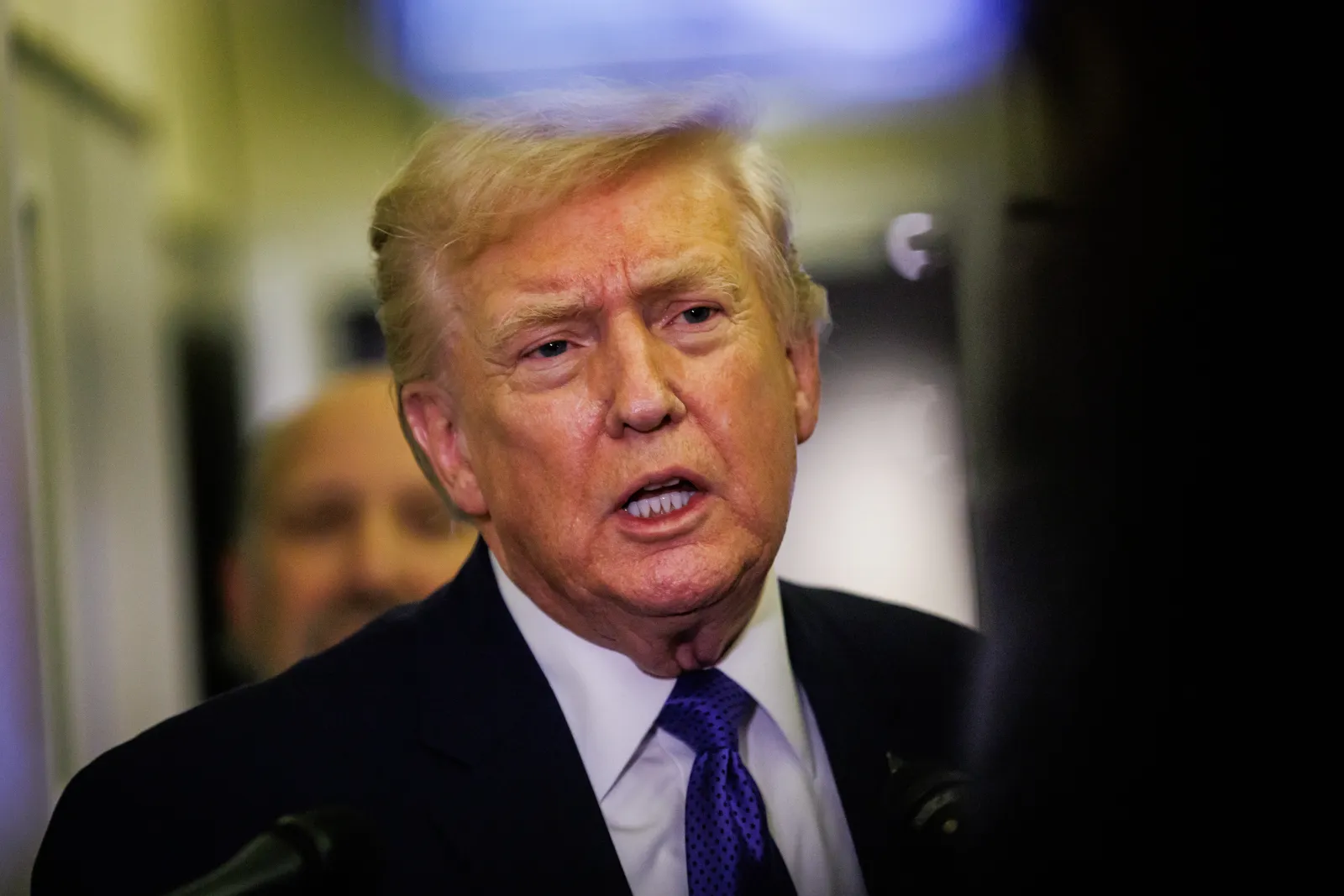
A new bill introduced by top Senate Democrats seeks to prevent any current or future president from personally benefiting from lawsuits filed against the federal government while in office, a move prompted by President Donald Trump's multibillion-dollar legal action against the Internal Revenue Service (IRS) and Treasury Department.
Ron Wyden of Oregon, the ranking member of the Senate Finance Committee, and Senate Minority Leader Chuck Schumer of New York unveiled the Stop Presidential Embezzlement Act on Tuesday, following Trump's $10 billion lawsuit over a previous leak of his tax records.
The proposal would effectively neutralize any personal windfall from such legal claims by imposing a 100 percent tax on settlements or awards received by a sitting president, vice president, Cabinet member or member of Congress from the federal government.
Read More on News
Newsweek has contacted the White House for comment via email outside regular office hours.
Why It Matters
The legislation comes as Trump, his sons Donald Trump Jr. and Eric Trump, and the Trump Organization pursue damages from the IRS and Treasury over a historic disclosure of confidential tax data that was later published by news outlets.
While the case centers on alleged harm to Trump and his business, Democratic lawmakers behind the bill say it raises broader concerns about conflicts of interest and a sitting president's ability to profit from his own administration.
...
Trump's Lawsuit
In announcing the legislation, Wyden and Schumer accused Trump of exploiting his office.
"Saying that Trump's lawsuit against his own government creates a conflict of interest does not begin to describe the depth of corruption behind what he's doing," Wyden said in a news release.
Trump's lawsuit argues that the government failed to protect his tax returns, which were stolen by Charles "Chaz" Littlejohn, who worked as an IRS contractor at the time. Prosecutors and court filings say Littlejohn unlawfully obtained the records and provided them to The New York Times and ProPublica. He pleaded guilty in 2023 and was sentenced to five years in prison in 2024.
The leaks occurred between 2018 and 2020, and one of the resulting reports—published by The New York Times in 2020—found that Trump paid $750 in federal income tax in 2016. Trump's lawsuit said the disclosures caused serious damage.
In the filing, the plaintiffs said, "Defendants have caused Plaintiffs reputational and financial harm, public embarrassment, unfairly tarnished their business reputations, portrayed them in a false light, and negatively affected President Trump, and the other Plaintiffs' public standing."
A spokesperson from Trump's legal team told Newsweek: “The IRS wrongly allowed a rogue, politically motivated employee to leak private and confidential information about President Trump, his family, and the Trump Organization to The New York Times, ProPublica and other left-wing news outlets, which was then illegally released to millions of people. President Trump continues to hold those who wrong America and Americans accountable."
Conflict Concerns
The lawsuit, however, places Trump in the unusual position of being both plaintiff and, as president, head of the executive branch responsible for defending the government. Former federal officials, who were included in an amicus brief filed last week, have argued this threatens the fairness of the proceedings.
"President Trump controls both sides of this litigation," they said, adding, "On the government side, the president has increasingly asserted control over litigation decisions by the Department of Justice."
The former officials continued: "Collusive litigation threatens the integrity of the judicial process … [and] it is uncertain whether the Department of Justice will zealously defend the public fisc in the same way that it has against other plaintiffs."
Trump has acknowledged his position, saying, "I'm supposed to work out a settlement with myself," while commenting on February 2 about suing part of his own administration in a separate case.
"I think what we'll do is do something for charity," the president continued, adding: "We could make it a substantial amount. Nobody would care because it's going to go to numerous very good charities."
Wyden has questioned Trump's charitable pledge, saying: "At a time when so many American families are struggling to get by, it's a shameful abuse of office for Trump to put himself in line to pocket billions of taxpayer dollars. The only reason Trump is talking about donating this money is because even he realizes what he's doing is indefensible with the public."
The senator added, "Odds are he'd find a way to profit from any settlement or throw it into some vanity project like his fancy ballroom, so Congress needs to shut it down immediately."
In a polarized era, the center is dismissed as bland. At Newsweek, ours is different: The Courageous Center—it's not "both sides," it's sharp, challenging and alive with ideas. We follow facts, not factions. If that sounds like the kind of journalism you want to see thrive, we need you.
When you become a Newsweek Member, you support a mission to keep the center strong and vibrant. Members enjoy: Ad-free browsing, exclusive content and editor conversations. Help keep the center courageous. Join today.


View 0 Comments
Submit Correction
View Editorial & AI Guidelines