...

By Andrew Stanton
Reporter
0
Share
Newsweek is a Trust Project member
See more of our trusted coverage when you search.Prefer Newsweek on Googleto see more of our trusted coverage when you search.
President Donald Trump’s approval rating on the economy dropped in the year since he announced wide-ranging tariffs on imported goods into the United States, according to recent polls.
In a statement to Newsweek, White House spokesperson Kush Desai said that since Liberation Day, Trump has “secured over 20 new trade deals and trillions in manufacturing investments.”
“These deals and investments are still materializing, but America has already seen lower goods trade deficits, lower drug prices, and countless groundbreakings across the country for new semiconductor, auto, and semiconductor manufacturing plants. After the short-term disruptions of Operation Epic Fury [the war with Iran] are behind us, Americans can count on returning to this solid economic trajectory of growth,” he said.
Read More on Politics
Why It Matters
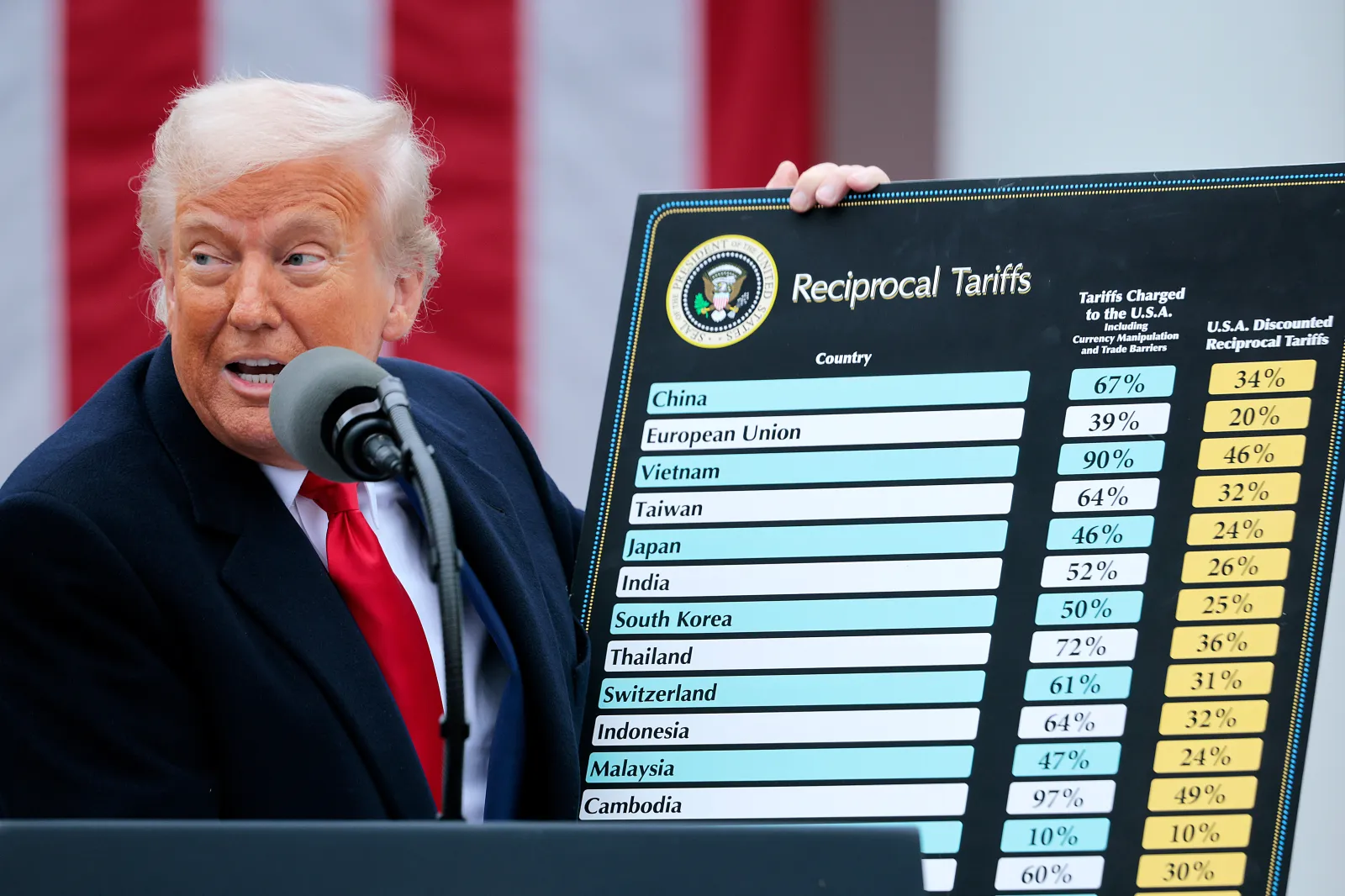
On April 2, 2025, Trump announced his new tariff policy on “Liberation Day.” Those tariffs would close the trade gap and restore U.S. manufacturing jobs, he said at the time, though many economists warned Americans would have to pay higher prices for imported goods. One year later, the Supreme Court has struck down many of his tariffs, a cornerstone of his economic agenda. His administration, however, has touted a backup plan to implement tariffs.
Voter responses to tariffs is a central question for Trump’s popularity. The economy remains a major concern for Americans, and uncertainty around the tariffs and their impact on the economy could become a challenge for Trump and Republicans, particularly ahead of the 2026 midterm elections, when Democrats are hoping to flip control of the House of Representatives and the Senate.
How Trump’s Approval Rating Changed Since Tariff Announcement
Recent polling has shown a dip in Americans’ approval of Trump’s handling of the economy.
Just 35 percent approved of Trump’s handling of the economy, while 60 percent disapproved of it, in the latest poll from YouGov and The Economist, which surveyed 1,665 adults from March 20-23, 2026.
For comparison, a YouGov poll from March 30-April 1, 2025 showed that 45 percent of Americans approved of Trump’s handling of the economy, while 48 percent disapproved.
Quinnipiac University polling shows a similar narrative—the latest survey showed 58 percent of Americans disapproving of Trump on the economy, while 38 percent approved. It surveyed 1,191 registered voters from March 19-23, 2026 and had a margin of error of plus or minus 3.6 percentage points.
...
In April 2025, 40 percent approved of Trump’s handling of the economy, while 55 percent disapproved, according to the pollster.
The latest CNN poll, from March 26-30, showed 69 percent of Americans disapproving of Trump’s handling of the economy, while 31 percent approved. CNN found in their March 6-9, 2025 poll that 44 percent of Americans approved of Trump on the economy, with 56 percent disapproving.
Why Supreme Court Struck Down Trump Tariffs
The Supreme Court struck down much of the administration’s tariff policy. The court ruled against the tariffs in a 6-3 decision on February 20, with Justices Samuel Alito, Clarence Thomas and Brett Kavanaugh dissenting. The ruling struck down the sweeping tariffs Trump had imposed under the International Emergency Economic Powers Act (IEEPA) in April 2025. The court's majority found that it was unconstitutional for the president to unilaterally set and change tariffs because the power to tax lies with Congress.
Chief Justice John Roberts wrote the majority opinion of the court. The court's three liberal-leaning justices, Elena Kagan, Sonia Sotomayor and Ketanji Brown Jackson, joined along with conservative-leaning justices Neil Gorsuch and Amy Coney Barrett.
A majority of Supreme Court justices ruled he must identify “clear” congressional authorization to impose those tariffs.
“The President asserts the extraordinary power to unilaterally impose tariffs of unlimited amount, duration, and scope. In light of the breadth, history, and constitutional context of that asserted authority, he must identify clear congressional authorization to exercise it,” the court ruled.
The ruling continued, “IEEPA’s grant of authority to ‘regulate...importation’ falls short. IEEPA contains no reference to tariffs or duties. The Government points to no statute in which Congress used the word ‘regulate’ to authorize taxation. And until now no President has read IEEPA to confer such power.”
Kavanaugh raised concerns about the ruling in a dissenting opinion.
“In the meantime, however, the interim effects of the Court’s decision could be substantial. The United States may be required to refund billions of dollars to importers who paid the IEEPA tariffs, even though some importers may have already passed on costs to consumers or others,” he wrote.
Trump has called the ruling a “disgrace.”
Which Trump Tariffs Are Still in Place?
While the Supreme Court overturned many of the tariffs—including the large reciprocal tariffs—some do remain in effect. Those include new tariffs imposed after the Supreme Court ruling, under Section 122 of the 1974 Trade Act, which allows presidents to impose duties of up to 15 percent for a period of 150 days without congressional approval to remedy a “fundamental international payments problem.”
Industry-specific tariffs imposed on national security grounds under Section 232—covering key sectors such as steel, aluminum, autos and parts, lumber, furniture, and some semiconductors—were also not included in the Supreme Court’s ruling.
What People Are Saying
CNN data analyst Harry Enten wrote to X this week: “Polls, including CNN's, is a disaster for Trump on the economy. More disapprove of him (72%) on inflation [than] Carter (!!) or Biden at this time in a presidency. Trump's disapproval (76%) is higher than Biden's worst (72%) on gas prices. Trump's on a stairway to hell.”
Democratic Congressional Campaign Committee (DCCC) spokesperson Viet Shelton wrote in a statement on Thursday: “After running on an empty promise to lower costs, House Republicans' support of Trump’s reckless tariffs has turned their central 2024 promise into their biggest 2026 liability.”
What Happens Next
Senate Democrats have introduced a proposal to create a new tax rebate program designed to return tariff revenue directly to households affected by tariffs. Former Trump adviser Stephen Moore previously told Newsweek that tariff refunds will be a “very complicated issue” and that businesses who paid the tariffs “will have to be rebated.”
View 0 Comments
Submit Correction
View Editorial & AI Guidelines