10
Loading video...

By Melissa Fleur Afshar
Reporter
0
Share
Newsweek is a Trust Project member
See more of our trusted coverage when you search.Prefer Newsweek on Googleto see more of our trusted coverage when you search.
Emerald Fennell’s Wuthering Heights has arrived with the kind of heat that cannot be contained by a single verdict.
In the first wave of reviews, some critics have embraced Fennell’s high-gloss, high-drama approach as an intoxicating, audacious reinvention of Emily Brontë’s 1847 novel—while others have rejected it as a hollow, overworked provocation that mistakes sensation for substance.
What is consistent is the sense that this is not a cautious prestige adaptation: it is a filmmaker with a recognizable signature, turning a canonical romance into something and more divisive.
Read More on Entertainment
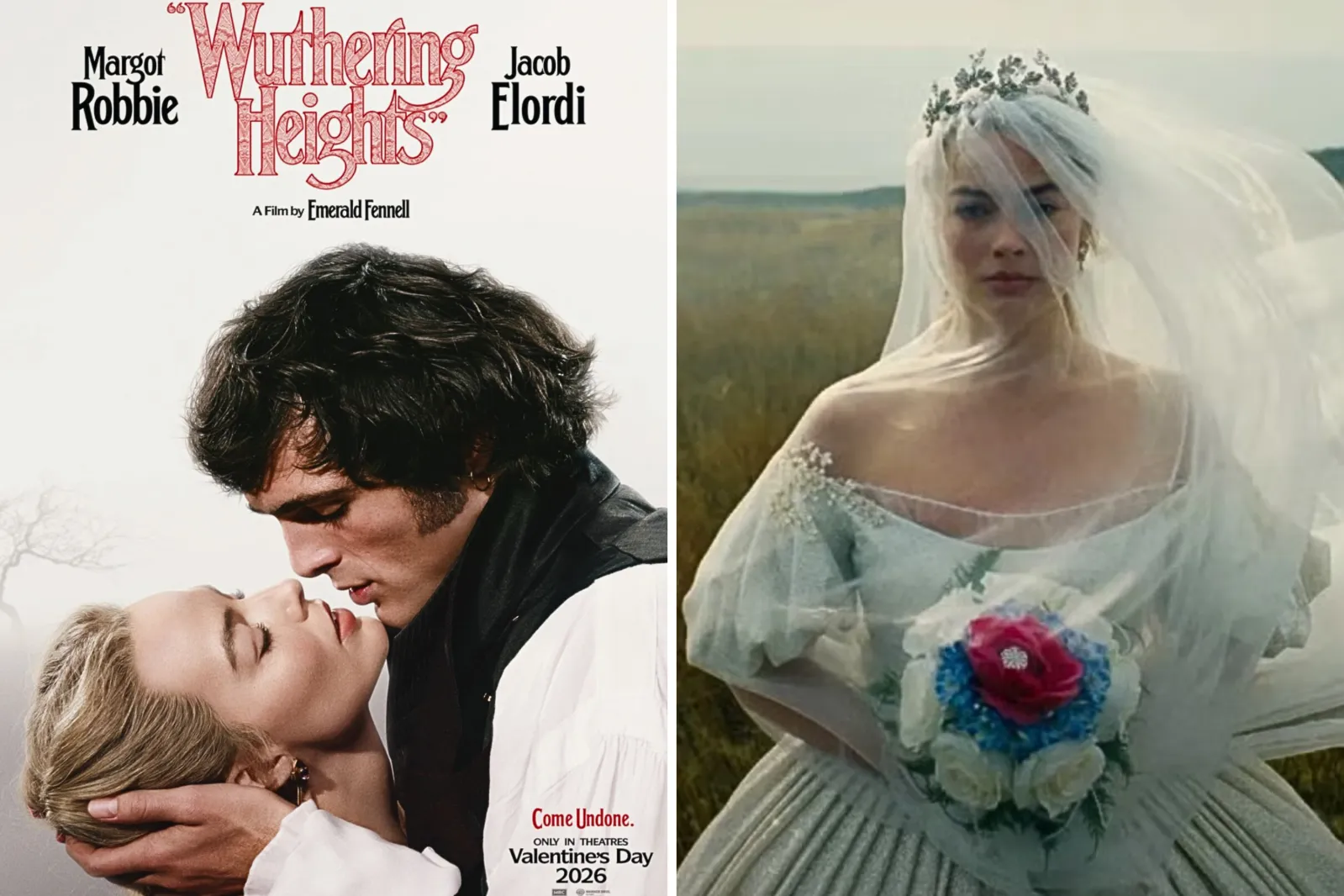
The film—starring Margot Robbie as Catherine "Cathy" Earnshaw and Jacob Elordi as Heathcliff—has been framed, even in its marketing, as an interpretation rather than a faithful adaptation, with the title officially presented in quotation marks to underscore the point.
That decision, along with Fennell’s deliberate deviations from Brontë’s plot and its contemporary setting, has fueled debate around tone and representation. Now, as major critics weigh in, the early consensus is not a consensus at all.
The Telegraph: A Five-Star 'Thrill Ride'
Robbie Collin, The Telegraph’s chief film critic, is firmly in the rapturous camp, awarding the film five stars and calling it “a bosom-heaving, gasp-inducing thrill ride.”
Collin praises Fennell’s willingness to pursue “trembling, transgressive depths” with Robbie and Elordi at the center, and she is blunt about the approach: this is not an adaptation that cares about textual reverence.
“You could never accuse Emerald Fennell’s Wuthering Heights of being a faithful adaptation of Emily Brontë’s 1847 novel,” Collin writes—before adding that “fidelity doesn’t appear to be remotely of interest to it.”
In Collin’s telling, that is the point: the film's brazen unfaithfulness is not a bug but the engine, powering something operatic and visceral rather than dutiful.
The Guardian: A Two-Star 'Misfire' With Style but Little Feeling
For Peter Bradshaw at The Guardian, the same qualities register as excess without emotional payoff.
Bradshaw gives the film just two stars, calling it an “emotionally hollow” misstep—an overcooked vision that trades Brontë’s corrosive intimacy for a campy, fashion-shoot intensity.
He argues that Fennell pushes the story toward stylized silliness, with melodrama dialed up to the point of exhaustion, and suggests that even the film’s self-conscious posture—signaled by the title’s inverted commas—does not land as meaningful commentary so much as empty affectation.
...
Bradshaw also flags Fennell’s sweeping structural changes: he notes the removal of key characters, including Catherine’s older brother Hindley, and the abandonment of the novel’s later material—choices that compress the narrative into a more streamlined, adult-focused spectacle.
He credits actor Martin Clunes—as Mr. Earnshaw—with nearly stealing the film but contends that the film “misuses” Hollywood talents Robbie and Elordi, leaving them stranded inside a concept that looks lavish yet feels, to him, like “mock emotion.”
Bradshaw adds that Andrea Arnold's 2011 adaptation is strides better.
Los Angeles Times: Bold, Filthy, but Not Fully Committed
Amy Nicholson, writing in the Los Angeles Times, treats Fennell’s film as a provocative swing that lands—just not as perfectly as it could.
Nicholson describes the movie as a “bold, filthy fantasy,” impressed by its sensory world-building and its willingness to push Brontë’s obsession into a more explicit, modern register. She singles out the early stretch as especially strong, praising the film’s opening movement for establishing a world where violence, class and desire churn together in the mud, and she also commends Clunes, a British actor best known for TV roles, for his successful turn as a bruising, volatile patriarch.
But Nicholson’s bottom line is conditional praise: she argues that if Fennell wants to make a deliberately eroticized, heightened Wuthering Heights, the film needed to go further—more conviction, more intensity, less hesitation.
While Fennell may be determined to titillate audiences, she does not always press the pedal all the way down.
The New Yorker: Extravagant Surfaces, Paper-Doll Lovers
Justin Chang, in The New Yorker, is more skeptical of the film’s depth.
His review frames Fennell’s Wuthering Heights as “extravagantly superficial,” with Robbie and Elordi playing versions of Catherine and Heathcliff that never quite deepen beyond the film’s stylized exterior.
Chang acknowledges Fennell’s penchant for anachronism, exaggeration and shock—the heavy-breathing visual and musical language that wants to jolt the classic into the present—but argues the movie feels divided against itself, wavering between sincerity and camp.
Chang also dwells on the adaptation’s liberties: the merging or reshaping of characters and the altered family dynamics that shift the moral architecture of Brontë’s story. And he points directly at a controversy the film has stirred, including the enduring debate around Heathcliff’s ethnicity as described in the novel.
Chang adds that the film never fully grapples with the richer, thornier implications at the intersection of race and class.
Variety: Bold, Operatic—and Strategically Restrained
Peter Debruge, reviewing for Variety, positions Fennell’s film within the broader screen history of Wuthering Heights, noting how adaptations have shifted over time from comparatively tame to increasingly adult.
Debruge describes Fennell’s reinvention as full-blooded and R-rated, arguing she amplifies what earlier versions kept implicit: the power games, the physical desire, the volatility between Catherine and Heathcliff.
He also praises the film’s design contrasts—Wuthering Heights as a storm-lashed nightmare, Thrushcross Grange as a luridly decadent counterpoint—and highlights Fennell’s operatic instincts, from a deeply stylized visual palette to a musical identity shaped by Anthony Willis and songs from Charli XCX.
Yet Debruge also suggests the film understands the value of withholding, after the escalation of Fennell’s previous work, notably Saltburn.
On X, Variety’s Jazz Tangcay offered an enthusiastic endorsement, calling Fennell’s Wuthering Heights “scorching hot and twisted,” praising Robbie and Elordi’s chemistry and the film’s craftsmanship.
View 0 Comments
Submit Correction
View Editorial & AI Guidelines