...

By Sam Stevenson
Associate News Editor
0
Share
Newsweek is a Trust Project member
See more of our trusted coverage when you search.Prefer Newsweek on Googleto see more of our trusted coverage when you search.
Confusion spread online after a "15.3 percent" figure tied to President Donald Trump’s standing in polling trackers went viral on Wednesday.
Several posts on the social media platform X treated that number as Trump’s overall approval rating and concluded it meant he had become the most unpopular president in modern history since this particular polling metric came into use.
But approval ratings and "net approval" are not the same measurement, and mixing them up can change what a number means.
Read More on Fact Check
White House spokesman Davis Ingle told Newsweek: “What matters most to the American people is having a commander-in-chief who takes decisive action to eliminate threats and keep them safe, which is exactly what President Trump is doing with the ongoing successful Operation Epic Fury.
"President Trump campaigned proudly on his promise to deny the Iranian regime the ability to develop a nuclear weapon, which is what this noble operation is seeking to accomplish. The President does not make these incredibly important national security decisions based on fluid opinion polls, but on the best interests of the American people.”
...
The Claim
Some social media users on X claimed Trump’s approval rating "hit a new low at 15.3 percent," and argued that would make him "the most unpopular president ever."
One post from Canadian journalist Mark Slapinski said: "BREAKING: Trump's approval rating hits a NEW LOW at 15.3 percent. The most unpopular president ever!"
Another post, from the user The Patriotic Blonde, @ImBreckWorsham, referenced prediction market Polymarket while repeating the "15.3 percent approval" framing.
The account posted: "According to Polymarket, Trump's approval rating hit a NEW LOW this week at 15.3 percent, making him literally the most unpopular president ever."
A post from Polymarket’s official account did mention the 15.3 percent figure, but it correctly referred to it as Trump’s net approval rating and not his raw approval rating figure.
That figure originated from polling analyst Nate Silver’s presidential approval tracker and reflects the gap between those who approve of Trump’s job performance and those who disapprove, rather than his overall approval percentage.
Another post, however, stripped that context away. An account called Royal Intel claimed Trump’s "approval rating falls to an all-time low of 15.3 percent," presenting the net approval figure as a raw approval rating.
A "community note," which is where readers can add "context they thought people might want to know," was later added beneath the post, stating that no reputable poll shows Trump’s approval at 15.3 percent and that his lowest recent approval rating stood in the high‑30s, according to polling averages compiled by RealClearPolling and The Economist, among others.
The Facts
Approval rating is the share of respondents who say they approve of a president’s job performance.
Net approval (sometimes shown as a "spread") is a different measure: approval minus disapproval.
In other words, a net approval of -15.3 does not mean 15.3 percent of Americans approve; it means disapproval exceeds approval by 15.3 points.
Polling guru Silver had highlighted a "new net low in our Trump approval tracking" of net negative 15.3 points, which is the type of figure that can be misread if treated as a raw approval percentage.
By contrast, major polling aggregators that publish both approval and disapproval percentages have shown Trump’s approval in the high 30s or low 40s in recent averages, not the teens.
At the time of writing, RealClearPolling’s job-approval average listed Trump at 42.3 percent approval and 55.2 percent disapproval in its displayed date range, a "spread," or net approval rating, of negative 12.9 points.
Meanwhile, The Economist’s tracker presented an approval figure of 39 percent and a disapproval of 56 percent at its last update, alongside a net approval value of minus 18.
Those readings are far above 15.3 percent approval, even though they still reflect net-negative standings in those trackers.
The second part of the viral claim—"most unpopular president ever"—also depends on defining the metric and the historical dataset.
Gallup’s presidential job approval series is widely cited as the long-running benchmark, and it dates polling on presidential approval back to the late 1930s.
In that Gallup-tracked historical record, the lowest approval rating cited is 22 percent for President Harry S. Truman in a February 1952 survey period, which is lower than the low points listed for other modern presidents in the same compilation.
Because the "15.3” figure being shared online refers to a net-approval-style number rather than a raw approval percentage, it cannot be compared directly to Truman’s 22 percent approval rating.
And using strict approval percentage (not net approval), the historical low most commonly cited in the Gallup series is Truman’s 22 percent, not Trump's 15.3 percent.
Ruling
False.
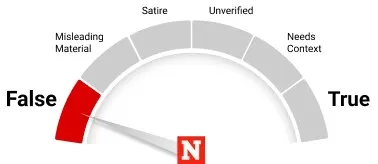
The "15.3" figure that circulated online referred to net approval, not Trump’s raw approval rating.
Public polling averages place his approval around the high 30s to low 40s, not the teens.
And in Gallup's historical approval series, the commonly cited low for a modern president remains Harry Truman’s 22 percent approval in 1952.
Fact Check Metadata
Claim reviewed: Posts on X said President Donald Trump’s approval rating fell to 15.3 percent, making him the most unpopular president ever.
Ruling: False.
Primary claimant: Social media users on X.
Update 03/19/26, 9:47 a.m. ET. This article was updated with a statement from the White House.
View 0 Comments
Submit Correction
View Editorial & AI Guidelines