
10
Loading video...

By Jennifer Radcliffe
0
Share
Newsweek is a Trust Project member
See more of our trusted coverage when you search.Prefer Newsweek on Googleto see more of our trusted coverage when you search.
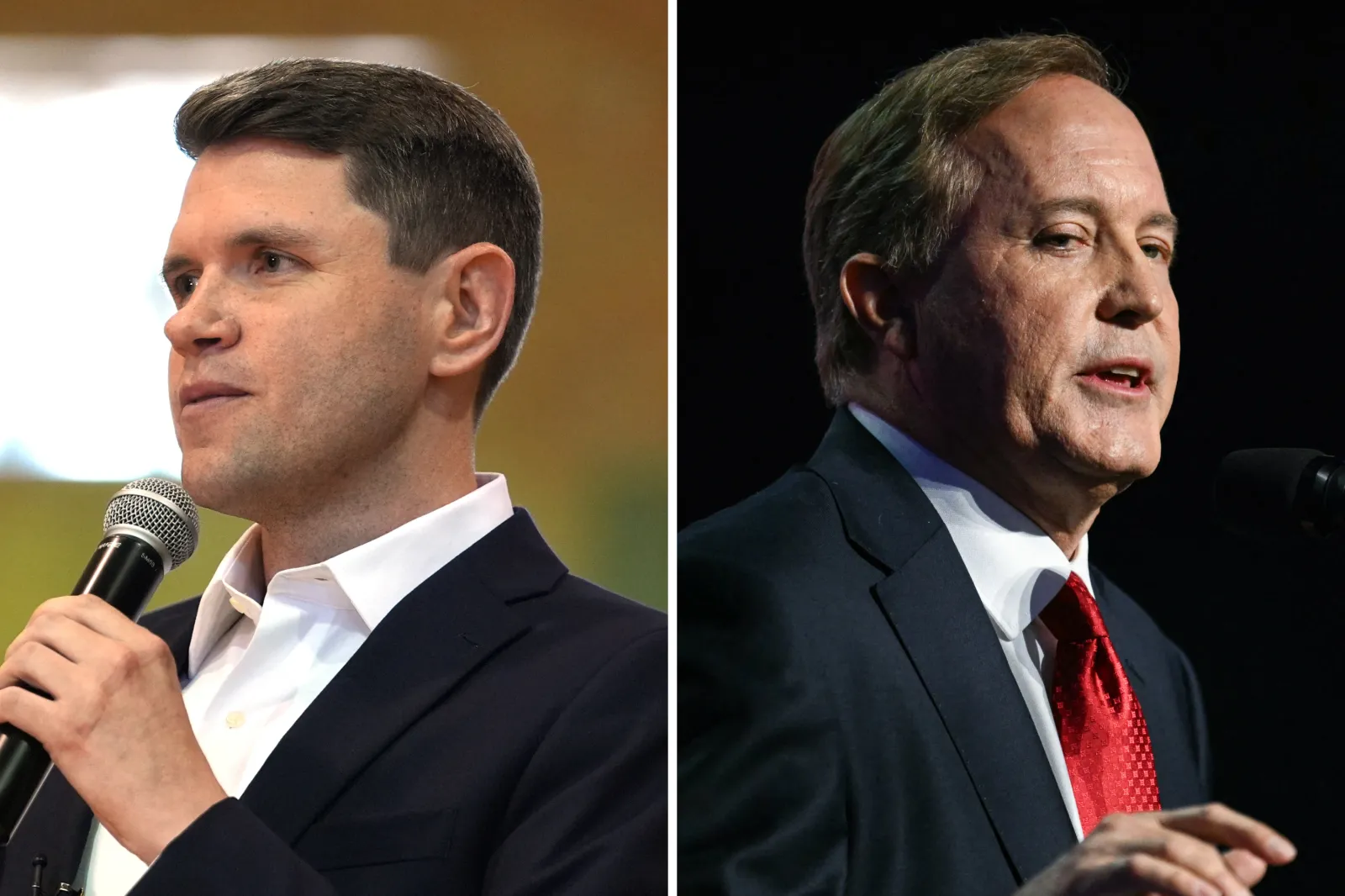
Republican Ken Paxton and Democrat James Talarico are making Christianity a defining issue in the home stretch of Texas’ U.S. Senate race, offering sharply different visions of what faith should mean in American political life.
The divide included the launch of competing faith coalitions. The attorney general's "Pastors for Paxton" featured 27 faith leaders, largely from evangelical, charismatic and nondenominational churches, while Talarico, a Presbyterian seminarian, organized "Faithful Texans for Talarico" to include Christian, Jewish, Muslim and other religious voters.
The broader question at the heart of the competing coalitions is not whether faith matters, but whose vision of Christianity will resonate with Texas voters in one of the nation's most competitive and closely watched Senate races, with control of the chamber potentially hanging in the balance.
Read More on Politics
“What I find most interesting is that Christianity itself has become something the candidates are contesting,” Sam Martin, the Frank and Bethine Church Endowed Chair of Public Affairs at Boise State University, told Newsweek.
Newsweek reached out to both campaigns for comment.
...
Ken Paxton: Survived 'By the Grace of God'
The emphasis on faith comes with unusual scrutiny for Paxton, whose political career has been shadowed by legal and personal controversies.
The 63-year-old has served as Texas attorney general since 2015, building a national profile as one of the country's most prominent conservative legal figures through challenges to Democratic administrations on immigration, abortion, election law and religious liberty. He defeated four-term U.S. Senator John Cornyn in this year's GOP primary, despite concerns that he was a deeply troubled candidate who had been impeached by the Republican-led Texas House in 2023 on allegations of corruption and abuse of office, before being acquitted by the state Senate.
Additionally, his estranged wife, state Senator Angela Paxton, later cited adultery as grounds in their divorce filing.
Despite years of legal and personal controversies, Paxton has retained strong support among many conservative Christian voters and remains one of President Donald Trump's most loyal allies in Texas. Trump has repeatedly praised Paxton as one of the country's leading attorneys general and rewarded that loyalty with a high-profile endorsement in the Senate race, though he jokingly described him as "a pain in the ass" at a Texas campaign rally earlier this month.
In a June 25 interview on Texas Lieutenant Governor Dan Patrick's podcast, Paxton reflected on his 2023 impeachment and other battles that have marked his political career.
“I truly believe that God just delivered me, not because I am a great person, because God is sovereign and he does what he wants to do,” Paxton said. “I don’t take credit for it; it’s really by the grace of God.”
Later that month, at the Faith & Freedom Coalition’s Road to Majority Conference in Washington, D.C., Paxton again framed his political survival in terms of faith.
“I’m not here because of some great thing I did. I’m here because God delivered me,” he said.
"Pastors for Paxton" has taken its message onto the campaign trail. Several members joined Paxton in Rockwall for the start of his “Come and Take It” bus tour, with the campaign saying coalition members would lead their communities in prayer ahead of Election Day.
“Texas pastors have always been the heart of our communities, and they know exactly what is at stake in this race,” Paxton said in announcing the group. “I am honored to have them standing by my side as we work to ensure America remains one nation under God.”
Not every conservative Christian supporting Paxton is doing so enthusiastically.
Roche Coleman, senior pastor of Impact Church of The Woodlands, told Newsweek he did not join "Pastors for Paxton" and does not publicly endorse political candidates.
“That being said, I will reluctantly vote for Ken Paxton,” Coleman said, adding that the attorney general's “policies are average at best” and that “the constant gridlock that characterize Paxton's private and professional life are not flattering.”
Yet Coleman said issues including abortion, transgender rights and church autonomy far outweighed those concerns. He also argued that Talarico's theological views fall outside what he considers orthodox Christianity.
“The denomination and pastors Talarico affiliate with do not align with orthodox Christianity,” Coleman said.

...
Talarico: Campaigning as Ministry
Talarico has grounded his message in the New Testament command to love one’s neighbor, arguing that Christianity demands compassion for immigrants, poor people and others on society’s margins.
“Scripture says you can’t love God and hate other people,” Talarico said in a sermon posted online. “You can’t love God and abuse the immigrant. You can’t love God and bully the outcast. You can’t love God and oppress the poor.”
The 37-year-old Democratic state representative from Austin is a former public-school teacher and student at Austin Presbyterian Theological Seminary who has emerged as one of the most recognizable figures in Texas Democratic politics. A frequent critic of Christian nationalism, he has built a national profile by arguing that public education, economic fairness, immigration reform and other progressive causes are rooted in Christian teaching.
He regularly frames policy disagreements in explicitly theological terms and has argued that Christian faith does not belong to a single political party.
At the October 19 virtual kickoff for "Faithful Texans for Talarico," Talarico told faith leaders that his longtime pastor, Reverend Jim Rigby, had helped him reconcile what he initially saw as competing callings: running for the U.S. Senate or continuing his studies at Austin Presbyterian Theological Seminary.
“I was torn between these two callings, and I couldn’t figure out if I should run for the seat or I should continue my work in the ministry,” Talarico said, who recounted Rigby telling him the Senate campaign itself could be “a form of ministry."

...
Actor Jordan Walker Ross, who portrays Little James in The Chosen, helped launch Talarico's coalition.
“A lot of politicians like to talk about Christian values, but you don’t really see that reflected in their legislation or the way that they live, but you do see that in the way that James lives,” Ross said in a coalition launch video, pointing to loving one’s neighbor and caring for “the needy, the sick, the immigrant.”
Talarico's religious message is arriving alongside a sustained effort by conservatives to cast him as a radical. Republican critics have mocked him as "Talafreako" and portrayed his views on abortion, gender identity and government policy as evidence that he sits far outside the Texas mainstream.
Can Progressive Christianity Win in Texas?
Michael O. Emerson, director and Chavanne Fellow in Religion and Public Policy at Rice University’s Baker Institute for Public Policy, told Newsweek that the prominence Talarico has placed on Christianity is unusual for a modern Democratic candidate in Texas, where Democrats have not won a statewide election since 1994.
“At the statewide level, it is almost unheard of,” he said. Talarico, he added, rose to state and national prominence in part because of the novelty of placing Christian faith at the center of the causes he supports and opposes.
Emerson estimates that Texas has about 23 million Christians and said evangelical Christians account for about 30 percent of the state’s voting-age population, Catholics account 22 percent and mainline Christians account 12 percent.
Moderate churchgoers, mainline Protestants, Latino Christians and suburban voters are the groups worth watching, Martin said.
“In a competitive statewide race, modest changes in turnout or voting behavior can make a real difference,” she said.
Religious Democrats are hardly new to Texas, Martin added, and Christian theology played a major role in Democratic politics and the civil rights movement long before religious identity became as tightly sorted by party as it is today.
“What’s unusual is how central Talarico has made theology to his political identity in the current environment,” she said. “Most Democratic candidates who are religious will talk about their faith and then move pretty quickly back to policy. Talarico actually argues from Christianity.”

...
Texas will be an important testing ground for whether progressive Christianity can find a larger political audience in a deeply religious and traditionally Republican state, Brandon Rottinghaus, a political science professor at the University of Houston, told Newsweek.
“Religion has become a dividing line in the Texas Senate race, but it’s no longer a conversation dominated exclusively by Republicans,” he said.
Talarico’s faith gives him a way to discuss compassion, economic fairness and social justice in explicitly moral terms, Rottinghaus said, but also exposes him to criticism from conservative Christians who interpret the same teachings differently.
Mark Jones, a political scientist at Rice University’s Baker Institute, said that Talarico's religious appeals could alienate some conservative Christians.
"It's more likely to generate animosity than if Talarico were to simply not have faith be any part of his campaign messaging," he said.
Ultimately, conservative Christians may ignore Talarico's messaging and Paxton's flawed background to vote for the candidate they believe will appoint conservative judges and support conservative policies.
“If they believe a candidate will deliver on the issues they care about, they’re often willing to overlook behavior they would otherwise condemn,” Martin said.
An Undecided Christian Voter
Jodi Hunt, executive director of the Neuhoff Institute for Ministry and Evangelization at the University of Dallas, was the Catholic voter who challenged Talarico on abortion during the October 14 CNN town hall in Fort Worth.
Hunt argued on the debate stage that unborn children deserved protection and asked how voters could trust Democratic candidates to defend human dignity if they did not support policies protecting "the most innocent among us."
Talarico responded by saying that Christians can interpret the topic differently and reach different moral conclusions.
“The Bible is silent on the issue of abortion,” he said. "It means you and I both have to look at different scriptures to try to come to a conclusion."
Hunt pushed back.
“The Bible is not silent on abortion,” she replied. “There is the Ten Commandments: 'Thou shalt not kill.'”
Talarico later replied, "You know I'm an educator like you, and if I believed that abortion was murder, that it violated the Ten Commandments, then I wouldn't support it. So, it is okay that you and I come to different conclusions about that."
Despite the disagreement, Hunt told Newsweek she remains undecided in the race and plans to wait until Election Day to decide.
“I know there are many like us still in this place and we want to take our time to be sure we vote for the person who will represent our values and protect Texans,” she said. “At this time neither candidate has 100 percent convinced me that they are that person.”
For Hunt, the role of religion in the race comes down to trust rather than simply determining which candidate professes the correct faith.
“Voters are not dumb; we can see how the politicians will say anything to get elected,” she told Newsweek. “At the end of the day, the big question is whether or not we can trust the candidate to do the will of the people, no matter their faith beliefs. ... Knowing who they are day to day, when no one is looking, helps us figure out who we can trust."
Newsweek’s reporters and editors used Martyn, our AI assistant, to produce this story.
Contact Newsweek editors for this story: Jennifer Radcliffe and Anthony Murray.
View 0 Comments
Submit Correction
View Editorial & AI Guidelines