...

By Tom O'Connor
Deputy Editor, National Security and Foreign Policy
0
Share
Newsweek is a Trust Project member
See more of our trusted coverage when you search.Prefer Newsweek on Googleto see more of our trusted coverage when you search.
Nearly one month into the U.S.-Israeli war against Iran, the Islamic Republic continues to demonstrate the capacity to strike back in ways that complicate the joint campaign and narrow the White House's options.
While the conflict has undoubtedly dealt severe blows to Iran, with the slaying of Supreme Leader Ayatollah Ali Khamenei and the targeting of other senior officials along with military capabilities, the Islamic Revolutionary Guard Corps (IRGC) has fought on, launching hundreds of drones and missiles against Israel and Arab states hosting U.S. military bases.
Iranian strikes disrupting regional energy production, paired with efforts to close the Strait of Hormuz trade chokepoint, have sent global markets into disarray, directing international criticism not only toward Iran but also at the United States and Israel for their decision to launch the conflict. The tempo of Iran's barrages may have slowed over the past week, but the Islamic Republic's retaliation rages according to plan.
Read More on News
For U.S. President Donald Trump, who has expressed surprise at the scope of Iran's response, there appear to be little more than two choices ahead: a negotiated de-escalation or a military escalation.
And while the U.S. leader has repeatedly hinted at progress toward the former option, all signs on the ground, including a substantial build-up of additional U.S. forces, indicate the White House is actively planning for the latter path.
"Iran's retaliation has clearly created a more challenging situation than the United States expected, given that it anticipated it could meaningfully destroy the vast majority of Iran's military capabilities, which it has, and yet it has not led the Iranians to actually stop having meaningful ability to strike the Gulf, to strike Israel, to strike the U.S.," Jonathan Panikoff, former deputy national intelligence officer for the Near East at the National Intelligence Council who's now serving as director of the Atlantic Council's Scowcroft Middle East Security Initiative, told Newsweek.
"It just looks different. It's at a different rate," Panikoff said. "So, I think President Trump now is having to reconsider a number of different options."
...
Fight or Flight
Despite Trump's recent assertion that "nobody thought" Iran would lash out at Arab nations with U.S. military presence, Iranian officials and analysts have warned of such a scenario for years. Officials of the six Gulf Cooperation Council (GCC) states also warned of such an outcome in the lead-up to the conflict, realizing they would likely bear the brunt of Iranian retaliation.
U.S. military planners had long taken this scenario into account as well, though the degree to which Iran has managed to carry through with its threats has exceeded the expectations of many.
"I think it's certainly in the upper bounds of what we would have expected," Gregory Treverton, who previously served as National Intelligence Council chair and is now a professor at the University of Southern California, told Newsweek. "I think most of us would have said the only two things the Iranians have going for them is closing the Strait of Hormuz and expanding the war to the Gulf states, hoping that they can get through them pressure on the United States and Israel to quit."
"But they've been more successful in that than I think even I would have thought," Treverton said. "They've done quite well with their obvious counters. So, in some sense, they're really in control of the war. Now this is really their war to end when they want it, and not ours to win when we want it."
Yet Trump has repeatedly portrayed himself as being in the driver's seat, declaring victory on several occasions and touting a string of successes. Such claims have merit, as the U.S. and Israel have managed to inflict substantial damage on Iranian air, land and sea capabilities, and have likely further set back Iran's nuclear program, all while hollowing out senior political and military positions.
More recently, Trump has indicated positive developments surrounding talks in which Iranian officials had allegedly acceded to key demands, such as to never produce a nuclear weapon.
But Iranian officials have always denied seeking weapons of mass destruction, and they have rejected claims any formal negotiations were underway amid the current conflict. Lieutenant Colonel Ebrahim Zolfaghari, spokesperson for Iran's Khatam-al Anbiya Central Headquarters, even mocked the suggestion, asking if Washington's "internal conflicts reached the point where you are negotiating with yourselves."
Trump has also garnered a reputation for seeking talks while preparing military action. The U.S. and Israel launched their joint attack on Iran late last month in the midst of ongoing nuclear talks and, in June, Trump oversaw the bombing of three Iranian nuclear facilities amid the 12-Day War sparked by an Israeli attack against Iran, which also took place during negotiations between Washington and Tehran.
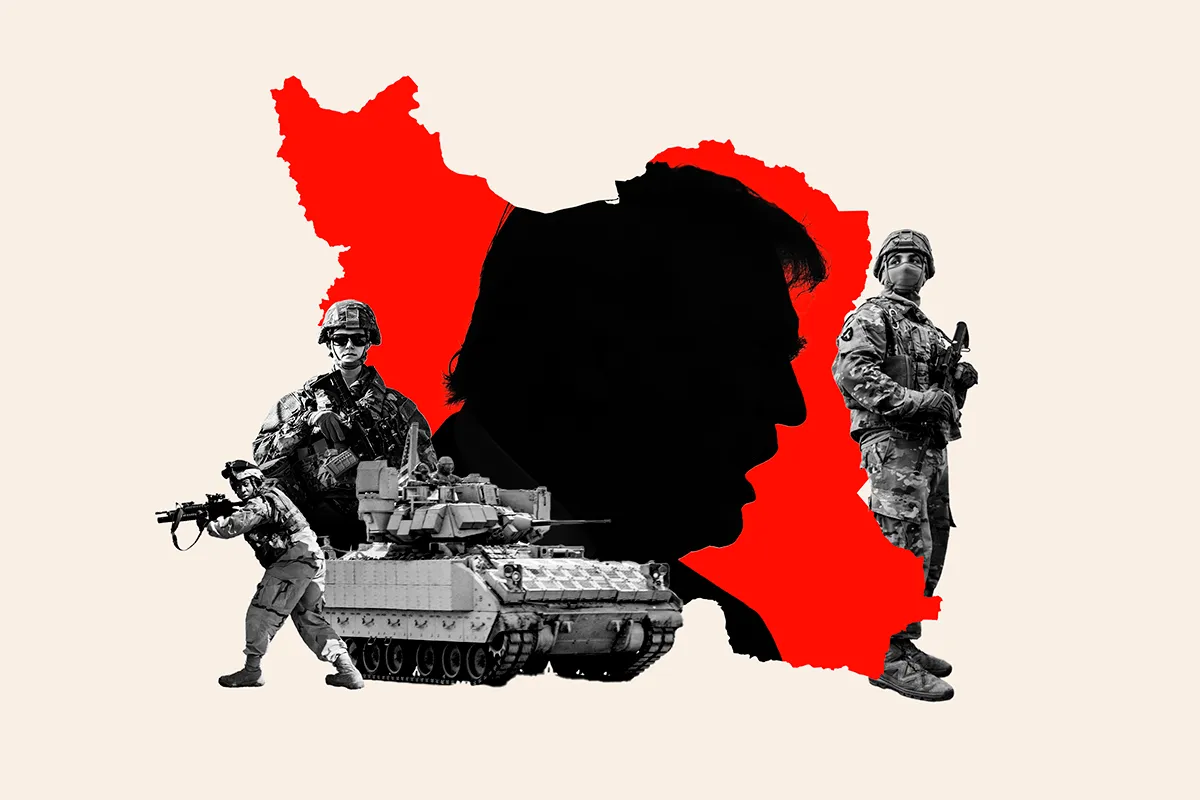
This time around, thousands of additional U.S. troops, including the 11th and 31st Marine Expeditionary Units and personnel of the Army's 82nd Airborne Division, are en route to the Middle East, fueling speculation of an invasion. Possible targets include the seizure of Kharg Island and other Iranian territories in and adjacent to the Strait of Hormuz, or even a Special Operations raid to recover highly enriched uranium believed to be entombed at the Isfahan Nuclear Technology and Research Center.

"I think the next few days will be pretty significant, because either there'll be enough of a deal for Trump to quickly go home, or he may feel like he has to take the next step and do something, like a raid on Kharg or going after the nuclear materials," Treverton said. "It looks to me like this has got to go one way or the other pretty dramatically, fairly soon."
"We're now at the point where in some ways we can't continue this too much longer, running out of patience from allies, running out of weaponry," he added. "So, in some sense, it's got to end pretty soon, one way or the other."
Reached for comment, a White House spokesperson referred Newsweek to comments delivered Wednesday by Press Secretary Karoline Leavitt.
"The remaining elements of the Iranian regime have another opportunity to cooperate with President Trump, permanently abandon their nuclear ambitions and cease actively threatening America and our allies," Leavitt told reporters. "The president's preference is always peace. There does not need to be any more death and destruction."
"But if Iran fails to accept the reality of the current moment, if they fail to understand that they have been defeated militarily and will continue to be, President Trump will ensure they are hit harder than they have ever been hit before," Leavitt said. "President Trump does not bluff and he is prepared to unleash hell."
The Iranian Vote
Even if Trump does seek to follow through with a deal, there is no guarantee Iran would accede. Tehran has set its own objectives in the conflict, and, believing it has the upper hand, does not appear ready to immediately call the fight.
In fact, Iranian Foreign Minister Abbas Araghchi has claimed gains of Iran's own, including demonstrating the Islamic Republic's capability to impose regional disruption, exert control over the Strait of Hormuz and undermine U.S. credibility through the lack of international support for Washington's war effort.
"Iran seeks to deal a decisive blow to the aggressor states in order to establish its deterrence," Ali Bagheri Dolatabadi, professor from Yasouj University in Iranian capital Tehran, told Newsweek. "Iranian officials believe they should not have given in to pressure from regional states for a ceasefire during the June war. That ceasefire sent the wrong message to Israel and encouraged it to wage a new war. This time, that decision will not be repeated. Iran will therefore continue the war until the desired outcome is achieved."
Rather than disrupt Iran's capability to wage war, the elimination of leadership and key commanders appears to have emboldened key actors, particularly the IRGC, to dig in rather than capitulate.
"Contrary to what Western officials believe, the martyrdom of Ayatollah Khamenei did not cause any disruption in the country’s management and leadership," Dolatabadi said. "Their assumption that the management of the war could be disrupted by assassinating commanders was also wrong. Currently, the leadership of the armed forces is functioning well. Iran had already prepared for this situation and implemented a kind of decentralized system by delegating authority to commanders on the battlefield."
Michael Eisenstadt, a former U.S. military analyst now serving as director of the Washington Institute for Near East Policy's Military and Security Studies Program, argued that "Iran prepared for the possibility of further decapitation strikes in the run-up to the current war, reportedly designating three or four successors for all commanders, and they seem to have been weathering the decapitation strikes in the current war relatively well."
He identified Iran's core wartime objectives as being "to survive and to emerge from the war with significant residual military capabilities (since their production base has been hit, and they may not be able to recommence production of missiles and drones in the near future), while inflicting maximum pain on the United States and Israel—and the global economy if need be—so that the United States and Israel don't ever do this again."
At the same time, he pointed out that the U.S. and Israel also faced hurdles in achieving their objectives, which may not necessarily be in complete alignment.
"The United States and Israel are trying to maximize the destruction of Iran's military capabilities (and Israel is trying to foment regime change), though it appears that Iran is likely to emerge from the war with some capabilities intact, because some drone and missile bases are deep underground, and cannot be reached from the air," Eisenstadt told Newsweek.
"But the main challenge is ensuring that the region's oil and gas gets to market to avoid a global recession," he added. "This will probably be the main challenge of the coming days, in the form of an operation to ensure that all countries can use the Strait of Hormuz, while limiting damage to oil and gas production in the region."

...
Rallying the Troops
Thus far, the Islamic Republic's survival has yet to be tested by any major internal uprisings, such as occurred in late December and early January. The unrest was quelled through a deadly crackdown that spurred Trump's initial military build-up in the region and roughly monthlong nuclear talks.
Eisenstadt noted that the fate of the Iranian government would remain uncertain even if it did outlast the current conflict, pointing to examples of past states facing fatal turmoil after military setbacks, such as Yugoslavia following NATO's bombing campaign, the Soviet Union following its intervention in Afghanistan and both Egypt and Syria following the first Arab-Israeli War.
Both Trump and Israeli Prime Minister Benjamin Netanyahu have urged the Iranian people to rebel against their government, and such an outcome is still the hope for Israeli officials, though one they say is far from guaranteed.
"One month into the Iran war, the Iranian regime appears stable," Nate Swanson, former director for Iran at the National Security Council who is now director of the Atlantic Council's Iran Strategy Project, told Newsweek.
"The Islamic Republic has proven to be much larger than any one specific individual," Swanson said. "There has not been any significant domestic uprising to date, and most notably, the regime continues to avoid defections amongst political and security elites. If anything, the most hardline voices within the regime apparatus, presumably led by the IRGC, have been empowered."
A U.S. land incursion may serve as the ultimate stress test for Iran, which has not fought a conventional ground war since a deadly eight-year conflict with Iraq in the 1980s and has not faced off with a great power since a joint British-Soviet invasion decades earlier during World War II. A battle with the U.S. would likely see Iran resort to asymmetrical tactics rather than fight in the open, capitalizing on drone, rocket and missile attacks along with guerrilla warfare to inflict attrition.
But in seeking to break Iranian resolve, Trump may very well run the risk of further fueling it.
"I don't see how a Kharg Island or similar operation will change Iranian calculus or the trajectory of the war," Swanson said. "The most likely reaction will be another significant Iranian retaliation."
View 0 Comments
Submit Correction
View Editorial & AI Guidelines