...

By Ryan Chan
China News Reporter
0
Share
Newsweek is a Trust Project member
See more of our trusted coverage when you search.Prefer Newsweek on Googleto see more of our trusted coverage when you search.
The United States has deployed four aircraft carriers on missions across the Indo-Pacific this year, helping the Pentagon project power and maintain naval supremacy.
The aircraft carriers USS Carl Vinson, USS Nimitz and USS George Washington have concluded their deployments, according to official announcements, leaving their sister ship, USS Abraham Lincoln, as the only U.S. aircraft carrier operating in the region.
A U.S. Pacific Fleet spokesperson told Newsweek on Wednesday that many U.S. Navy platforms operate in the Indo-Pacific at any given time to maintain "a consistent and reliable presence," as the U.S. is committed to ensuring the region is free and open.
Read More on U.S.
Why It Matters
The U.S. operates the largest aircraft carrier force in the world by hull count, consisting of 10 Nimitz-class and one Gerald R. Ford-class nuclear-powered vessels. The fleet is homeported in Virginia, California, and Washington, with one forward-deployed in Japan, and is regularly deployed on missions in Europe, the Middle East and Asia.
Serving as highly mobile airfields, aircraft carriers are viewed as a key indicator of U.S. military strength, helping project America's combat power to deter and defend against adversaries, including China, which operates the largest navy in the world by number of vessels and seeks to challenge U.S. military supremacy across the Pacific.

...
What To Know
The Carl Vinson returned to San Diego, California, on August 14, following a nine-month mission in the U.S. 3rd, 5th and 7th Fleet operating areas in the eastern Pacific Ocean, the Middle East, and the western Pacific and Indian Oceans, respectively.
One of the notable events during the Carl Vinson's deployment was Exercise Pacific Steller 2025, a triple aircraft carrier war game in the Philippine Sea in February, where it joined French and Japanese counterparts to demonstrate allied sea power to China.
Following its 7th Fleet operations, the West Coast-based aircraft carrier transited to the Middle East amid regional tensions, where its aviation force, including F-35C stealth jets, began striking Iran-backed Houthi rebels to protect shipping lanes in the Red Sea.
The Nimitz, the oldest U.S. aircraft carrier in service, also deployed under the U.S. 3rd, 5th and 7th Fleets for nine months, including a nearly four-month mission supporting the U.S. Central Command in the Middle East. The deployment concluded on Tuesday.
However, the Nimitz's deployment was not uneventful. Before its return to Bremerton, Washington, it lost a fighter jet and a helicopter on the same day in late October while operating in the South China Sea, where China maintains a strong military presence.

...
In response to the incidents, China said it would provide necessary assistance but also accused the U.S. of flexing its military muscles in the South China Sea. Both aircraft—an F/A-18F fighter jet and an MH-60R helicopter—were recovered in early December.
When the Carl Vinson and the Nimitz conducted operations in the Middle East in June, the George Washington, homeported at Yokosuka Naval Base near Tokyo, kicked off its first patrol in the western Pacific following its return to Japan in November 2024.
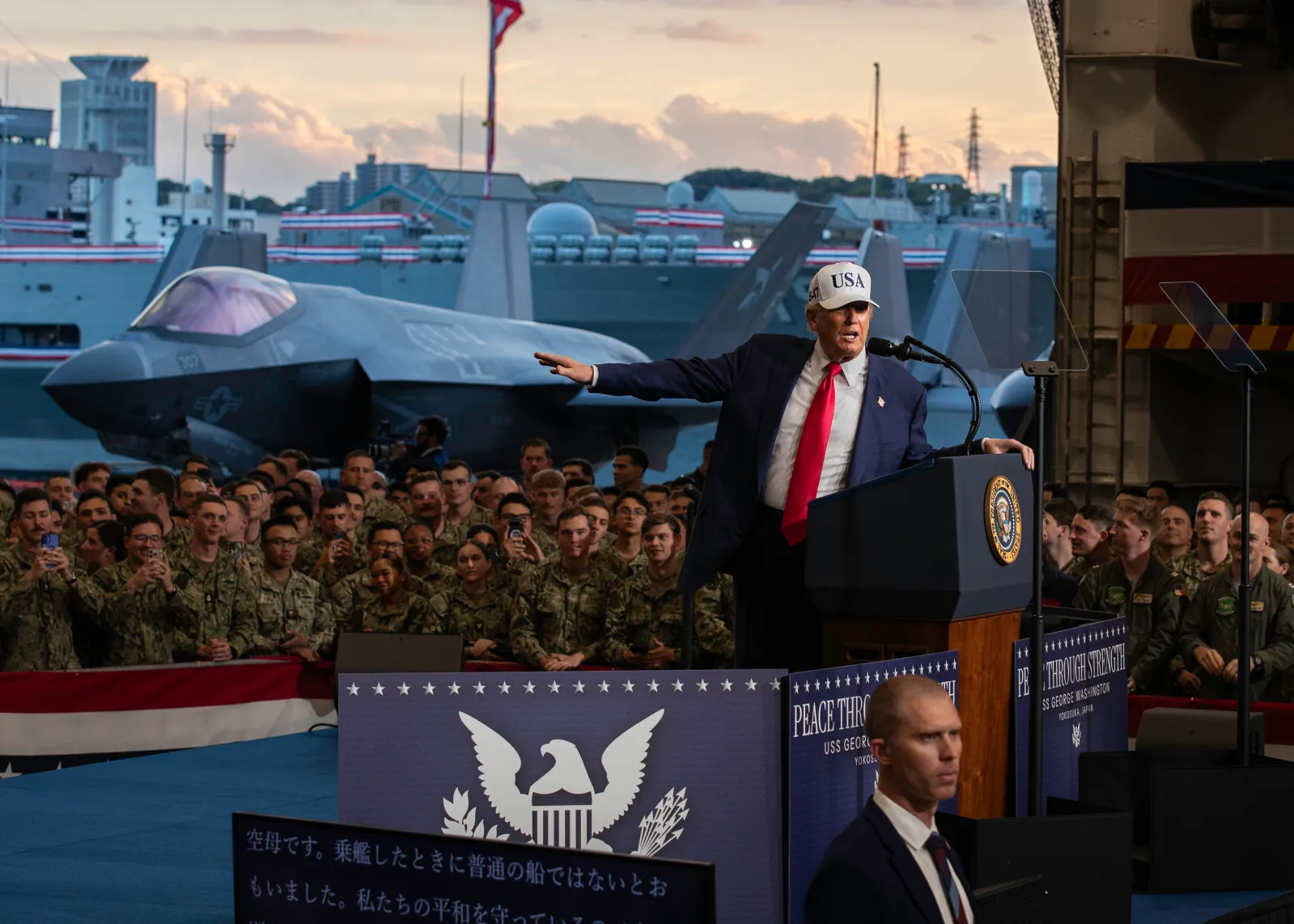
During its 7th Fleet deployment, which ended on December 11, the George Washington returned briefly to Yokosuka. It hosted President Donald Trump during his visit to Japan in late October, where he praised U.S. naval power amid military rivalry with China.
The Japan-based warship, equipped with F-35C jets, also conducted a dual aircraft carrier operation near Australia with its British counterpart, HMS Prince of Wales, in July as part of Exercise Talisman Sabre 2025. The British vessel carried F-35B jets.
As of Monday, the Abraham Lincoln, deployed from San Diego in late November, was operating in the Philippine Sea following a visit to Guam. It remains unclear whether it will also head toward the Middle East or continue to operate in the western Pacific.
The U.S. military offers flexible deterrence options to protect national interests across different commands while maintaining a ready, capable and lethal force in the Indo-Pacific for defense and contingency response, a U.S. Pacific Fleet spokesperson said.
...
What People Are Saying
A U.S. Pacific Fleet spokesperson told Newsweek: "During our deployment/operations, U.S. Pacific Fleet is reliably present, working side-by-side with our allies and partners. Our forces routinely interact with foreign units with professionalism and due regard for the safety of all vessels and aircraft."
U.S. Navy Rear Admiral Amy Bauernschmidt, commander of the Carl Vinson Carrier Strike Group, said: "Our Sailors' dedication and hard work over nearly nine months was vital to sustained operations, including combat, protecting our American values of freedom, prosperity and security on the high seas."
U.S. Navy Rear Admiral Fred Goldhammer, commander of the Nimitz Carrier Strike Group, said: "We have traveled more than two thirds of this planet during this nine month deployment, and I cannot overstate the positive impact Nimitz Strike Group has made as part of our mission to maintain peace through strength by sustaining credible deterrence alongside our Allies and Partners."
U.S. Navy Captain Tim Waits, commanding officer of USS George Washington, said: "Our mission is to preserve the peace, respond in crisis, and win decisively in war … Our presence in the Indo-Pacific and integration with our allies and partners gives us a strategic advantage that enables mission success."
What Happens Next
The U.S. is expected to continue maintaining a persistent aircraft carrier presence near China, as the East Asian naval power now operates three aircraft carriers, enabling it to increase the frequency of deployments and extend its reach in the western Pacific.
View 0 Comments
Submit Correction
View Editorial & AI Guidelines