10
Loading video...

By Joe Edwards
Reporter
0
Share
Newsweek is a Trust Project member
See more of our trusted coverage when you search.Prefer Newsweek on Googleto see more of our trusted coverage when you search.
Residents and visitors to Hawaii are being advised to take action as Hurricane Nolo passes by the state, with forecasters warning that the system could bring "catastrophic and life-threatening flash flooding" to parts of the islands into the weekend.
"The danger won't necessarily end when Nolo moves away," AccuWeather meteorologist Nicholas Arman said in an email the outlet sent to Newsweek on Thursday. "Floodwaters can remain high, saturated slopes can continue to give way and damaged roads can leave communities isolated."
"People across the Big Island should be prepared for impacts and disruptions that could last days beyond the storm itself," Arman added.
Read More on Weather
What the National Hurricane Center Forecasts
As of an update the National Hurricane Center (NHC) issued 11 p.m. Hawaii Standard Time on Thursday, Nolo was strengthening as it moved north-northeast, with maximum sustained winds increasing to near 80 miles per hour.
The hurricane was about 240 miles south of South Point, Hawaii, and moving at 5 mph, it said.
Nolo was expected to slow through late Friday before turning west-northwest and then west while accelerating over the weekend. The NHC said the center of the storm is forecast to remain well south of the main Hawaiian Islands.

...
"Additional strengthening is forecast, and Nolo is expected to become a major hurricane on Saturday," the NHC said.
The system is expected to bring 15 to 30 inches of rain, with some areas seeing up to 35 inches, to eastern and southern portions of the Big Island, according to the NHC.
"This rainfall could produce catastrophic life-threatening flooding and mudslides, especially in areas of steep terrain," it warned.
Western portions of the Big Island are expected to receive 5 to 8 inches of rain, with localized totals of up to 10 inches. Maui could receive 4 to 8 inches, with isolated amounts reaching 15 inches. Life-threatening flooding and mudslides are also possible in both areas.
The remainder of the islands could see between 1 and 3 inches, with up to 6 inches locally.
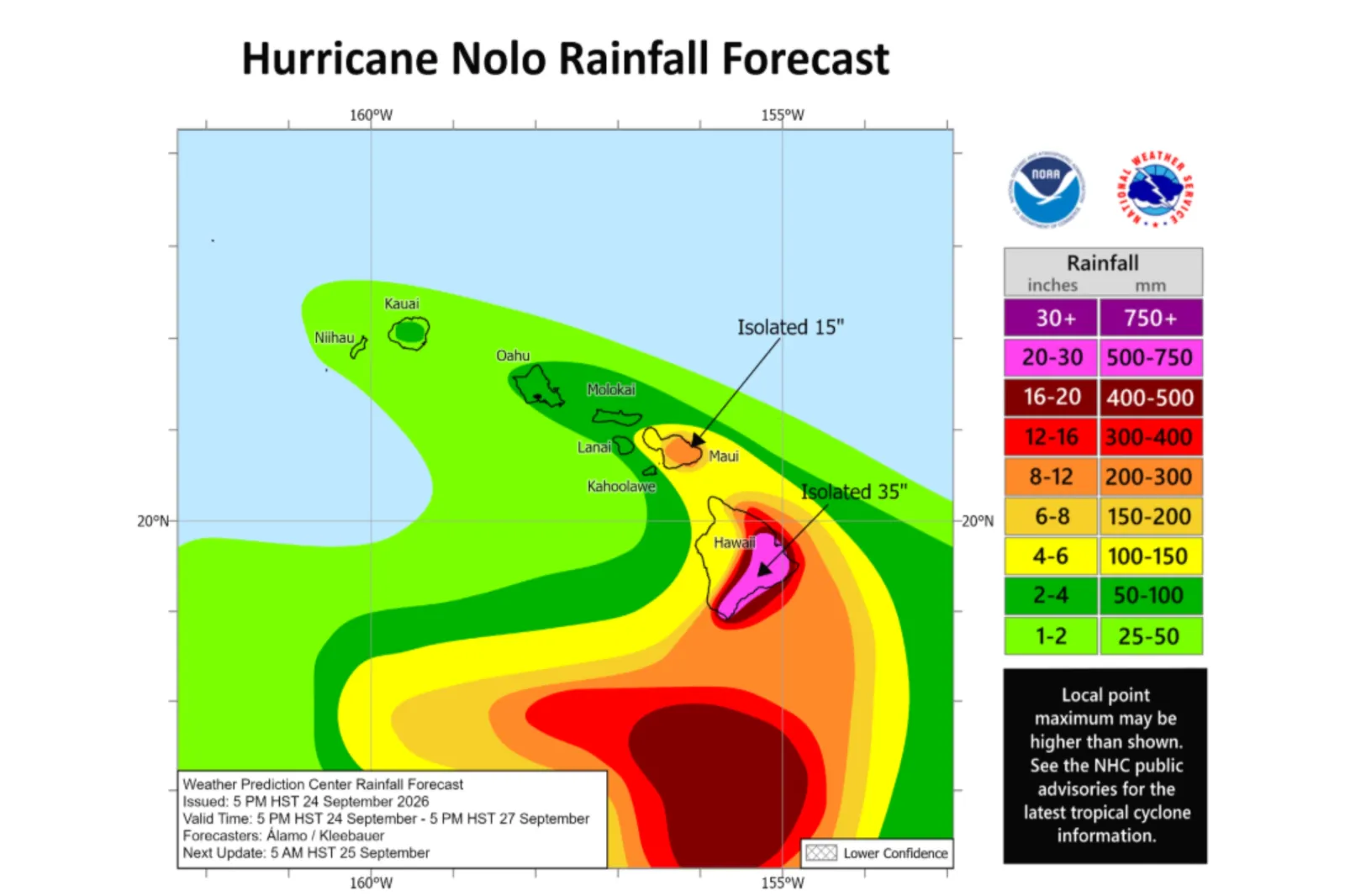
...
A storm surge of 1 to 3 feet above ground level is possible in Hawaii County if the peak surge overlaps with high tide, the NHC said, adding that the deepest water levels are expected along the immediate coast.
Swells capable of causing life-threatening surf and rip currents are expected to reach the Big Island's east- and south-facing shores by Friday and could spread westward through the weekend, the NHC added.

...
The agency said a hurricane watch and tropical storm warning are in effect for Hawaii County, while Maui County is under a tropical storm watch.
"Tropical storm conditions are expected to begin on the Big Island Friday night with hurricane conditions possible on Saturday," the NHC said.
Officials Issue Advice on How To Prepare
The National Weather Service's Honolulu forecast office advised those under watches and warnings to complete preparations to protect life and property, and reach a safe location before dangerous weather arrived. It also urged people to follow any evacuation orders.
Hawaii's Emergency Management Agency advised earlier this week that residents and visitors to the state, particularly those on Big Island and Maui, should review family emergency plans, check emergency supplies and prepare property for possible flooding and damaging winds.
"Consider evacuating to a safer shelter, especially if you are in southeast Hawaii Island," the agency said, adding that power outages should also be prepared for.
Storm updates should also be monitored, as storm track and forecasts can be subject to change, it noted.
"We've prepositioned a lot of emergency vehicles. We have now over 500 National Guards people available to help us in case this storm is really tough," Hawaii Governor Josh Green said in a video posted on social media earlier this week.
Residents can find information about open shelters near them via the Hawaii Emergency Management Agency's website.
Contact Newsweek editors on this story: Matthew Robinson and Shakeema Edwards.
View 0 Comments
Submit Correction
View Editorial & AI Guidelines