10
Loading video...

By Gabe Whisnant
News Editor
0
Share
Newsweek is a Trust Project member
See more of our trusted coverage when you search.Prefer Newsweek on Googleto see more of our trusted coverage when you search.
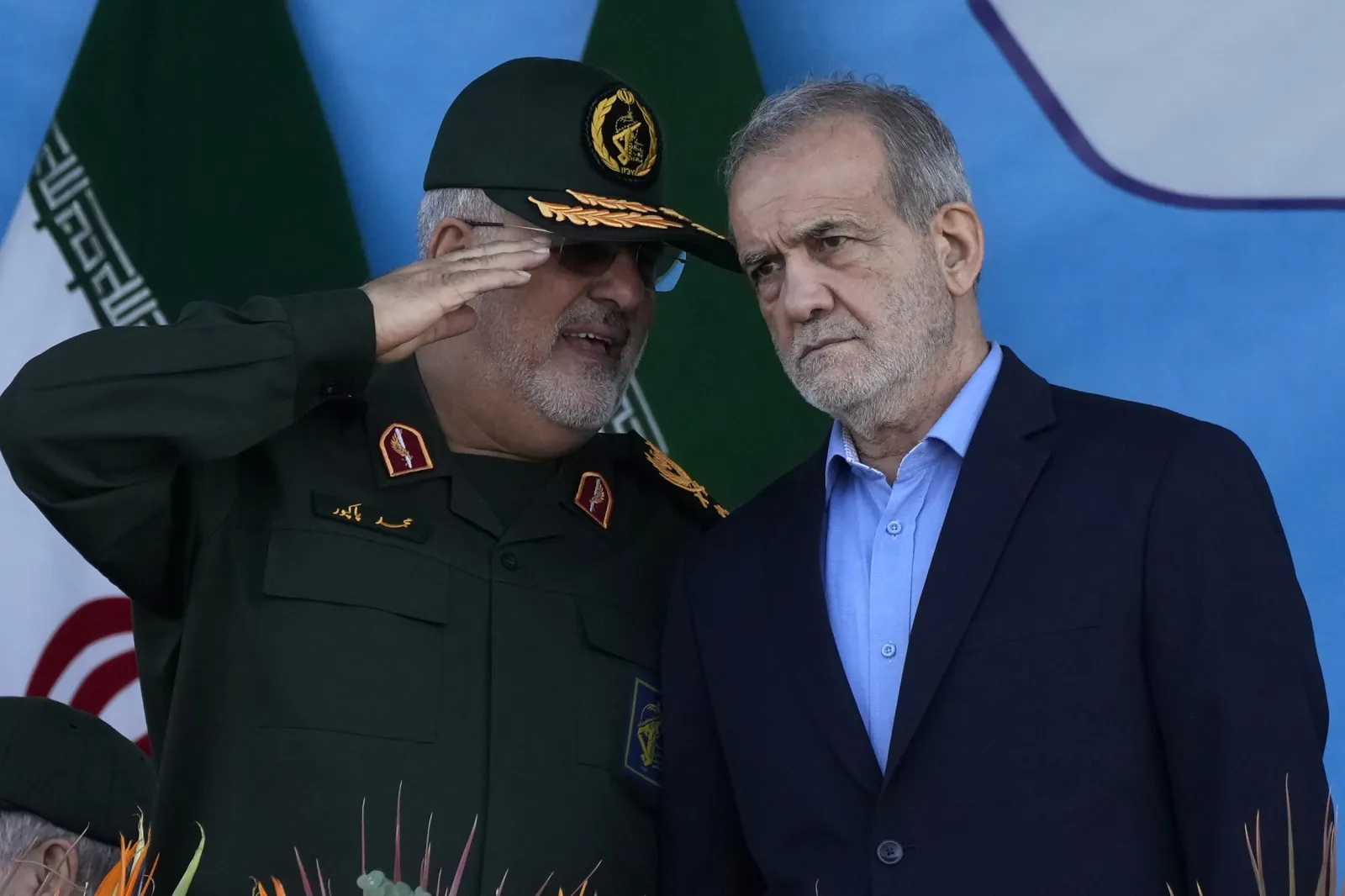
Mohammad Pakpour, the newly appointed commander of Iran's Islamic Revolutionary Guard Corps (IRGC), issued a stark warning in response to Israel's strikes that killed former IRGC leader Hossein Salami.
Speaking through Iran's state news agency IRNA, Pakpour vowed retaliation, saying, "In retribution for the blood of our fallen commanders, scientists and citizens, the gates of hell will soon be opened upon this child-killing regime."
On Friday night, the Israel Defense Forces (IDF) said that missiles have been launched from Iran in retaliation after earlier strikes by Israel. Photos and videos later showed plumes of smoke rising over Tel Aviv. The IRGC said that "hundreds of ballistic missiles would be involved" in the retaliation.
Read More on World
Iran's first wave of several waves of retaliatory missile strikes injured at least 34 people, according to the country's paramedic service.

...
Why It Matters
Israel launched a series of strikes across Iran on early Friday morning, local time, targeting nuclear facilities and military sites, killing Salami and at least one other senior military official and significantly escalating tensions between the longtime regional rivals.
President Donald Trump's Middle East envoy Steve Witkoff is still scheduled to travel to Oman this weekend for discussions on Tehran's nuclear program, though officials say it remains uncertain whether Iranian representatives will take part.
What To Know
Similar to Pakpour, Salami also leveled a threat to the United States, saying Iran would "open the gates of hell" if attacked by Israel or America. The former IRGC commander then took a swipe at Israeli Prime Minister Benjamin Netanyahu, asserting that he was trying to pull the U.S. into an "unending war." The general said that Iran was prepared to fight but was also still prioritizing diplomacy at the time.
Israel's continued strikes killed 78 people and injured more than 320 on Friday, with the "overwhelming majority" of casualties being civilians, according to Iran's ambassador to the U.N. Security Council.
An Israeli military official previously told Newsweek that the strikes were part of "Operation Rising Lion," conducted after intelligence indicated that Iran had enough material to produce 15 nuclear bombs. The Israeli military said it deployed over 200 fighter jets and launched 330 munitions.
As night descended on Friday, Iranian media reported explosions on the northern and southern edges of Tehran, as well as at Fordow—near the holy city of Qom—a key nuclear facility that had been untouched in the initial round of strikes. Israel's military confirmed it was targeting Iranian missile and drone launch sites.
Air defense systems were activated throughout Tehran, and blasts were also heard in the central city of Isfahan.
The attack marks what appears to be the most substantial attack on Iranian soil since the country's war with Iraq in the 1980s, heightening fears of a broader conflict.
In a letter to the U.N. Security Council, Iranian Foreign Minister Abbas Araghchi condemned Israel's targeted killings of Iranian officials and scientists as "clear instances of state terrorism." The letter, obtained by The Associated Press, called for an emergency meeting and asserted Iran's right to self-defense under the U.N. Charter.
"This right is non-negotiable," Araghchi said. "Israel will come to deeply regret this reckless aggression and the grave strategic miscalculation it has made."
Araghchi urged the Security Council—set to convene at 3 p.m. Friday in New York—to "take urgent and concrete measures to hold the Israeli regime fully accountable for its crimes."
...
What People Are Saying
The IDF said in a statement, "A short while ago, the IDF identified missiles launched from Iran toward the territory of the State of Israel. Defense systems are operating to intercept the threat. The public is instructed to enter a protected space and remain there until further notice. Leaving the protected space is only permitted following an explicit directive. Continue to follow the instructions of the Home Front Command."
Shortly afterward, an Israeli military official said that "dozens of Iranian ballistic missiles are en route to Israel" in a statement shared with Newsweek, adding that "the people of Israel have been instructed to remain in bomb shelters until further notice."
Israeli Prime Minister Benjamin Netanyahu said Israel told the U.S. about its plans to attack Iran in advance, "They knew about the attack. What will they do now? I leave that to President Trump."
President Donald Trump posted on Truth Social Friday morning: "Two months ago I gave Iran a 60 day ultimatum to "make a deal." They should have done it! Today is day 61. I told them what to do, but they just couldn't get there. Now they have, perhaps, a second chance!"
Iran's Supreme Leader Ayatollah Ali Khamenei said in a recorded message Friday in which he vowed revenge: "We will not allow them to escape safely from this great crime they committed."
What Happens Next?
Both Israel and Iran are expecting continued strikes.
This article contains reporting by The Associated Press.
Update: 6/13/25, 1:15 p.m. ET: This article was updated with new information and remarks.
Update: 6/13/25, 1:24 p.m. ET: This article was updated with new information and remarks.
Update: 6/13/25, 2:43 p.m. ET: This article was updated with new information and remarks.
Update: 6/13/25, 7:02 p.m. ET: This article was updated with new information and remarks.
View 0 Comments
Submit Correction
View Editorial & AI Guidelines