...

By Peter Aitken
Politics Weekend Editor
0
Share
Newsweek is a Trust Project member
See more of our trusted coverage when you search.Prefer Newsweek on Googleto see more of our trusted coverage when you search.
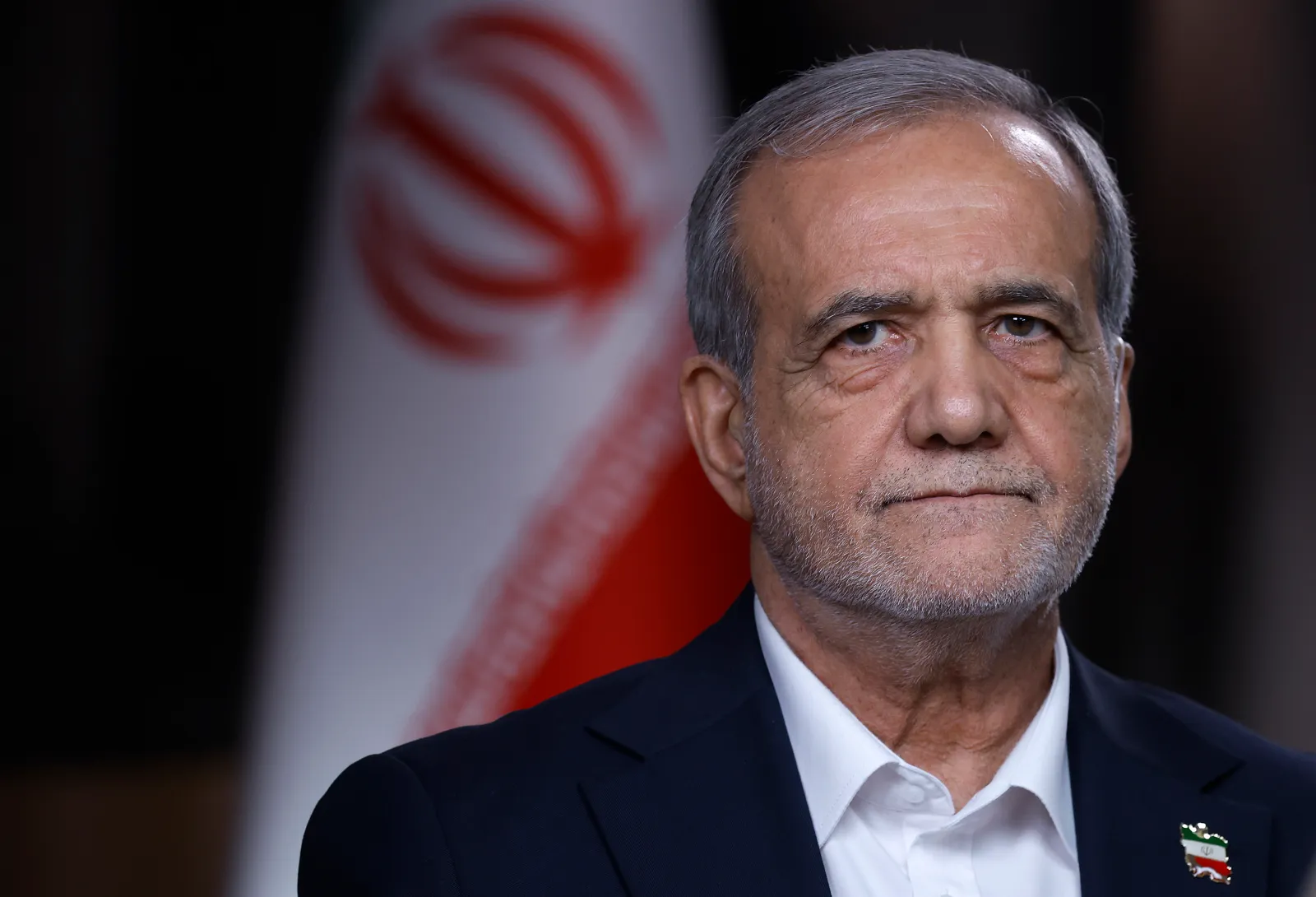
Iran’s President Masoud Pezeshkian apologized in a video for attacks on U.S-allied Gulf Arab countries, and then walked back that statement on social media as the Islamic Republic’s clerical rulers delayed and then accelerated the selection of a successor to assassinated Supreme Leader Ali Khamenei. Both uncharacteristic U-turns indicated that the regime may be beginning to crack under a withering assault from American and Israeli forces on a mission to disarm Iran and crush its leadership.
Why It Matters
Defiance in the face of external pressure has been a trademark of the Islamic Republic since it was founded in 1979 so Pezeshkian’s apology and an initial delay in the leadership transition appeared to be unprecedented concessions to enemies at the gates. While Iran has always had moderate and hardline factions within its leadership, disagreements almost never break out in the open in moments of crisis. And Iran is facing its greatest crisis in half of a century of clerical rule, with U.S President Donald Trump demanding unconditional surrender and Israeli Prime Minister Benjamin Netanyahu saying his forces want to topple the regime.
Read More on Politics
...
What To Know
U.S. officials have said the goal of the operations against Iran has been to diminish the country's nuclear program and Navy, not regime change.
When asked by reporters about who he would like to see rule Iran on Tuesday, President Donald Trump said, "Most of the people we had in mind are dead."
Several major figures have been touted as potential candidates, including Khamenei's son Mojtaba and senior cleric Ayatollah Alireza Arafi, the latter of whom is part of the three-man council tasked with picking the next leader, along with Pezeshkian and Chief Justice Gholam-Hossein Mohseni-Ejei, as established under Article 111 of Iran’s constitution.
Pezeshkian's initial apology caught many off-guard, with such apologies rare, especially in war time, but it did not land well with parliamentary hardliners. Iranian parliament member Hamid Rasaee posted a statement on X, calling Pezeshkian's address "weak, unprofessional, and publicly unacceptable," and joined clerics in demanding an "end the activities of this temporary council as soon as possible by introducing the future leader, thereby ensuring the protection of the revolution of Imam Khomeini and Imam Martyr Khamenei.”
Pezeshkian then issued a second statement that he merely intended to clarify that the country had attacked only "U.S. military bases, facilities, and installations in the region" and had not attacked neighboring countries, according to the New York Times.
He also said Iran would not attack any nation unless strikes originated from that country or if their "airspace, territory, and waters are not used to attack" Iran. However, several hours after his apology, the United Arab Emirates (UAE), Qatar and Bahrain were still sounding alerts or reporting intercepted Iranian missiles, according to the Associated Press.
"I should apologize to the neighboring countries that were attacked by Iran, on my own behalf," he said. "From now on, they should not attack neighboring countries or fire missiles at them, unless we are attacked by those countries. I think we should solve this through diplomacy."
The U.S. strikes haven't been coming from the Gulf Arab governments being struck by Iran, but from U.S. bases and vessels in the region, the AP reported.
Iran Divided Over Question of Succession
Pezeshkian's apology and later clarification, which notably did not include any element of apology towards regional neighbors, occurring in response to criticism has prompted some to question whether there is any unity in the regime.
A reformist cleric, Rahmatollah Bigdeli, had in turn dismissed Rasaee's comments as "ignorance," writing: “The constitution does not specify a time limit for the validity of the interim leadership council, and questioning the validity of this council is tantamount to questioning the legitimacy of the decision-making bodies of the regime."
Abbas Akhoundi, a former minister aligned with the reformists, slammed the "diversionary and toxic debate” over succession, writing on X that "the stench of the power struggle in wartime is nauseating."
"It seems that what doesn't matter is Iran and the defense of the Iranian homeland. What a state of degradation we've fallen into!" he added, questioning if "the main issue for Iran" really was picking its next leader or defending the homeland.
And if some regime figures worried about how that apology might land overseas, Trump seized on it as proof of the success of "Operation Epic Fury," writing recently on Truth Social: "Iran, which is being beat to HELL, has apologized and surrendered to its Middle East neighbors, and promised that it will not shoot at them anymore. This promise was only made because of the relentless U.S. and Israeli attack."
On Sunday, Iran's semi-official Mehr news agency reported that the nation's Assembly of Experts, responsible for picking a new head of the regime, had elected a replacement after days of uncertainty over who would succeed Khamenei. The new leader has not been announced yet.
Update 3/8/26 12:40 pm ET: This article was updated with new information.
In a polarized era, the center is dismissed as bland. At Newsweek, ours is different: The Courageous Center—it's not "both sides," it's sharp, challenging and alive with ideas. We follow facts, not factions. If that sounds like the kind of journalism you want to see thrive, we need you.
When you become a Newsweek Member, you support a mission to keep the center strong and vibrant. Members enjoy: Ad-free browsing, exclusive content and editor conversations. Help keep the center courageous. Join today.


View 0 Comments
Submit Correction
View Editorial & AI Guidelines