...

By Amira El-Fekki
Middle East News Reporter
0
Share
Newsweek is a Trust Project member
See more of our trusted coverage when you search.Prefer Newsweek on Googleto see more of our trusted coverage when you search.
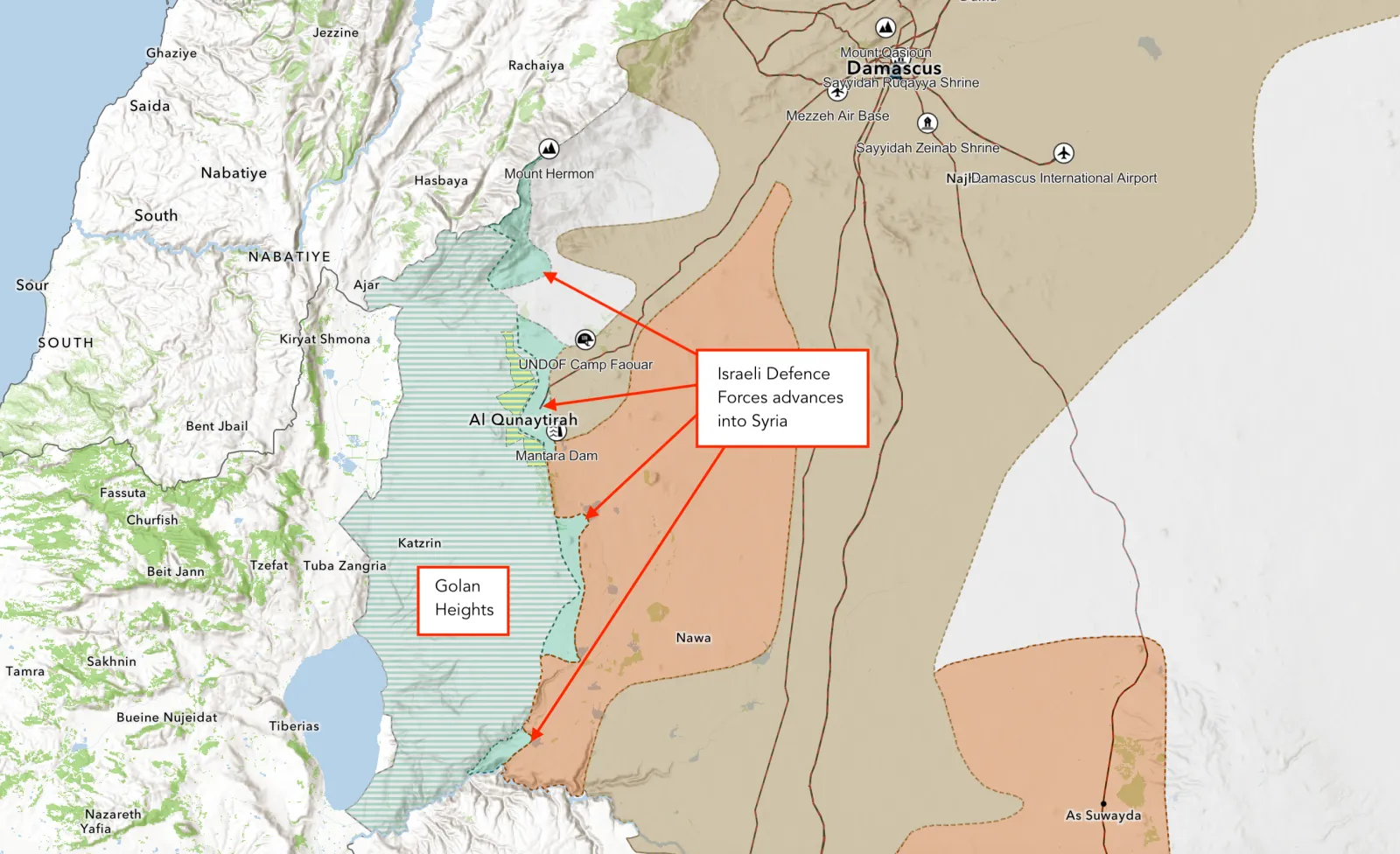
Israel has pushed troops further into parts of southern Syria, citing the need to secure its borders from armed groups as Arab leaders and Iran have accused Israel of attempting to seize territory by force.
The advances are detailed in a map produced by the Critical Threats Project at the American Enterprise Institute and the Institute for the Study of War.
Newsweek contacted Israeli Prime Minister Benjamin Netanyahu's office and Syrian authorities for comment.
Read More on World
Why It Matters
Escalation in Syria adds another dynamic to the complex web of conflicts in the region with fragile ceasefires between Israel and Hamas in Gaza, and Israel and Hezbollah in south Lebanon.
U.S. President Donald Trump's administration has also been pushing for the elimination of Iranian influence in the region, namely through the militant groups backed by the Islamic Republic such as Hamas and Hezbollah.
A prolonged Israeli troop presence would also inevitably raise concerns that Israeli forces plan long term occupation — as with the Golan Heights, which Israel captured from the Syria in the 1967 Middle East war and the West Bank and Gaza Strip, which it took from Jordan and Egypt respectively and where Palestinians now seek a state.
What To Know
The Israeli military conducted air strikes late Tuesday on several locations in the Damascus countryside and Daraa province in southern Syria, just days after Israeli Prime Minister Benjamin Netanyahu called for "demilitarizing" the region.
The U.N. Secretary-General voiced concern about the numerous Israeli airstrikes in Syria launched since the fall of the Bashar al-Assad regime, urging the withdrawal of Israeli forces from the demilitarized zone in the strategically important Golan Heights.
In December, Syrian rebels fighting under Hay'at Tahrir al-Sham (HTS), overthrew Assad's regime. The group is now officially ruling Syria through its leader Ahmed al-Sharaa, a former Al-Qaeda affiliate. But HTS does not control the south, near Israel's northeast border, leaving it potentially vulnerable to militant groups.
The Israeli Defense Forces said on Wednesday they struck military targets including "command centers and multiple sites containing weapons," adding that they will continue to operate "to remove any threats to Israelis."
The new Syrian regime has condemned the "Israeli incursion" demanding its "immediate and unconditional withdrawal" from Syria, according to a statement during a national dialogue on Tuesday.
...
The map from the Institute for Study of War and AEI's Critical Threats Project showed the Israeli army advancing south of Damascus countryside and in Daraa province in southern Syria.
Netanyahu has said Israel has no intention of withdrawing from southern parts of Syria for now.
What It Means for Syria and the Middle East
Israel's critics say it is seeking to impose a de facto annexation of Syrian territories but the Syrian regime has not escalated a response against Israel.
"Sharaa lacks the capacity to seriously counter Israeli operations militarily and risks destabilizing the government transition even if he could respond militarily to Israeli operations," the Institute for the Study of War said.
Syria's government would favor diplomacy, Syrian analyst Samir Alabdullah told Newsweek.
"The Syrian government is trying to take advantage of the growing international support and its positive relations with some regional countries to pressure Israel to withdraw from the areas where it advanced," he said.
What People Are Saying
**Director of Policy Analysis Department at Harmoon Center for Contemporary Studies Samir Alabdullah: "**It is likely that Russia and Turkey will play a role on this matter, given their large influence in Syrian affairs and complicated relations with Tel Aviv and Damascus."
Israeli Prime Minister Benjamin Netanyahu: "We will not allow forces of the HTS or the new Syrian army to enter the territory south of Damascus. We demand full demilitarization of southern Syria, in the provinces of Quneitra, Daraa and Sweida. And we will not tolerate any threat to the Druze sect in southern Syria."
Iran's Foreign Ministry spokesperson Esmail Baghaei: "Israeli attacks on Syria were a blatant violation of the U.N. Charter, international law, and Syrian sovereignty, and the repetition of such acts of aggression is tantamount to an invasion."
Arab League Secretary-General Ahmed Aboul Gheit: "The Israeli occupation's raids and attacks on Syrian territory are a reckless provocation and a dangerous escalation aimed at exploiting Syria's political transition to impose an illegal and illegitimate reality. Any Israeli occupation of Syrian land constitutes a flagrant violation of international law."
What's Next
Israeli forces are expected to remain stationed in southern Syria and continue to carry out operations against military targets. While Syria and Arab countries may challenge this, there is little they can do to counter it militarily for now.
View 0 Comments
Submit Correction
View Editorial & AI Guidelines