...

By Ryan Chan
China News Reporter
0
Share
Newsweek is a Trust Project member
See more of our trusted coverage when you search.Prefer Newsweek on Googleto see more of our trusted coverage when you search.
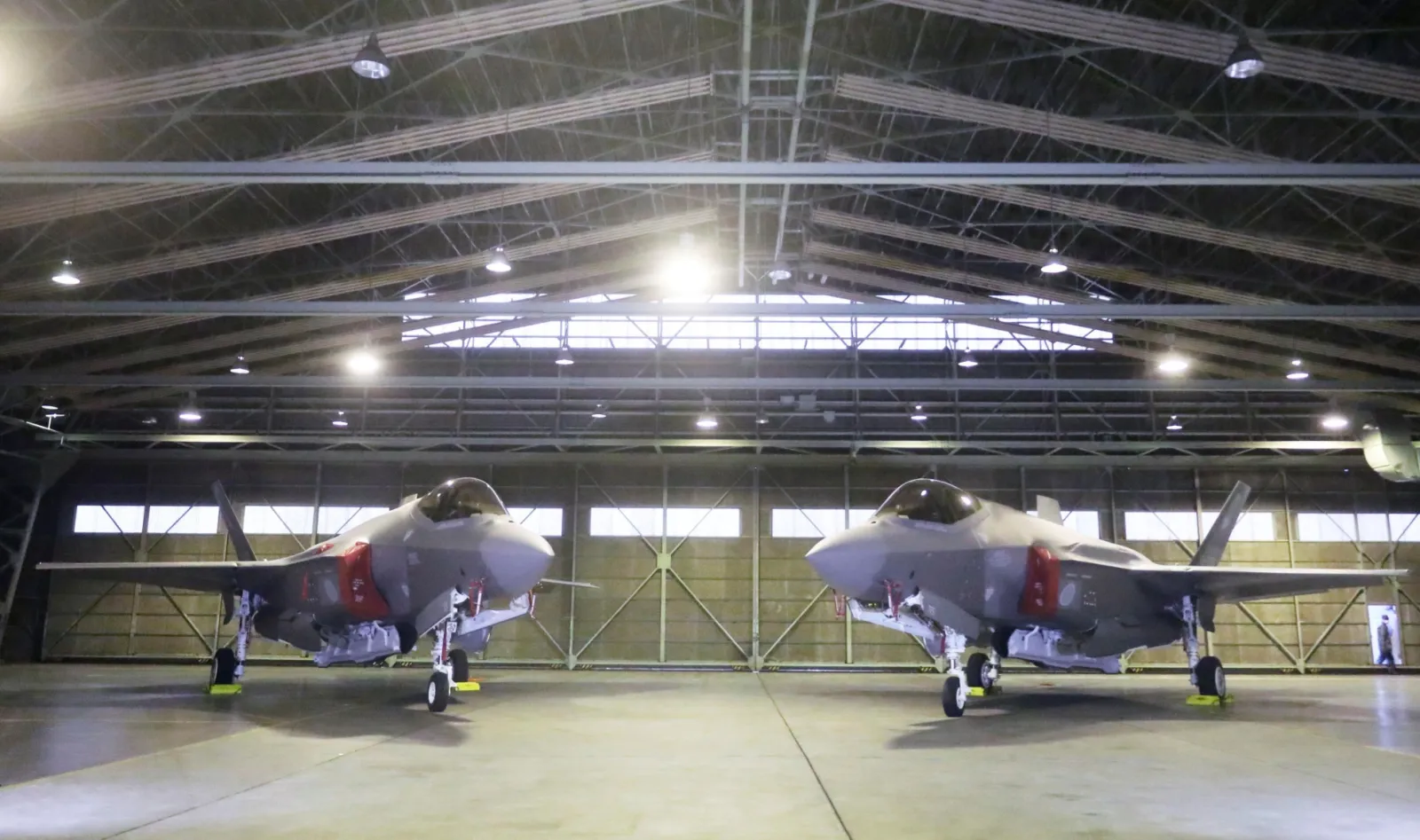
Japan plans to expand the number of bases hosting advanced F-35A stealth fighter jets amid neighboring countries' military activities and air power modernization efforts.
Chitose Air Base on Hokkaido, Japan's northernmost main island near Russia, is set to become the third base for the country's F-35A jets, with deployment scheduled to begin in fiscal year 2030, according to a defense ministry document released on December 10.
Why It Matters
Japan—a key treaty ally in the United States' Indo-Pacific strategy—is the largest foreign operator of F-35 jets outside the U.S., with 105 F-35As and 42 F-35Bs, which operate from conventional runways and naval vessels, respectively.
Read More on World
The acquisition of F-35 jets is part of Japan's efforts to bolster its defenses—including the introduction of long-range missiles—amid "the most severe and complex security environment of the post-war era," citing threats from Russia, China and North Korea.
Under the so-called "partnership without limitations," Russia and China have conducted joint military maneuvers in the western Pacific to counter the U.S.-Japan alliance, most recently with a joint patrol near Japan on December 9 that involved bomber aircraft.
...
What To Know
Chitose Air Base will equip one of its two F-15 jet units—either the 201st or 203rd Tactical Fighter Squadron—with 20 F-35A jets, with the first group of eight aircraft scheduled to arrive in 2030, according to a Japanese Defense Ministry document.
"Countries surrounding Japan are rapidly modernizing their air forces by introducing new aircraft, including fighter jets believed to have stealth capabilities, and upgrading existing models," the document read. Both Russia and China operate stealth fighter jets.
Another factor in deploying F-35A jets on Hokkaido is to strengthen Japan's ability to respond to foreign military aircraft approaching its airspace, Tokyo noted, referring—without naming—joint long-distance bomber flights from neighboring countries.
Newsweek has emailed the Russian Defense and Foreign Ministries for comment. The Chinese Foreign Ministry did not immediately respond to a request for comment.
Chitose Air Base is an optimal location for hosting F-35A jets due to already having the necessary infrastructure for operations, sufficient land for deployment and airspace for training, the document said, adding that all factors were considered comprehensively.

...
Japan's F-35A jets currently deploy at Misawa Air Base and Komatsu Air Base on the main island of Honshu, facing the Pacific Ocean and the Sea of Japan—also known as the East Sea, which borders Japan, the Korean Peninsula and Russia—respectively.
Misawa Air Base is home to a pair of F-35A jet units—the 301st and 302nd Tactical Fighter Squadrons—while the 303rd Tactical Fighter Squadron at Komatsu Air Base is replacing F-15 jets with F-35A jets, according to a map by Japan's Defense Ministry.
The future F-35A jet squadron on Hokkaido will be Japan's fifth unit operating the stealth aircraft, the defense ministry said, meaning Komatsu Air Base's second F-15 jet unit—the 306th Tactical Fighter Squadron—will soon undergo an aircraft transition.
Regarding Japan's newly acquired F-35B jets, which are intended to operate from aircraft carriers, they are deployed at Nyutabaru Air Base on Kyushu—Japan's southernmost main island—as a temporary squadron, according to the same map.
The Aviationist, a military aviation website, reported that Japan's Defense Ministry also plans to establish a permanent F-35B jet unit as the 202nd Tactical Fighter Squadron.
Besides the aforementioned aircraft, Japan operates F-2 jets at Hyakuri Air Base near Tokyo and Tsuiki Air Base on Kyushu. On the outlying island of Okinawa, two F-15 jet units are deployed at Naha Air Base amid China's intensified military activities.
What People Are Saying
A Japanese Defense Ministry document read: "The ministry of defense and the Self-Defense Forces intend to steadily introduce F-35A fighter jets, which possess high network capabilities and stealth performance, in order to further refine and strengthen the quality and quantity of Japan's air power, and to ensure the complete defense of our country."
The Russian Defense Ministry said: "The Russian Aerospace Forces and the Air Force of the People's Liberation Army of China conducted another joint air patrol in the Asia-Pacific region…The event was carried out as part of implementing the military cooperation plan for 2025 and is not directed against third countries."
Guo Jiakun, a spokesperson for the Chinese Foreign Ministry, said: "It needs to be stressed that the China-Russia joint strategic air patrol is an operation carried out under the annual cooperation plan, and showcases the two sides' determination and capability in jointly responding to regional security challenges and keeping the region peaceful and stable."
What Happens Next
It remains to be seen whether Japan will further expand the number of air bases hosting stealth jets, particularly at Naha Air Base amid the deterioration of its ties with China.
View 0 Comments
Submit Correction
View Editorial & AI Guidelines