...

By Hugh Cameron
Reporter
0
Share
Newsweek is a Trust Project member
See more of our trusted coverage when you search.Prefer Newsweek on Googleto see more of our trusted coverage when you search.
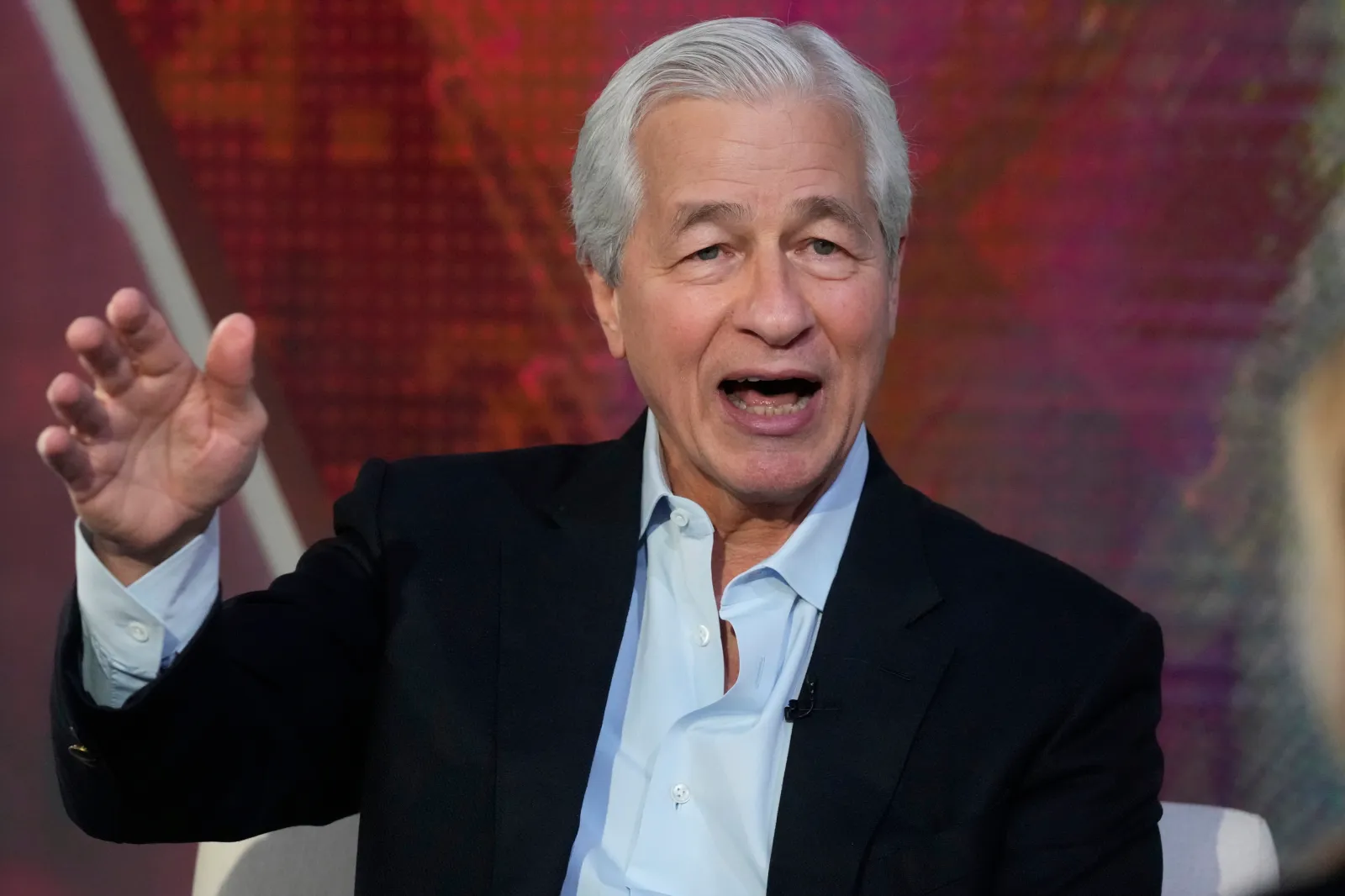
Jamie Dimon, CEO of financial services and banking giant JPMorgan, has highlighted a number of potential risks facing the U.S. economy.
In a series of interviews on Tuesday, Dimon raised concerns about President Donald Trump’s recent policy change on H-1B visas, said that inflation could prove a drawn-out challenge for the Federal Reserve and warned that the country’s mounting deficit—a bugbear of many economists—is an unsustainable issue requiring the urgent attention of policymakers.
Why It Matters
As chief executive of one of the world’s biggest banking institutions and a central player in the global economy, Dimon is among the most influential voices in American finance, his economic forecasts monitored by markets and policymakers alike.
Read More on Politics
While Dimon is less pessimistic than others in his outlook, many economists have warned about a host of headwinds—both contemporary and longer-term—facing the U.S. economy that could soon push it into a major downturn.
What To Know
On Tuesday, Dimon said that Friday’s announcement of a $100,000 fee for H-1B visa applications was a shock that could impede the flow of foreign-born talent into the U.S. In an interview with the Times of India, Dimon said the news "came out of the blue," and that JPMorgan would be "engaging with stakeholders and policymakers" over the matter.
"For us, visas matter because we move people around globally—experts who get promoted to new jobs in different markets," Dimon said, adding that immigration was one of America’s "core strengths."
In a separate interview with CNBC TV18, Dimon said that the announcement "caught everyone off guard," and cited the H-1B as an example of "merit-based immigration."
JPMorgan is among the program’s heaviest users, according to United States Citizenship and Immigration Services (USCIS), and was one of the firms which advised their foreign-born employees to remain in the U.S. or return before the order came into effect on Sunday.
...
Speaking to CNBC TV18, Dimon also warned that America’s $37.5 trillion national debt poses a growing risk to the economy if left unaddressed.
"I can give you a logical argument that it could become a problem in six months. I can give you a logical argument that it might be six years. But it will become a problem," Dimon said. "And like most problems, you’re better off dealing with the problem than letting it happen."
Dimon added that neither economic growth nor the revenues accrued from Trump’s tariffs would be sufficient to solve the issue. He went on to cite faster growth—driven by looser regulations—as a potential remedy, as well as a targeted initiative like the Simpson-Bowles Commission, created by President Barack Obama in 2010 to address the country’s financial health.
Beyond long-term fiscal issues, Dimon said that current inflationary pressures could impede the economic recovery and create challenges for policymakers hoping to speed up growth.
"If inflation does not go away, it's going to be hard for the Fed to cut [rates] more," he said. "And you know, inflation seems a little bit stuck in 3 percent."
The annual inflation rate currently sits at 2.9 percent, according to the latest report from the Department of Labor. Following on from its announcement of a 25-basis-point cut last week, Federal Reserve officials indicated that they expect two more cuts of this size before the end of the year. Chairman Jerome Powell told reporters that, in the Fed’s view, the "balance of risks has shifted" toward labor market conditions rather than inflation.
What People Are Saying
Jamie Dimon, speaking to CNBC TV18 on Monday, said: "There's a lot of conflicting data, but right now unemployment is still low. Consumers, both low-end and higher-end, are spending their money. At the low end, they're clearly a little stretched, and credit losses are going up slightly. So, it's not a disaster—it's a weakening. I don't know if that's just a weakened economy or not."
Mark Zandi, chief economist at Moody’s Analytics, recently told Newsweek: "I don't think the economy is in a recession, at least not at this point, but it feels like it's on the brink, it's on the precipice of a recession."
What Happens Next?
Several forecasts have pointed to a heightened risk of a U.S. recession within the next 12 months. Moody’s Analytics currently placed the odds at just under 50 percent, which Zandi described as "uncomfortably high."
"It’s less than 50 percent, but historically, the probability has never gotten this high, and a recession has not ensued," he posted to X.
View 0 Comments
Submit Correction
View Editorial & AI Guidelines