
By Andrew Stanton
Reporter
0
Share
Newsweek is a Trust Project member
See more of our trusted coverage when you search.Prefer Newsweek on Googleto see more of our trusted coverage when you search.
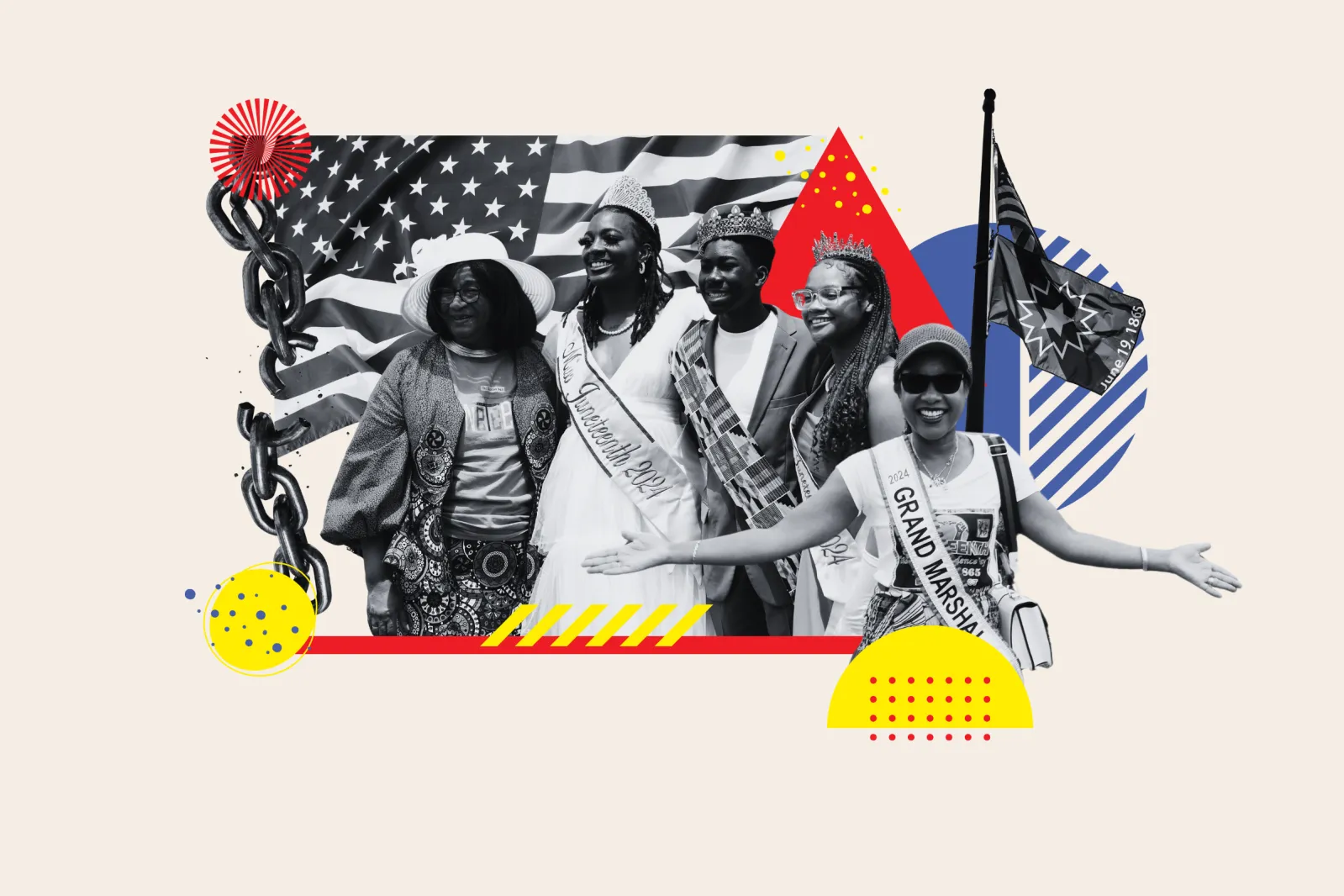
Juneteenth, the nation's newest federal holiday, is celebrated by Americans on June 19 to commemorate the end of slavery in the United States, with a history dating back to the 1860s.
Why It Matters
Juneteenth became a federal holiday in 2021 when then-President Joe Biden signed bipartisan legislation into law, officially designating it as a federal holiday. However, it has been celebrated by the African American community for over 150 years and has been a recognized holiday in Texas for decades.
Read More on U.S.
What To Know
President Abraham Lincoln issued the Emancipation Proclamation on January 1, 1863, declaring that "all persons held as slaves" within Confederate states "are, and henceforward shall be free."
But many remained enslaved for years to come. The proclamation applied only to states in rebellion against the Union, and it would take a Civil War for that freedom to come to fruition in Confederate states. Juneteenth marks the date when Union soldiers arrived in Galveston, Texas, to officially declare slaves in the state as being free.
General Gordon Granger issued General Order No. 3 on June 19, 1865, freeing the state's slaves.
"The people of Texas are informed that, in accordance with a proclamation from the Executive of the United States, all slaves are free. This involves an absolute equality of personal rights and rights of property between former masters and slaves, and the connection heretofore existing between them becomes that between employer and hired labor," the order reads.
June 19 emerged as a celebratory day for African Americans in Texas, as Juneteenth celebrations followed the next year and have continued to this day, though the holiday has seen some changes over the years.
Leslie Wilson, associate dean of Montclair University's College of Humanities and Social Sciences, told Newsweek that the Emancipation Proclamation was a "tool" Lincoln used, essentially telling Confederate states slaves would be freed if they do not stop fighting the Union. Most southern states did not pay attention to the order. As Union troops took control of each state, they would declare slavery over under the proclamation.
...
That means each southern state has its own Emancipation Day when slavery ended, but Juneteenth is celebrated because it was the last of those days, Wilson said. Other states did not popularize their Emancipation Day as Texans, who held large celebrations that spread across the country over the next century.
People in Texas celebrated with large picnics and dressed up for the events, serving foods like Red Velvet Cake—a symbol of resilience, Wilson said.
Darryl Heller, director of the Civil Rights Heritage Center at Indiana University, told Newsweek it is important to celebrate Juneteenth as the nation has still not "fully grappled with how significant slavery is" to its history.
"Juneteenth is a reminder that the Emancipation Proclamation in 1863 did not free all the slaves, all the people who were enslaved, and even the end of the Civil didn't guarantee freedom for everyone," he said.
Even Juneteenth did not mark the end of slavery in every state. That would come on December 6, 1865, when the 13th Amendment passed, he said.
Years of reconstruction would follow as former slaves and their families worked to reunite, establish political power in the United States and build new lives. But it would still be another century before Black Americans were guaranteed full rights and treated as equal citizens under the U.S. Constitution.
Heller said people can have meaningful dialogues and "real discussions about the history of this country" this year to celebrate Juneteenth.
"Looking under the surface and going deeper to try to understand not just the day itself, but what produced the day and what was the aftermath of it, I think is a really, really important part of the celebration itself," he said.
Juneteenth is about "Black resilience," Wilson said*.*
"Black people across the nation will celebrate it whether or not it is a federal or state holiday. African American history has already demonstrated the strength of the holiday and the conviction of its followers. People like Opal Lee did a great deal to expand knowledge of Juneteenth and to convey its importance to black and white communities," he said.
Juneteenth Celebrations Extend Across the U.S.
Juneteenth grew from a local Texas holiday to a "western regional holiday" by 1910, he said. By the early 1960s, the celebration became popular in cities like New Orleans, Tulsa, Oakland, San Francisco, Los Angeles and Denver. Communities on the East Coast began to have a "deeper connection" with the holiday during the Civil Rights and Black Power Movement, Wilson said.
Different understandings had emerged about the end of slavery. In the North, many were taught that it ended with the Emancipation Proclamation, but those in the South learned slavery only ended when slaves were freed state-by-state by Union troops, he said.
"When people from Texas starting moving acrsos the country in the late 1800s and into the 1900s, they were celebrating Juneteenth because it had been memorialized in their minds. People in different states said, 'Oh, I never know about this.' They would say 'How did you not know about this,' and it became very popular," he said.
On the East Coast, some were initially skeptical after learning in school that slaves were freed after the Emancipation Proclamation, he said.
"In the 20th century, as more and more people moved across the country and bringing their cultures and their customs with them, then Juneteenth became more popular outside of Texas, and it had become more popular in urban centers where African-Americans had migrated," he said.
Juneteenth celebrations became "acts of resistance" during the Jim Crow era, Portia Hopkins, a historian at Rice University, told Newsweek. Those gatherings sustained "cultural memory when Black freedom remained under siege," she said. They were organized locally and situated within Black community centers and churches.
Wilson said the understanding of Juneteenth was "widespread throughout the nation in African American communities" by the time it became a state holiday in Texas in 1980.
"It took another 20 years for white America to begin its recognition of Juneteenth and another 10 after that for commercial interests to promote the holiday," he said.
The holiday can "remind African Americans of the shortcomings of American politics and society and encourage them that they again need to fight for the rights that they are "promised by the constitution," according to Wilson.
Juneteenth Became a Federal Holiday in 2021
The efforts to make Juneteenth a national holiday gained traction after "the murder of George Floyd in 2020 and the national reckoning it sparked," Hopkins said.
"In 2021, Juneteenth became a federal holiday, making it the first new national holiday since Martin Luther King Jr. Day in 1983. That recognition is deeply symbolic because it affirms that Black history is American history and that the story of freedom is more complicated—and more honest—when it includes the voices of those for whom it was long withheld," she said.
The holiday is being "celebrated amid a complex social and cultural American landscape" in 2025, Hopkins said, noting the recent renaming of military bases after Confederate leaders and rollbacks of DEI initiatives.
"Nevertheless, Juneteenth celebrations continue to be vibrant, meaningful and optimistic about the future because, in essence, that was at the heart of the celebration within its original context in the first place," she said.
Onwubiko Agozino, professor of sociology at Virginia Tech University, told Newsweek he believes Juneteenth is a day to come out against slavery, which still exists in the world, and a reminder of why the U.S. should "value diversity."

...
"Part of the reason why America is America the beautiful is because of the diversity that benefits everybody," he said. "It's also in Constitution, in the 14th Amendment,. And in the Preamble of the Constitution, it says 'We the people.' Not 'We the white men.'"
What People Are Saying
Former President Barack Obama, in a post on X (formerly Twitter), on Thursday: "On Juneteenth, we celebrate freedom and recommit ourselves to the work that remains undone. We remember that even in the darkest hours, there is cause to hope for tomorrow's light."
Leslie Wilson, associate dean of Montclair University's College of Humanities and Social Sciences, told Newsweek: "Juneteenth is a confusing holiday because it weakens the idea that the Emancipation Proclamation 'freed' the enslaved, that the 13th Amendment ended slavery, or that the surrender of General Lee brought an end to the Civil War and slavery. It suggests that what most kids have learned in school is not entirely correct. And the story of Juneteenth and the myth of Juneteenth are equally confusing. General Granger read a proclamation that said that the enslaved were free, but Union troops did not go throughout the area ensuring that all were free.
"The reading of the document also still ties the bondsmen and women to picking cotton for the Union (because there was a need to maintain trade to cover the national debt). In essence, African Americans see the holiday as their self-liberation from the underwhelming promises of American freedom. By and large, many of the enslaved used the proclamation to free themselves and create new lives by running away from Texas plantations, finding loved ones, and building new societies."
President Joe Biden, in a June 2024 statement: "One of my proudest moments as President was signing into law Juneteenth as a new Federal holiday—the first Federal holiday to be established since Dr. Martin Luther King, Jr. Day four decades prior. Juneteenth is an acknowledgment of the truth of our Nation's history. It is about realizing the idea that America was founded on: All people are created equal and deserve to be treated equally throughout their lives."
Update 6/19/25, 1:27 p.m. ET: This article was updated with additional information.
View 0 Comments
Submit Correction
View Editorial & AI Guidelines