...

By Sam Stevenson
Associate News Editor
0
Share
Newsweek is a Trust Project member
See more of our trusted coverage when you search.Prefer Newsweek on Googleto see more of our trusted coverage when you search.
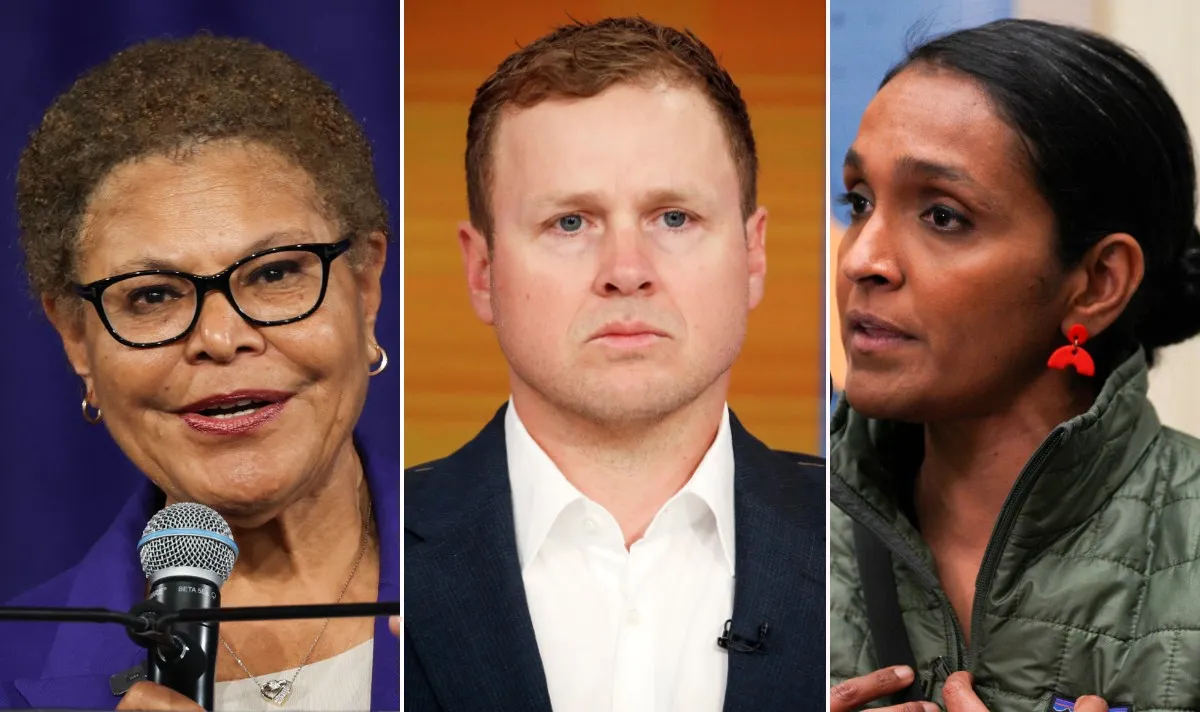
A new UC Berkeley/Los Angeles Times poll shows Los Angeles Mayor Karen Bass, Nithya Raman and reality TV star Spencer Pratt locked in a tight three-way contest ahead of the June primary, underscoring how sharply the race has shifted in recent weeks.
The survey found Bass, who has been endorsed by former Vice President Kamala Harris, at 26 percent, narrowly ahead of Democratic Los Angeles City Councilmember Raman at 25 percent and television personality Pratt, who is a registered Republican running for mayor as an independent, at 22 percent—placing all three within the margin of error and indicating no clear front-runner.
It marks a notable shift from earlier polling, which had consistently shown Bass with a clearer lead, and suggests turnout could determine which candidates advance to a November runoff.
Read More on Politics
But prediction markets still favor Bass, with Polymarket at about 71 percent and Kalshi near 69 percent, well ahead of Pratt, who starred in MTV's The Hills, and Raman.
"Everyone knew this would be a close race, and it shows Karen Bass in the lead heading into Tuesday," Doug Herman, a Bass campaign adviser, told Newsweek in an emailed statement on Thursday.
"It's a choice between a Mayor who reduced homelessness and hired more officers, a Councilwoman who voted repeatedly to allow encampments near schools and to shrink LAPD, or a reality TV villain. We will win."
Newsweek also contacted Pratt and Raman's campaigns via email for comment on Thursday morning.
Key Points
- A new UC Berkeley/Los Angeles Times poll put Bass at 26 percent, Raman at 25 percent and Pratt at 22 percent.
- Emerson College polling earlier in May showed Bass at 30 percent, Pratt at 22 percent and Raman at 19 percent.
- The number of undecided voters have dropped sharply from March levels, falling from 26 percent to 10 percent in the latest Berkeley poll.
- Raman and Pratt each gained roughly eight points since March in the Berkeley survey, while Bass’ support remained largely unchanged.
...
What The New Poll Shows
The UC Berkeley Institute of Governmental Studies poll, conducted May 19–24, is the largest public survey released ahead of the June 2 primary and shows the race tightening significantly in its final stretch.
The survey included 1,913 registered voters, 1,351 of whom were classified as likely voters, with a margin of error of about 3 percentage points.
While Bass maintains a nominal lead, a Berkeley polling expert described it as statistically insignificant, with all three candidates drawing support from different voter coalitions.
"You’ve got three very different candidates, each with very different constituencies, all within the margin of error. It’s going to boil down to turnout," said Mark DiCamillo, the director of Berkeley IGS polls.
The poll also highlights how quickly the race has consolidated. Undecided voters dropped to 10 percent, down from 26 percent in March—suggesting late deciders are now breaking toward challengers rather than the incumbent.
What’s Shaping The Race
The campaign has been shaped heavily by voter concerns over homelessness, housing affordability and public safety, as well as fallout from the 2025 Palisades Fire and the ongoing Sandy Fire.
Pratt, who lost his home in the Palisades blaze, has focused his campaign on criticism of Bass’ disaster response, while Raman has attacked the mayor’s homelessness policies and broader governance record.
Pratt has also leaned into AI-generated campaign videos, using stylized, often viral clips to amplify his message and attacks on opponents. The approach has driven significant online engagement, though its impact on voter behavior remains unclear.
How The New Poll Compares With Earlier Data
Earlier polling had painted a different picture. An Emerson College poll conducted May 9–10 showed Bass with a clearer advantage at 30 percent, compared with Pratt at 22 percent and Raman at 19 percent.
Even earlier surveys showed a fragmented race with high uncertainty. A March UC Berkeley/Los Angeles Times poll found Bass at 25 percent, Raman at 17 percent and Pratt at 14 percent, with more than a quarter of voters still undecided.
Other polling, including a Tavern Research survey conducted May 1–4, placed Bass at 22 percent, with Pratt at 18 percent and Raman at 16 percent, reinforcing the perception of a crowded and competitive field.
A UCLA Luskin poll, conducted March 15–29, with a plus or minus 4 percentage-point margin of error, showed Bass ahead on 25 percent, with Pratt and Raman in the low teens and 40 percent undecided—a dynamic that has since shifted as voters have broken toward the leading candidates.
Taken together, the data suggests Bass has maintained a consistent lead in most polling but has not significantly expanded her advantage, while both Raman and Pratt have gained ground as voters make up their minds.
What Prediction Markets Show
Prediction markets are trading platforms that aggregate crowd expectations into percentage odds, offering fast-moving signals but sometimes diverging from polls due to speculation and lower liquidity.
Despite the tightening in polls, these markets continue to favor Bass as the most likely winner.
At the time of writing, Bass was trading at roughly 71 percent on Polymarket, compared with around 25 percent for Pratt and about 6 percent for Raman. Kalshi showed Raman trading better, with Bass at 62 percent, Pratt at 22 percent and Raman at 17 percent.
It suggests a broad consensus that Bass is likely to reach the runoff, though they diverge from polling on how competitive the race for the second spot has become.
Pratt’s Sister Weighs In
The tightening race comes as Pratt’s sister, Stephanie Pratt, again weighed in on his candidacy—this time in more supportive terms.
"I admit I was the first person to tell people that they were idiots if they voted for my brother," she told Vanity Fair in an email interview on May 27. "Wow, was I wrong. He has spent every day since the fires, finding the facts, the mistakes, the negligence and uncovering the truth that they never wanted us to know."
Her comments reflect the unusual mix of celebrity attention and policy debate that has defined the contest.
What Happens Next
The top two candidates will advance to a November runoff if no candidate wins a majority in the June 2 primary.
With support converging among the leading candidates and fewer undecided voters remaining, the latest poll suggests the outcome may hinge on turnout in the final days of the race.
View 0 Comments
Submit Correction
View Editorial & AI Guidelines