10
Loading video...

By Alice Gibbs
Senior Reporter
0
Share
Newsweek is a Trust Project member
See more of our trusted coverage when you search.Prefer Newsweek on Googleto see more of our trusted coverage when you search.
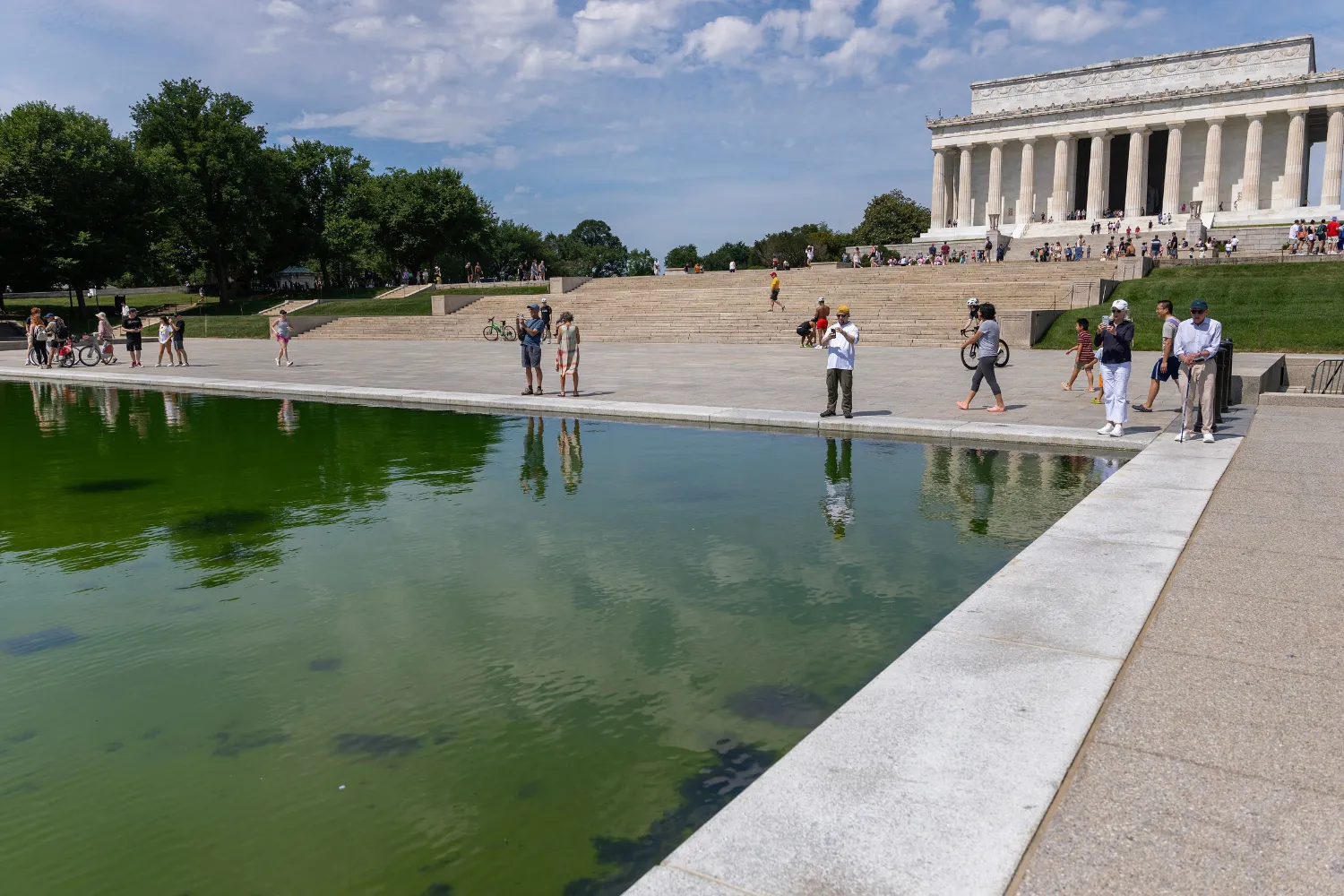
A multimillion-dollar renovation of the Lincoln Memorial Reflecting Pool—designed to give the historic landmark a deeper “American flag blue” finish—appears to have had an unintended consequence: the water already looks green.
Images of the pool from the last few days show algae spreading across the surface just days after the pool was refilled, raising questions about whether the redesign has altered conditions in ways that favor rapid blooms.
The overhaul, ordered by President Donald Trump as part of a broader effort to revamp the National Mall ahead of the U.S. 250th anniversary, involved resurfacing the century-old pool with a dark blue coating intended to improve its appearance and seal leaks.
Read More
The Original 1924 Columbia Island Design Trump Admin Citing To Build Arch6 min read

How the Lincoln Memorial Reflecting Pool Nearly Had a Pyramid7 min read

There’s a Wave of Historic Landmarks Reopening Across the US—Here’s Why5 min read

The pool was drained earlier this year to allow for repairs to its aging basin and infrastructure, crews then moved in to resurface the interior with the darker coating designed to deliver the “American flag blue” finish Trump had called for, before the pool was refilled and reopened shortly after. The compressed timeline—from draining to repainting to refilling within weeks—has left a relatively short window for systems to be flushed and stabilized, a period when water quality can be especially vulnerable to rapid changes.
While Trump had suggested the project would cost between $1.5 million and $2 million, federal records show contracts ultimately reached roughly $14 million. The work was awarded via a no-bid contract that has come under scrutiny and prompted a lawsuit from The Cultural Landscape Foundation, which argues the changes were carried out without required historic review.

...
A Historic Pool With Long-Standing Algae Problems
Stretching more than 2,000 feet between the Lincoln Memorial and the Washington Monument, the Lincoln Memorial Reflecting Pool was built between 1922 and 1923.
Managing the reflecting pool has long been a delicate logistical balance between aesthetics and environmental reality. The structure was never designed as a sealed, static feature. It relies on constant circulation, filtration and chemical treatment to maintain clarity across its shallow, sun-exposed surface.
By the 1980s, the pool was already deteriorating badly, with officials pouring concrete into the base to try to patch damage. In the 2000s, the pool was losing hundreds of thousands of gallons per week due to leaks and structural failure which ultimately triggered a full drain and reconstruction between 2010 and 2012.
Algae blooms are also nothing new. The shallow, slow-moving water has long been prone to appearing green in summer, particularly when heat, sunlight and stagnant conditions combine.
Over the decades, crews have repeatedly drained, scrubbed and recalibrated the system following major works—including after its 2012 reconstruction under the Obama administration—often contending with the same rapid return of algae once water is reintroduced.
Following the $34 million renovation in 2012, algae appeared within weeks of the pool reopening—prompting crews to drain and clean it again as officials worked to recalibrate the water treatment system. Algae returned quickly after that overhaul too, underscoring how difficult it is to fully eliminate blooms in a shallow, outdoor system like the reflecting pool.
An Interior Department spokesperson told Newsweek: "Versus previous administrations, the National Park Service is actually maintaining the beautifully completed Reflecting Pool. The nanobubbler technology has successfully destroyed the algae bloom that has plagued every pool reopening since 1922, most infamously, the Obama pool reopening that resulted in massive algae clumps taking over the pool’s surface following years of construction that cost taxpayers millions upon millions only to be broken and disgusting days later. Now, due to deploying the advanced nanobubbler technology, the algae is dead and being vacuumed up as we speak. We thank President Trump for fixing the Reflecting Pool for good."
Why The Algae Could Have Appeared
"There are number of factors which can impact algal growth in standing freshwater, similar to the Lincoln Memorial Reflecting Pool," Christopher Lowe, senior lecturer in marine biology at Swansea University, told Newsweek. These include:
1. Residual Algae From the Renovation Process
An Interior Department spokesperson told Politico that the current algae is “residual,” after supply lines sat dormant for eight weeks during construction—suggesting at least part of the bloom may be a routine post-renovation effect rather than a completely new issue.
2. The Darker 'American Flag Blue' Coating
The timing—just days after the pool was refilled—has prompted debate over whether the darker coating could be playing a role.
Darker surfaces absorb more sunlight and heat than lighter ones, which in shallow water can raise temperatures and increase the energy available for algae growth—potentially accelerating reproduction rates.
Lowe said this effect could be significant, as darker surfaces effectively act as a heat source. “The darker an object the more light it absorbs and the warmer it gets,” he said, adding that this can create “perfect conditions for algae to bloom” in shallow, sunlit water.
...
Alla Silkina, an algal biotechnology expert at Swansea University, explained that darker surfaces could contribute to conditions that favor growth, but stressed that other factors are typically more important.
“Darker surfaces can absorb more solar radiation and increase local water temperatures,” Silkina told Newsweek. “This may create more favorable conditions for algal growth, although nutrient availability, water residence time, and species composition are often the primary factors controlling bloom development.”
3. Weather and Environmental Conditions
Weather conditions may also be contributing. Warm temperatures, strong sunlight and relatively still conditions are well known to encourage algae growth, particularly in shallow, slow-moving bodies of water like the reflecting pool.
“When nutrients, light and temperature are all high, algae can reproduce extremely quickly,” Lowe said, noting that blooms can develop in a matter of days.
Silkina explained that these conditions can rapidly accelerate growth in the right environment.
“Light provides the energy for photosynthesis, while temperature influences metabolic and growth rates,” she said. “In shallow water, greater light penetration and warmer temperatures generally promote faster algal growth, provided nutrients are available.”
She added that nutrients remain a key limiting factor. “Even with favorable light and temperature conditions, blooms are unlikely to develop if essential nutrients such as nitrogen and phosphorus are limited,” Silkina said.
4. Water Flow and Underlying Infrastructure
Some reports have also pointed to longer-standing infrastructure challenges beneath the pool, including issues with circulation or aging pipe systems.
If water movement or filtration is reduced, conditions can become more stagnant—making it easier for algae to grow and accumulate.
Lowe noted that stagnant conditions can allow blooms to intensify rapidly, particularly in enclosed systems where water is not regularly mixed or refreshed.
“Water circulation can significantly reduce bloom development,” Silkina said. “Continuous mixing and flow prevent algae from accumulating in one location… visible blooms are less likely to appear rapidly in well-circulated waters.”
Why It Looks Green
The green color itself is caused by chlorophyll—the pigment algae use for photosynthesis. As algae multiply, they begin to dominate how light is absorbed and reflected in the water, overpowering the underlying blue coating and shifting its appearance from deep blue to green.
Silkina noted that under the right conditions, this visual change can happen quickly.
“Under ideal conditions algal populations can double within hours to a few days,” she said. “Visible blooms may develop within several days to one or two weeks, depending on the species and environmental conditions.”
A 'Perfect Storm'—and Unproven Claims
Taken together, these elements—residual algae, heat absorption, favorable weather and water flow—can create what scientists often describe as a “perfect storm” for rapid blooms rather than a single clear cause.
Alongside these explanations, some social media users have speculated—without evidence—that the situation could be the result of deliberate interference.
Figures including radio host and MAGA supporter Grant Stinchfield suggested the pool was “sabotaged” by Democrats, while author and Trump supporter Juanita Broaddrick wrote on X: “It appears very evident that the reflecting pool has been sabotaged. The left is evil.”
There is no public evidence to support those claims, and officials have not indicated any foul play.
Update 06/15/26, 10:05 a.m. ET: This story was updated with additional comment from Christopher Lowe.
Update 06/16/26, 02:40 a.m. ET: This story was updated with comment from the Interior Department.
Update 06/16/26 07:50 a.m. ET: This story was updated with additional information.
View 0 Comments
Submit Correction
View Editorial & AI Guidelines