10
Loading video...

By Joe Edwards
Reporter
0
Share
Newsweek is a Trust Project member
See more of our trusted coverage when you search.Prefer Newsweek on Googleto see more of our trusted coverage when you search.
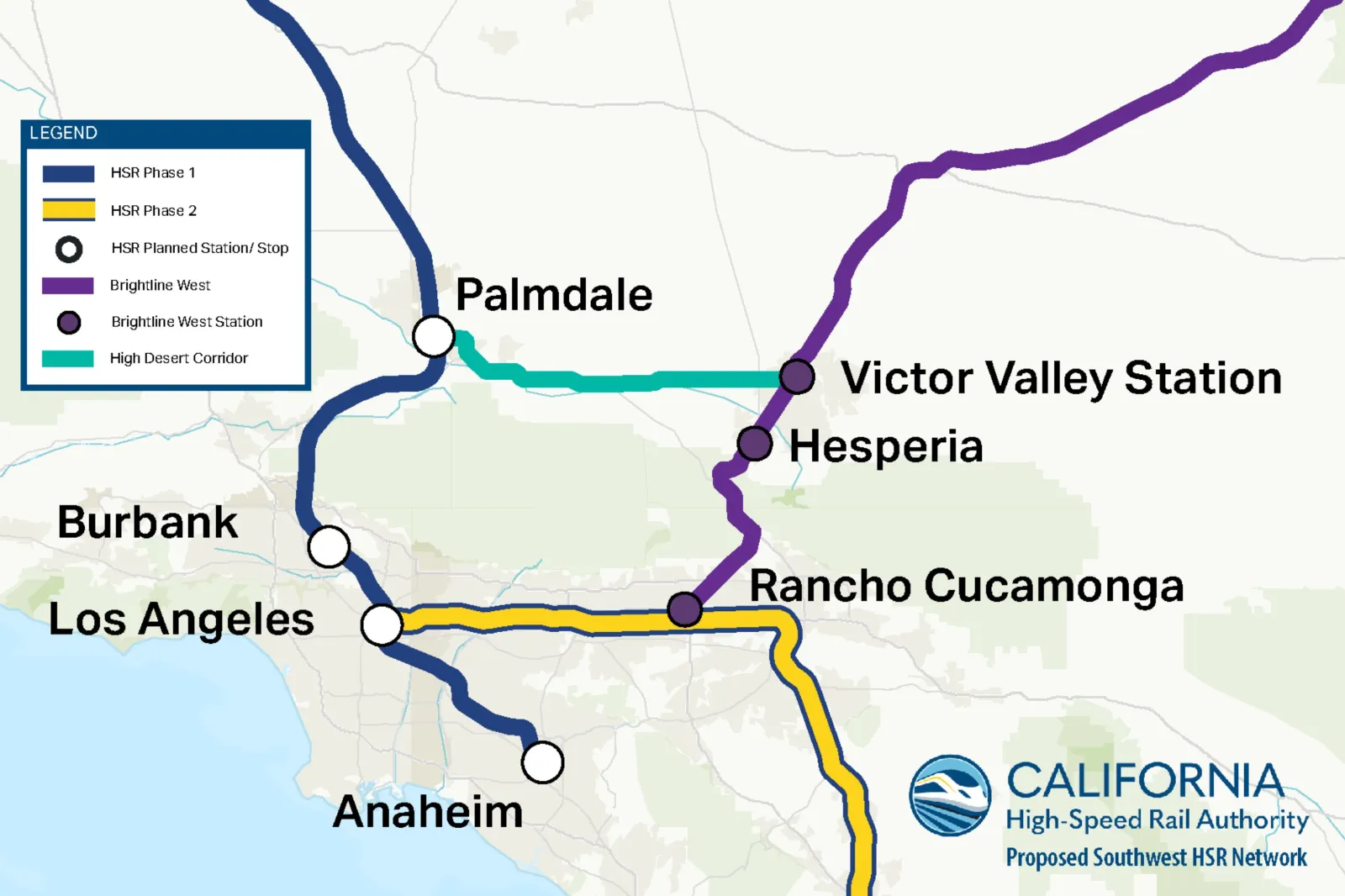
California high-speed rail planners have taken a step toward closing a gap in the state’s long-term rail network: a link between Palmdale and Victor Valley that could eventually connect California’s system with Brightline West’s planned Las Vegas service.
The California High-Speed Rail Authority and the High Desert Corridor Joint Powers Agency (HDCJPA) announced on Monday that they have signed a memorandum of understanding to coordinate work on environmental approvals, station planning and design, with a particular focus on Palmdale Station.
The memorandum of understanding centers on coordinating planning activities and does not create any new timelines or project milestones for the Palmdale-to-Victor Valley segment of the High Desert Corridor. Rather, it formalizes cooperation between the parties to support continued planning and environmental work, a California High-Speed Rail Authority spokesperson told Newsweek.
Read More on News
"This agreement supports coordinated planning and conceptual design at the future Palmdale Station to ensure compatibility between the statewide high‑speed rail system and the planned High Desert Corridor connection," they said.
Why It Matters
California’s high-speed rail project aims to carry passengers between Los Angeles and San Francisco at speeds of up to 220 mph, but it has faced years of delays, funding gaps and escalating costs. Approved by voters in 2008 with an expected 2020 completion date, the project remains unfinished.
What To Know
The HDC JPA includes Los Angeles County, LA Metro, Palmdale, Lancaster, Adelanto and Victorville, and is leading work on the High Desert Multipurpose Corridor, including a first-phase high-speed intercity rail connection between Palmdale and Victor Valley.
That stretch is significant because Victor Valley is also part of Brightline West’s route between Southern California and Las Vegas. Brightline West says its 218-mile electric passenger rail line will run from Las Vegas to Rancho Cucamonga, largely in the Interstate 15 corridor, with a Victor Valley station included in its plans.
...
The Palmdale-to-Victor Valley corridor would serve as what a California High-Speed Rail Authority spokesperson has called a "vital link," connecting Southern, Central and Northern California while eventually providing a route to Las Vegas through Brightline West.
The HDC JPA has previously described the proposed corridor as spanning roughly 54 miles between Palmdale and Victor Valley, with the potential to connect California High-Speed Rail, Metrolink and Brightline West.
The two public agencies say they "will seek to reduce costs to the public and accelerate delivery through coordinated materials purchases and construction."
"This Memorandum of Understanding is a pivotal step toward a fully connected, electrified high speed rail network across California. By coordinating planning, design and station integration at Palmdale, we’re laying the groundwork for clean, modern mobility that will better link Southern California to the statewide system," said HDC JPA chair Kathryn Barger.
The announcement comes as California’s high-speed rail project continues construction in the Central Valley. The authority said major segments from Merced to Bakersfield were under design and construction, nearly 90 miles of guideway were complete, 61 major structures were finished and another 30 were underway.
Newsom Announces Wider Transportation Funding
The rail agreement followed a separate Thursday announcement from Democratic Governor Gavin Newsom’s office that nearly $2.5 billion had been allocated for more than 150 transportation projects across California.
The governor’s office said the funding package included state highway work, public transit, local streets and roads, active transportation and intercity rail projects, and brought the Newsom administration’s transportation allocations for fiscal year 2025-26 to about $13.8 billion.
Notable projects listed by the governor’s office included $257 million for mobility hubs in southwest Los Angeles County, $99 million for the Whiskey Creek Bridge renovation in Shasta County and $64 million for Interstate 215 work in Riverside County.
Data Center Funding Idea Draws Scrutiny
As Newsweek previously reported, the California High-Speed Rail Authority said it was advancing an "asset commercialization strategy" involving energy and technology projects along the right-of-way and on surplus land.
That plan identified possible revenue sources including solar farms, battery storage, data centers, fiber optic lines, and transmission infrastructure. However, the strategy raised concerns among some community members, with public comments at a June board meeting highlighting risks related to water usage, pollution, noise, fire hazard, and the loss of farmland.
"The Authority is not proposing to build or operate data centers. It is focused on building and operating a high‑speed rail system," the California High-Speed Rail Authority spokesperson told Newsweek.
"As part of that mission, the Authority is evaluating opportunities to responsibly commercialize assets associated with the rail corridor. The system will require substantial fiber‑optic, communications, and power infrastructure to support operations. Where excess capacity exists, the Authority could lease access to third parties and generate ancillary revenue from infrastructure already being built for rail purposes.
"This approach is consistent with the Authority’s statutory obligation to operate the system without an ongoing operating subsidy. Exploring opportunities to generate non‑fare revenue from existing rail‑related assets can strengthen the long‑term financial sustainability of the system while delivering additional economic benefits to the people of California and the regions served by high‑speed rail.
"The first and only priority is building out a world‑class high‑speed rail system in California. All the work of the Authority is done in service of that goal," the spokesperson added.
Update, 7/23/26, 8:29 a.m. ET: This article was updated with comment from a California High-Speed Rail Authority spokesperson.
Contact Newsweek editors on this story: Ben Kelly and Cristina Diciu.
View 0 Comments
Submit Correction
View Editorial & AI Guidelines