...

By Melissa Fleur Afshar
Reporter
0
Share
Newsweek is a Trust Project member
See more of our trusted coverage when you search.Prefer Newsweek on Googleto see more of our trusted coverage when you search.
Several U.S. states may be able to get a good view of the aurora borealis tonight as they are set to appear over Canada and will be visible in some northern parts of the states.
While keen sky watchers can keep a look out for auroras tomorrow too, it is tonight that the light show will likely be stronger. They are best viewed in dark conditions either just after sunset or before sunrise, away from city lights.
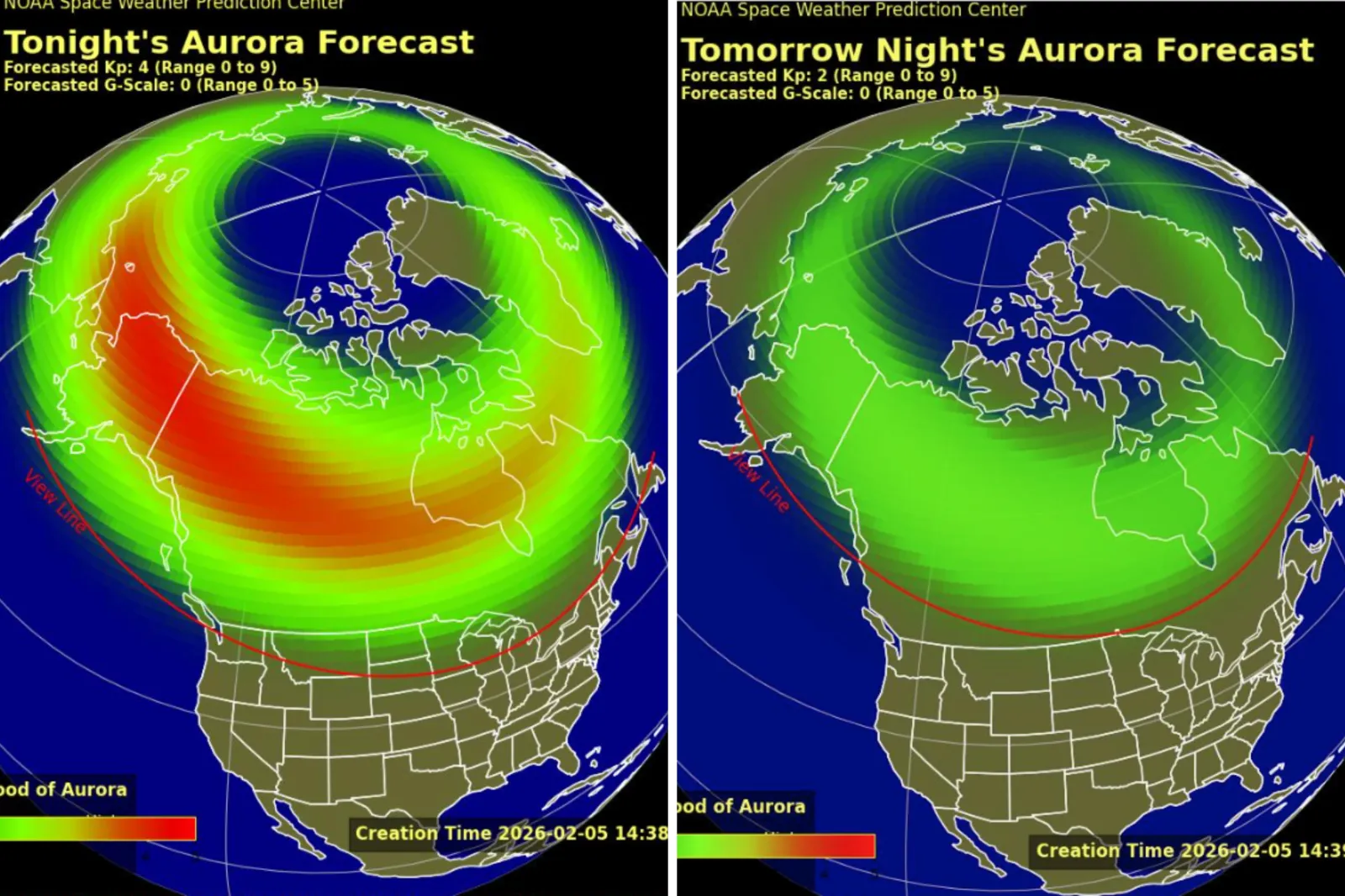
A map created by the National Oceanic and Atmospheric Administration's (NOAA) Space Weather Prediction Center shows that tonight auroras will be visible to the naked eye from several of the country's most northern states, including Maine, Michigan, Minnesota, Montana, New York, North Dakota and Washington.
Read More on Science
The forecast also predeicts a high likelihood of the northern lights over northern Alaska, and a lower change in the south of the state.
The cause of tonight's aurora lies in how the Earth is moving through the wake of a so-called coronal mass ejection "CME"—a large burst of plasma and magnetic field ejected from the surface of the sun—that struck yesterday.
The charged particles of the CME interact with atoms in the upper reaches of Earth’s atmosphere, causing them to become excited; they then release this excess energy in the form of light as they relax to a lower energy state.
The CME was released as the side-effect of a solar flare that exploded from the recently formed and giant sunspot 4366.
...
The Space Weather Prediction Center has also noted that minor geomagnetic storms, also a result of solar flares, are already underway. This is a strong indicator that the Northern Lights will soon be visible.
The last recorded Northern Lights display occurred in October 2025, when 15 U.S. states were able to get a good look at the dazzling show.
The Space Weather Prediction Center's tracker shows that the intensity and brightness of the aurora will fade as we enter February 6, and that its view line will slightly rise, leaving it much harder for those residing in the U.S. states bordering Canada to get a good look at the display.
Still, sky watchers may be able to catch a less defined glimpse at the aurora borealis because they can be observed from as much as 620 miles away if the conditions are optimal.
Do you have a tip on a science story that Newsweek should be covering? Do you have a question about space weather? Let us know via science@newsweek.com.
View 0 Comments
Submit Correction
View Editorial & AI Guidelines