...

By Maria Azzurra Volpe
Reporter
0
Share
Newsweek is a Trust Project member
See more of our trusted coverage when you search.Prefer Newsweek on Googleto see more of our trusted coverage when you search.
The northern lights may appear over parts of the U.S tonight as a coronal mass ejection (CME)—an eruption of plasma and magnetic field from the sun—is predicted to reach the Earth.
The impact could spark a G2-class geomagnetic storm, capable of producing auroral displays so intense they may be visible at lower-than-usual latitudes, including parts of the northern United States.
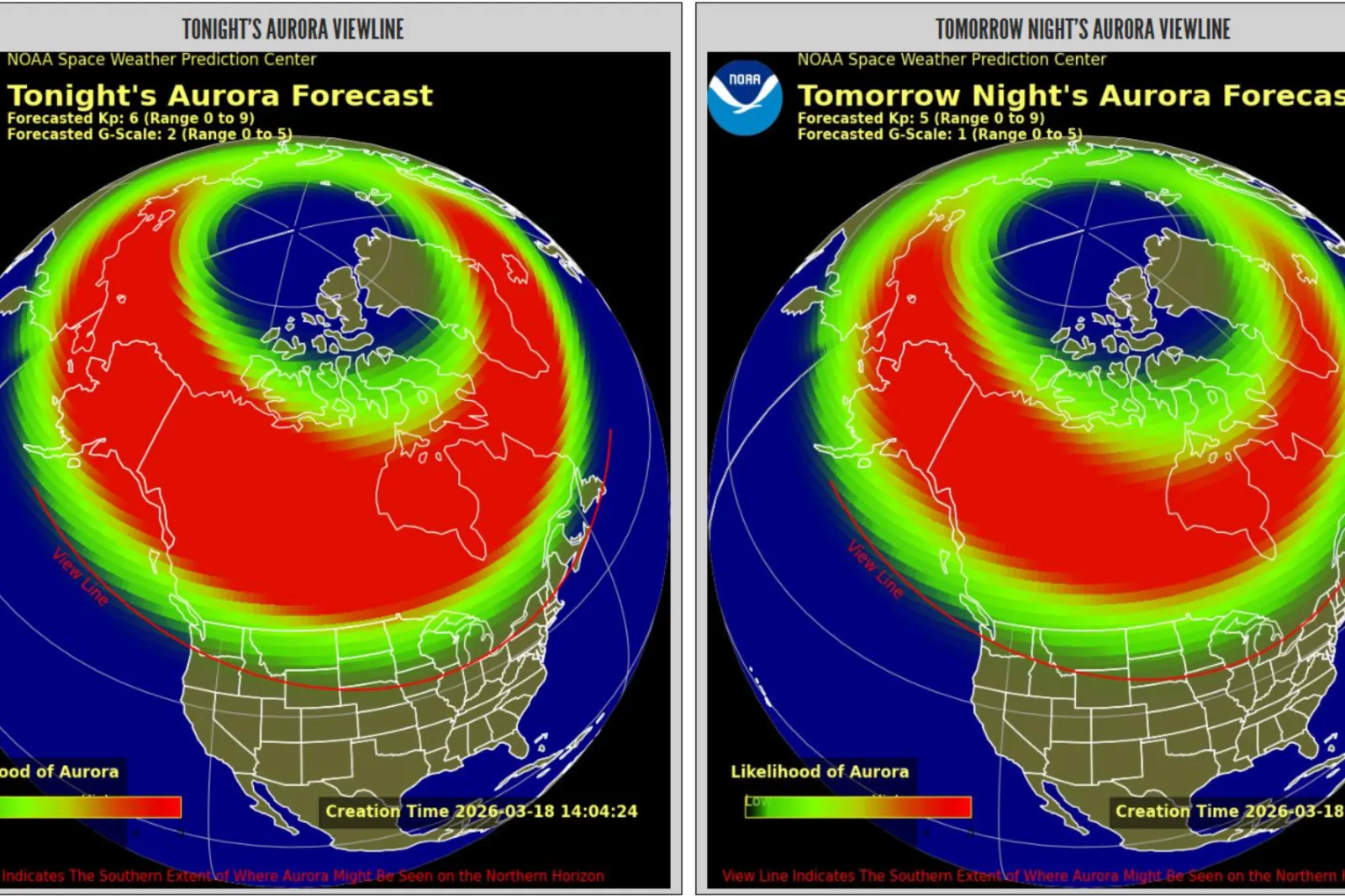
According to the Space Weather Prediction Center of the National Oceanic and Atmospheric Administration (NOAA), there is a geoplanetary disturbance rating of six out of a possible nine today.
Read More
Amazing Northern Lights Show Forecast for Up to 17 States Tonight3 min read

Northern Lights To Be Visible From New York to California1 min read

Map Reveals States Where Aurora May Appear Tonight As Space Storm Hits3 min read

A map provided by NOAA shows tonight's view-line, which represents the southern-most locations from which you may see the aurora on the northern horizon.
...
Tonight's light show could be visible from Idaho, Illinois, Iowa, Maine, Michigan, Minnesota, Montana, Nebraska, New Hampshire, New York, North Dakota, Oregon, South Dakota, Vermont, Washington, Wisconsin and Wyoming.
The bright green color on the map shows all the places where the aurora may be visible overhead as a result of the geomagnetic storm. The red spots show the places where the aurora is forecast to be more intense.
The northern lights are not visible in daylight. The best times to observe them is just after sunset or right before sunrise. Atmospheric conditions permitting, they can be observed from as far as 621 miles away.
The aurora may also be visible tomorrow night, as NOAA predicts a G1-class geomagnetic storm, and a geoplanetary disturbance rating of five out of a possible nine.
Clear skies and good weather are necessary for the northern lights to be visible. It is also advisable to find a dark place, free of light pollution and with a good view towards the northern horizon.
The best months to see aurora, statistically, are March and September.
Bright auroras can be visible even from large cities, though light pollution may limit the view. These displays can last all night, though brightness might fluctuate. Peak activity typically occurs around midnight.
If you're unsure whether you have actually spotted the northern lights, a smartphone can help confirm a sighting, because cameras are more sensitive than our eyes.
Do you have a science story to share with Newsweek? Do you have a question about northern lights? Let us know via science@newsweek.com.
View 0 Comments
Submit Correction
View Editorial & AI Guidelines