
...

By Ryan Chan
China News Reporter
0
Share
Newsweek is a Trust Project member
See more of our trusted coverage when you search.Prefer Newsweek on Googleto see more of our trusted coverage when you search.
A Newsweek map tracks four United States intelligence-collection aircraft flying across the western Pacific this week, using open-source flight data, as the Pentagon maintains a strong presence of forces in the region to keep China, its top military rival, at bay.
The aircraft were observed flying to and from Kadena Air Base—America's major air power hub on Japan's Okinawa Island—where the U.S. military deploys a fleet of planes for intelligence, surveillance and reconnaissance to ensure operational readiness.
The Chinese Foreign Ministry did not immediately respond to a request for comment.
Read More on World
Why It Matters
Kadena Air Base is one of the U.S. outposts along the First Island Chain, a north-south defensive line that consists of Japan, Taiwan and the Philippines, aimed at deterring and defending against potential Chinese aggression by projecting joint military forces.
American spy planes regularly operate from Kadena Air Base to conduct missions near China's coastline over the Yellow Sea, East China Sea and South China Sea, helping the Pentagon monitor Chinese military developments that could pose a threat to U.S. forces.
China has long protested what it called "frequent close-in reconnaissance" by U.S. aircraft and warships around the East Asian power's airspace and waters, which has sometimes resulted in "unsafe and unprofessional" encounters between the two forces.
What To Know
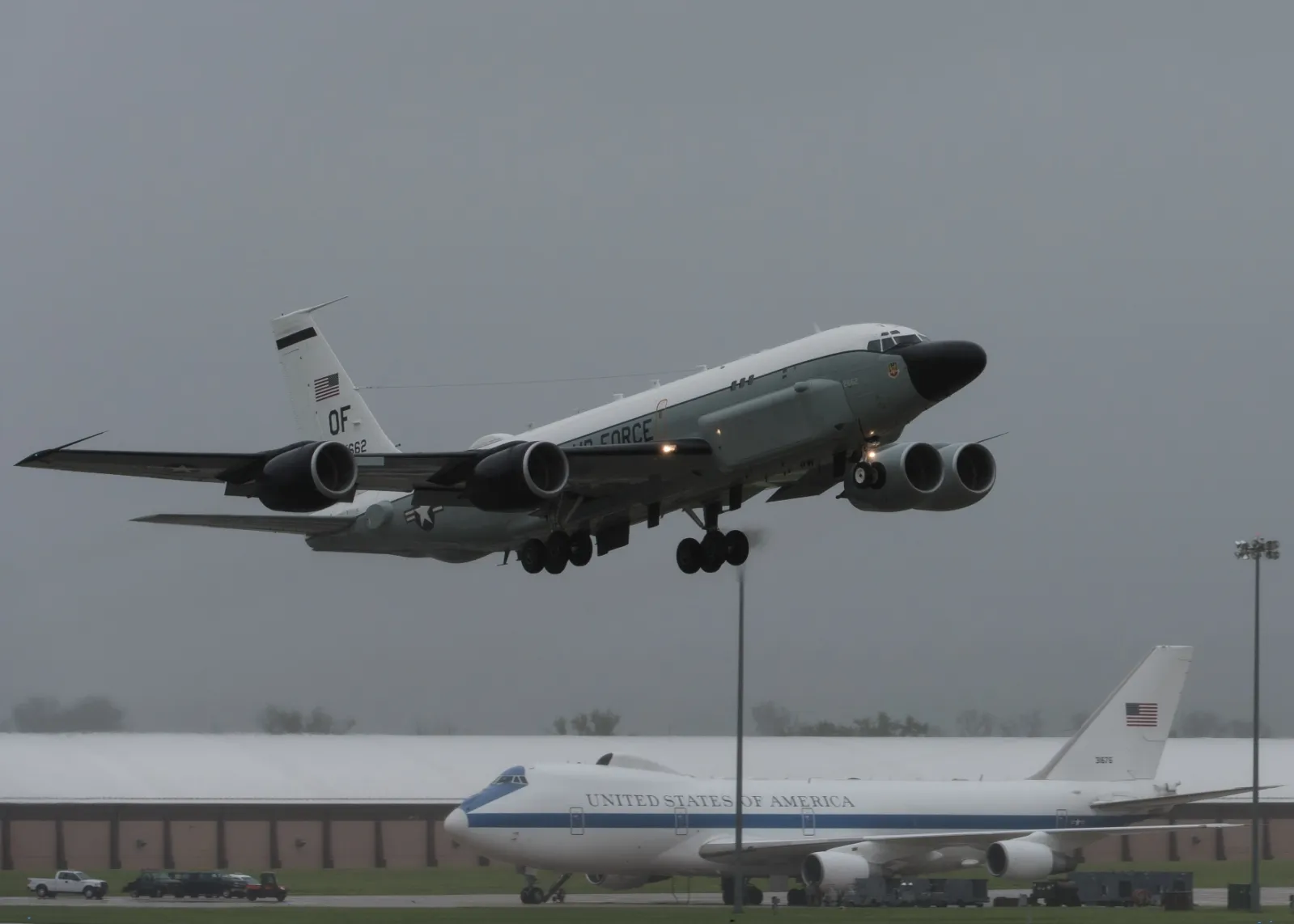
A U.S. Air Force RC-135V Rivet Joint aircraft, with registration number 64-14846, departed Kadena Air Base on Wednesday for a mission over waters between southern Taiwan and the northern Philippines, according to the online service Flightradar24.
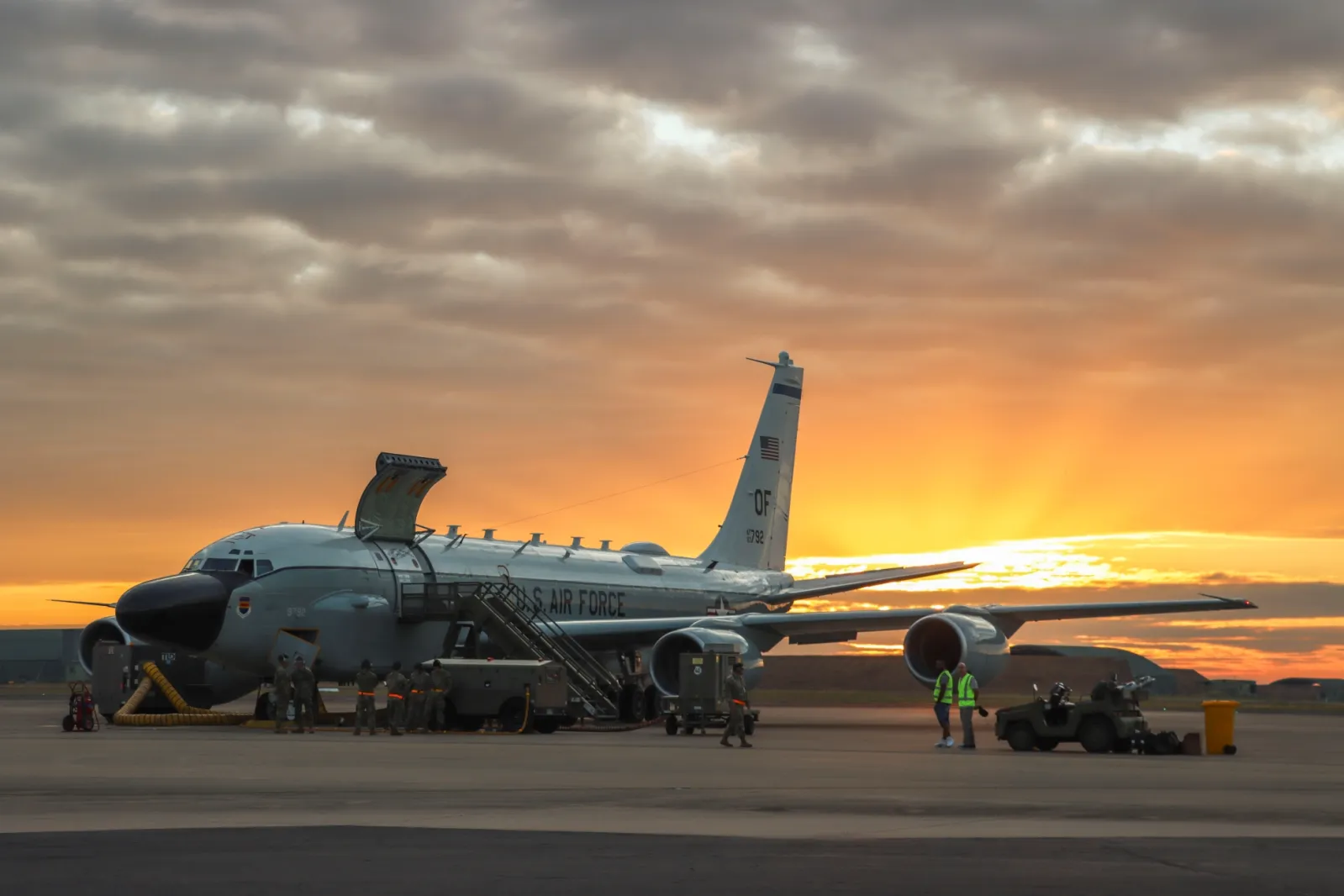
The Rivet Joint is a reconnaissance aircraft designed to "detect, identify and geolocate signals throughout the electromagnetic spectrum," providing near-real-time, on-scene intelligence collection, analysis and dissemination capabilities, the U.S. Air Force said.
...
On Thursday, an RC-135W aircraft, with registration number 62-4135 and also known as the Rivet Joint, flew a similar mission southwest of Taiwan before heading back to the Philippine Sea. It could be tracked until it reached Taiwan's southern waters.
However, Flightradar24 data did not record complete flight tracks for both the 64-14846 and 62-4135 aircraft, as most of their positions could not be located.
Meanwhile, a second RC-135W Rivet Joint, with registration number 62-4130, arrived at Kadena Air Base. It departed its home station at Offutt Air Force Base in Nebraska on Tuesday and made stopovers in Honolulu, Hawaii, and Guam during the flight.
The 62-4130 aircraft is likely on a rotational deployment to Kadena Air Base, replacing the 62-4135 aircraft, which is due to return to Nebraska, said @MeNMyRC1, an open-source intelligence analyst on the social media platform X who tracks U.S. spy planes.
A fourth U.S. reconnaissance aircraft, an RC-135S Cobra Ball capable of collecting optical and electronic data on ballistic missiles, likely concluded its deployment at Kadena Air Base on Thursday when it left Okinawa Island and landed in Honolulu.
The Cobra Ball 62-4128 aircraft had been stationed at Kadena Air Base since mid-December, following a month-long redeployment in Alaska amid possible Russian intercontinental ballistic missile tests, according to @MeNMyRC1's tracking record.
...
What People Are Saying
U.S. Air Force Lieutenant Colonel Michael Ellsworth, commander of the 82nd Expeditionary Reconnaissance Squadron, said: "The 82nd Expeditionary Reconnaissance Squadron delivers multi-domain situational awareness that is critical to all operational decisions in the Indo-Pacific … Our RC-135 Rivet Joint aircrew partner with Kadena-based [intelligence, surveillance and reconnaissance] platforms to provide clarity that allows commanders to anticipate, not react."
The Pentagon's Chinese military power report 2025 said: "As of late 2024, China has conducted multiple unsafe, operationally dangerous actions near allied aircraft over the last year, including reckless maneuvers (i.e., acrobatic maneuvers in close proximity to aircraft), close approaches in the air or at sea, and inappropriately discharging countermeasures (i.e., chaff or flares) in front of or in close proximity to aircraft."
What Happens Next
The U.S. military is expected to continue conducting spy flights across the western Pacific with aircraft deployed at Kadena Air Base. It remains to be seen whether American planes will be intercepted by the Chinese military again when they fly close to the country.
View 0 Comments
Submit Correction
View Editorial & AI Guidelines