10
Loading video...

By Jess Thomson
Science Reporter
0
Share
Newsweek is a Trust Project member
See more of our trusted coverage when you search.Prefer Newsweek on Googleto see more of our trusted coverage when you search.
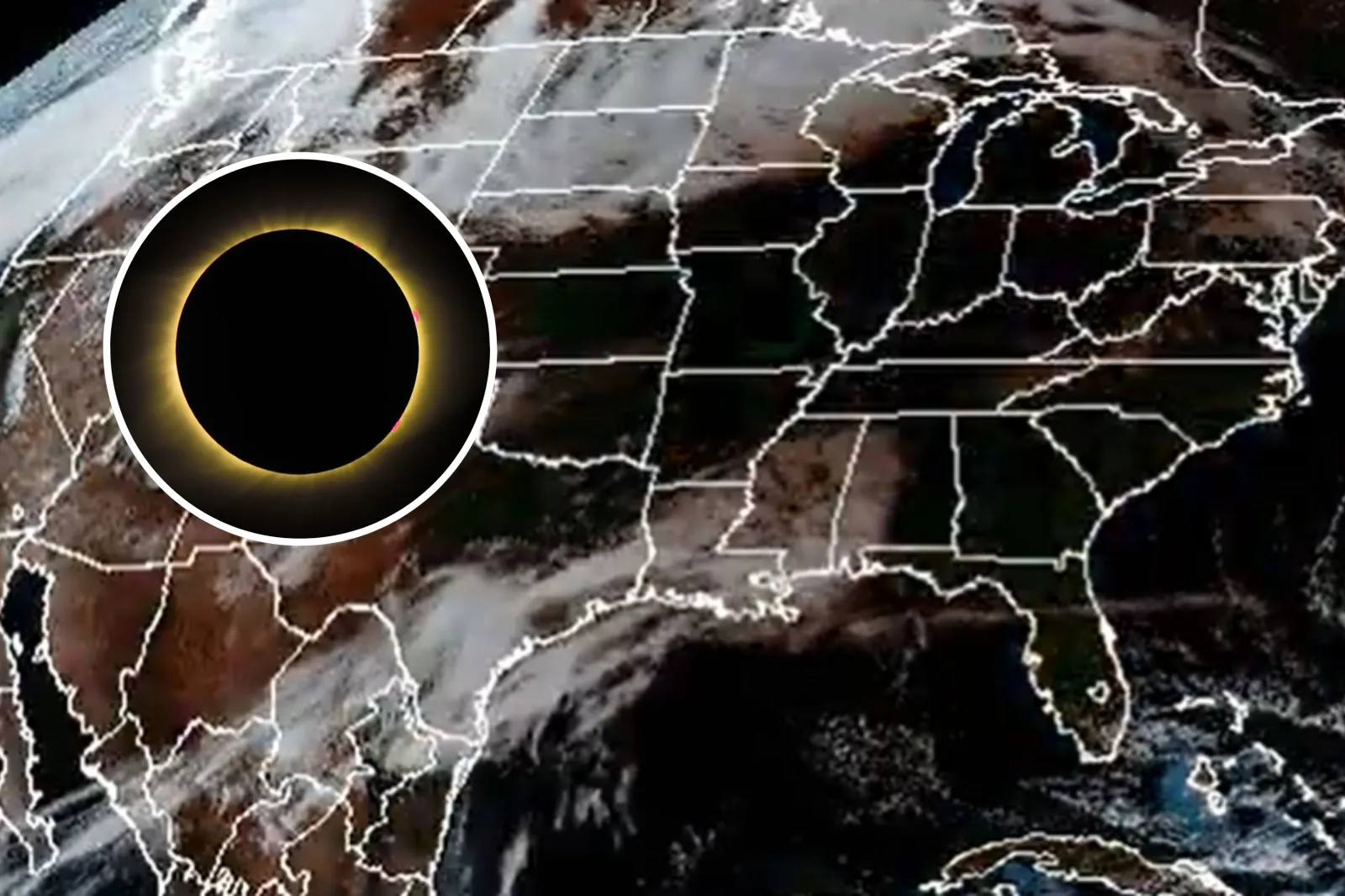
As millions of people across the U.S. looked up to the skies during Monday's solar eclipse, satellites orbiting the Earth caught a glimpse of the moon's shadow sliding across the country.
The April 8 total solar eclipse hit the U.S. over Texas, moving across the Midwest and leaving over New England and Maine, with 32 million people living within the path of the eclipse's totality.
The moon's shadow sped across the country at over 1,500 mph, with NASA and NOAA's GOES-16 satellite spotting the cosmic phenomenon from orbit.
Read More
Alexa Thwarts Monkey Attack on Toddler3 min read

Solar Eclipse to See Citizen Scientists Probe Upper Atmosphere3 min read

Freaky Mass of Gloop Washes Up on Beach3 min read

...
"Here's a look at the moon's shadow on @NOAASatellites GOES East as peak totality occurred this afternoon across the continental US! We hope you all had a safe and enjoyable viewing experience!" NOAA's NWS Northern Indiana posted to X on Monday.
A total solar eclipse occurs when the Moon passes directly between the Earth and the Sun. Total solar eclipses are rare and can only be observed from specific locations on Earth. They occur when the apparent diameter of the Moon is larger than the apparent diameter of the Sun, allowing the Moon to completely cover the Sun's disk.
The path of this year's totality stretched between 108 and 122 miles wide, with each given location seeing the totality for around 4 minutes.
A partial solar eclipse occurs when the moon covers only part of the Sun's disk from the perspective of viewers on Earth, with observers seeing a portion of the Sun covered by the Moon, resembling a crescent. This is also what is seen by viewers outside of the path of totality during a total eclipse, and before and after the moon completely blocks out the sun approaching totality.
"It is important to distinguish between a total solar eclipse and a partial eclipse. If any part of the solar disk is visible during the partial phases of an eclipse, then special solar viewing glasses are required to safely look directly at the Sun," Ryan Milligan, a lecturer in astrophysics at Queen's University Belfast, told Newsweek.
People watching a solar eclipse should wear specially designed eclipse glasses before and after totality, or during a partial eclipse.
"For anyone fortunate enough to be within the path of totality, once the moon FULLY covers the visible solar disk, it is perfectly safe to look directly at the eclipse with the naked eye to witness the pearly white outer atmosphere of the Sun, the corona. You will not be able to see the solar corona through eclipse glasses," he said.
There is a third type of eclipse known as an annular eclipse, which occurs when the Moon is too far from Earth to completely cover the Sun's disk, resulting in a ring of sunlight surrounding the darkened silhouette of the Moon. This usually happens when the Moon is near apogee, the farthest point in its orbit from Earth. Partial solar eclipses are more common than total or annular eclipses and can be observed from a broader geographic area.
The last time the U.S. saw a total eclipse was in August 2017 and the next will be in August 2044.
Do you have a tip on a science story that Newsweek should be covering? Do you have a question about eclipses? Let us know via science@newsweek.com.
View 0 Comments
Submit Correction
View Editorial & AI Guidelines