
...

By Ryan Chan
China News Reporter
0
Share
Newsweek is a Trust Project member
See more of our trusted coverage when you search.Prefer Newsweek on Googleto see more of our trusted coverage when you search.
North Korea showcased its nuclear capability by launching a new intercontinental ballistic missile (ICBM) on Thursday in a test just days ahead of the United States presidential election.
The unidentified ICBM was fired from near the North Korean capital city of Pyongyang at 7:11 a.m. local time, and it flew northeastward to the Sea of Japan, also known as the East Sea in South Korea, where it landed in the water at 8:37 a.m., according to Japan's Defense Ministry and South Korea's Joint Chiefs of Staff, as cited in media reports.
It was the longest-ever flight time for one of North Korea's missiles, with an airborne time of 86 minutes. The nuclear-capable missile traveled 621 miles and reached a maximum altitude of over 4,349 miles, the highest-ever for one of the North's missiles.
Read More on World
State media in North Korea confirmed the launch soon afterward, claiming the ICBM test aimed to demonstrate the "modernity" and "creditability" of the North's strategic deterrent.
Kim Jong Un, the leader of North Korea, vowed that his country would continue to bolster what he called "modern strategic attack forces" and "perfectly round off" the response capability of the nuclear forces, citing the security situation as well as perceived threats and challenges.
"I affirm that the DPRK [Democratic People's Republic of Korea] will never change its line of bolstering up its nuclear forces," said Kim, using the official name of North Korea.
...
According to the state media's report, he described the test as an "appropriate military action," which fulfilled the purpose of informing the North's enemies of its "counteraction will."
During a recent visit to strategic missile bases and an inspection of a Hwasong-18 ICBM, Kim called for maintaining a "counteraction posture" to launch the nuclear missiles promptly.
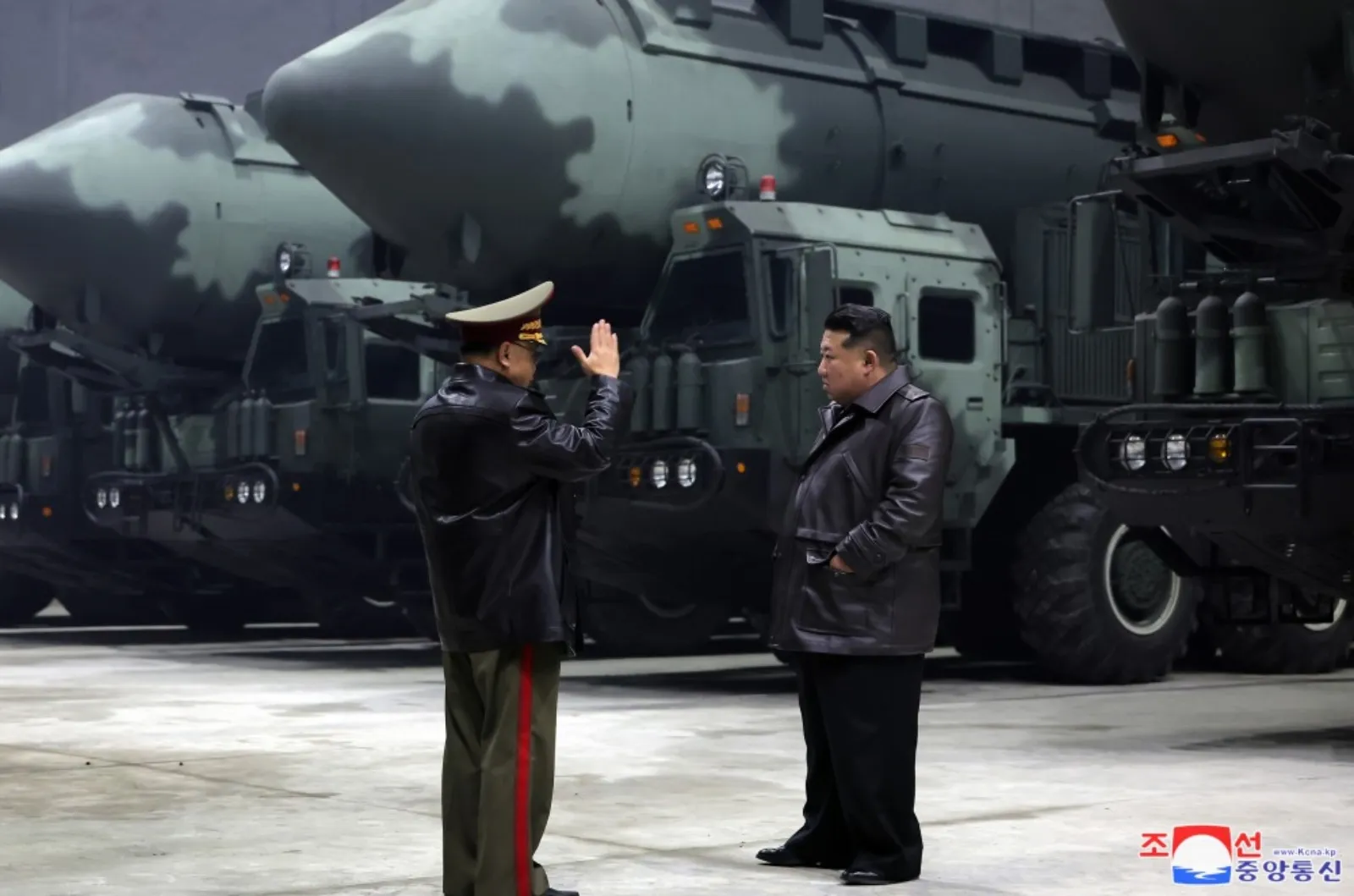
...
Thursday's launch came 10 months after North Korea fired a Hwasong-18 on December 18. A South Korean spy agency on Wednesday issued a warning of a possible North Korean ICBM launch around the U.S. presidential election, which will be held on November 5.
North Korea has pledged that neither Vice President Kamala Harris nor former President Donald Trump, who was the first sitting U.S. president to meet with a North Korean leader in 2018, would make it give up its nuclear weapons after becoming the next president.
The Stockholm International Peace Research Institute estimated that North Korea has roughly 50 nuclear weapons and has publicized five types of ICBMs, including the Hwasong-18, which is capable of striking the continental U.S. and has an estimated range of 9,320 miles.
There is a possibility that North Korea has launched a new solid-fuel long-range ballistic missile, a spokesperson for the South Korean military said in Seoul. Gen Nakatani, Japan's defense minister, also came to the same conclusion as he briefed reporters in Tokyo.
The missile launched on Thursday traveled on a steep vertical path, also known as a lofted trajectory, which is a common practice for North Korea as this technique can avoid the sovereign airspace of other countries when testing the missile's capability.
Although the observed range of the missile has shortened, the energy used to get to the apex of its trajectory indicated the missile's potential reach, Reuters previously reported.
The maximum altitude reached by the new North Korean ICBM is far higher than the International Space Station, which orbits Earth daily at 248 miles above the surface.
Update 10/31/24, 06:52 a.m. ET: This article has been updated with more details on the launch.
View 0 Comments
Submit Correction
View Editorial & AI Guidelines