
Photo-Illustration by Newsweek/Getty/Associated Press

By Jesus Mesa
Reporter
0
Share
Newsweek is a Trust Project member
See more of our trusted coverage when you search.Prefer Newsweek on Googleto see more of our trusted coverage when you search.
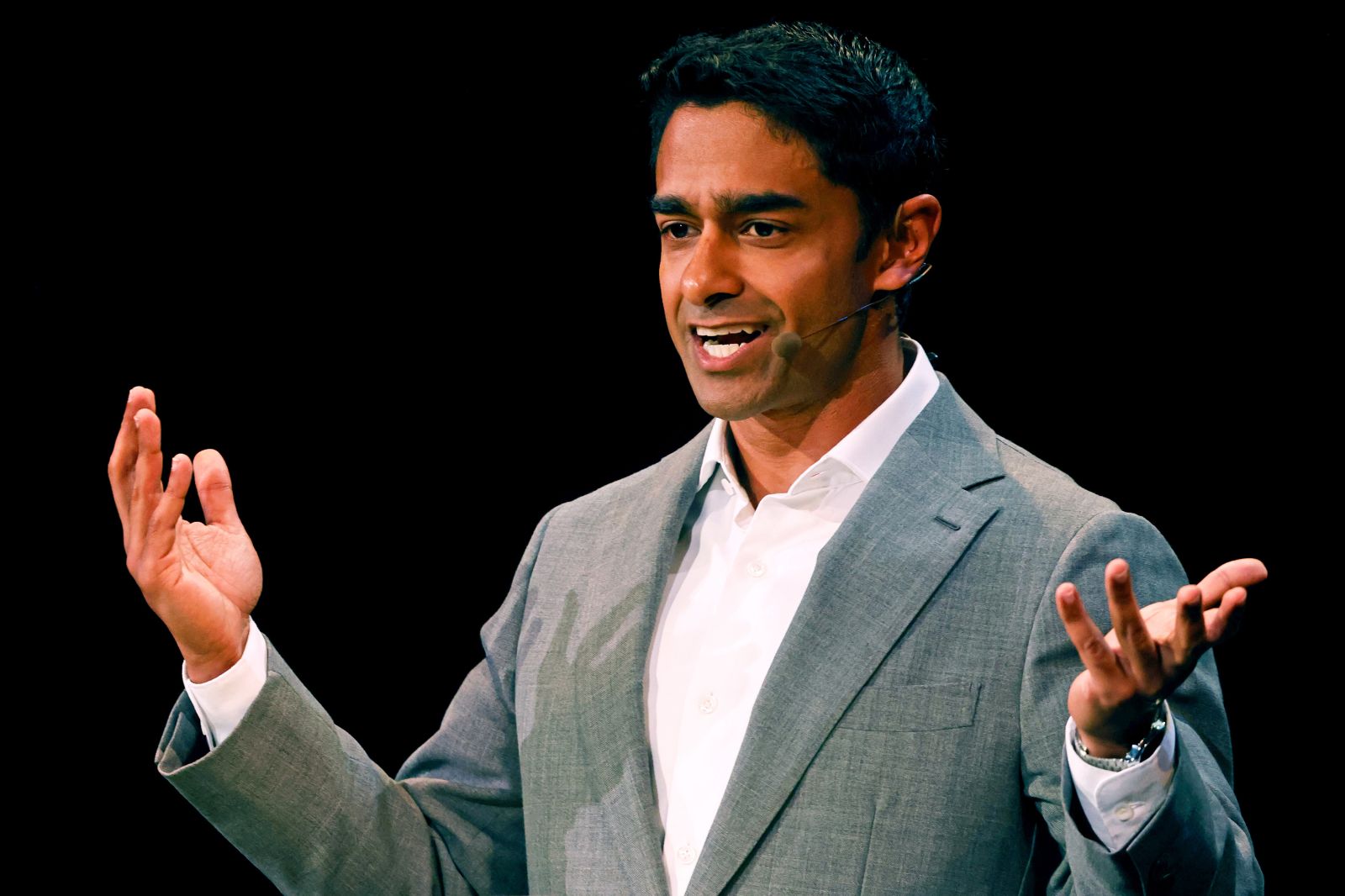
Nancy Pelosi spent 34 years representing San Francisco in Congress, becoming the first female Speaker of the House and emerging as one of Donald Trump's fiercest rivals. That seat is up for the first time in a generation, and Saikat Chakrabarti wants it.
Chakrabarti is a centimillionaire. Worth at least $167 million from his time as a founding engineer at Stripe, he could simply cash out and disappear. Instead, he ran into politics, becoming the former chief of staff to Alexandria Ocasio-Cortez and co-founder of Justice Democrats. Now he wants to reshape the Democratic Party from within.
His ambitions stretch far beyond San Francisco. He's organizing primary challenges to top Democrats, including House Minority Leader Hakeem Jeffries and Senate Minority Leader Chuck Schumer. He's laying groundwork for a progressive primary challenge strategy ahead of 2028. And he's framing it all around a single conviction: the Democratic Party is so out of step with voters that it polls lower than President Donald Trump among its own base.
Read More on Politics
In a sweeping conversation with Newsweek, Chakrabarti says he's running for Pelosi's seat not as an homage but as a rejection—the opening move in a larger campaign to remake Democratic leadership from the inside.
The Collapse of Democratic Power
Trump is unpopular. But that doesn't mean Democrats are winning. Recent polling from CNN/SSRS shows only 28 percent of Americans view the Democratic Party favorably, compared to 32 percent who view Republicans favorably. Nearly 71 percent have little to no confidence in the party at all.
For Chakrabarti, the party is unpopular because its leadership has failed.
"If we don't change the Democratic Party, we are going to keep losing elections, and we're not gonna be able to do anything for people," Chakrabarti said. "The one thing people don't like more than Donald Trump is a feckless and ineffective leadership in the party."
...
The numbers support his diagnosis on voter priorities. Anti-corruption measures such as banning congressional stock trading and closing the revolving door between Congress and lobbying polls at around 90 percent across party lines. Only 3 percent of Democrats want a larger military budget. Yet Democrats recently passed a $900 billion defense budget with 115 party members voting in support.
"They believe they have no power and that's not true," Chakrabarti said. "There are points of leverage where the Democrats can put up a real fight. There are areas where they can make an issue."
The damage runs deeper than opposition voters. Among Democrats, a December Quinnipiac University poll found that just 42 percent approve of how their party’s members in Congress are handling their jobs, down from 58 percent in October. Schumer’s standing is especially weak. The New York senator has a net minus-32 favorability rating among the public overall and a net minus-4 rating even among Democrats.
Chakrabarti points to concrete failures. In January, Border Patrol agents shot and killed Alex Pretti, a 37-year-old ICU nurse, in Minneapolis. Footage showed he was holding only a cell phone. Two weeks earlier, an Immigration and Customs Enforcement (ICE) officer shot Renee Good. The killings sparked national outrage and cost Homeland Security Secretary Kristi Noem her job.
Polling showed 62 percent of voters said Pretti's shooting was unjustified. Support for ICE cratered.
"That would have been the moment for Democrats to capture that national attention, hold the line on not just ICE funding, claw back the money to ICE and then use that national attention to win the battle of public opinion," he said. "But instead what they did is they kicked the can down the road for two weeks, passed a temporary funding measure. By that point, national attention had moved on."
The most recent government shutdown, he says, exemplifies what he calls “learned helplessness.” Years of losing to Republicans have convinced Democratic leaders they can’t win, so they don’t even try. Some believe their Republican colleagues will eventually come back to the table. Chakrabarti calls that a fantasy.
"Donald Trump has taken control of that party and Donald Trump is leading that party in a very dark direction," he said.

...
The deeper failure isn't tactical. Democratic leadership built an entire politics around opposing Trump rather than offering voters a reason to support Democrats. There's no positive vision. There's no compelling agenda. There's just "we're not that bad."
"It's not enough to run an anti-Trump campaign. You have to give people a positive vision of why they should vote for Democrats," Chakrabarti said.
The San Francisco Fight
Chakrabarti's insurgency hasn't come without sharp criticism. His main opponent in the San Francisco race, state Senator Scott Wiener, has launched sustained attacks on Chakrabarti's residency and voting history. He's argued that Chakrabarti didn't vote in San Francisco for nearly a decade, that he voted in New York while working for Ocasio-Cortez, and that he previously listed a $1.6 million Maryland home as his residence.
"On the Maryland home, that's just a lie. Like, I've never actually lived in Maryland. I bought my parents a home in Maryland and I never lived there," he said. "This is honestly the kind of politics that San Franciscans are sick of, because my opponent knows it's a lie. I mean, I've met Scott Wiener several times over the last several years. He knows I've never lived there, but he's willing to lie anyway."
As of early 2026, Wiener leads in both polling and fundraising. He has raised $2.8 million, compared with Chakrabarti's $1.8 million (mostly his own money) and San Francisco Supervisor Connie Chan's $175,000. Wiener holds the endorsement of California Attorney General Rob Bonta and the state Democratic Party. An October 2025 poll showed Wiener at 61 percent favorability, the highest among potential candidates.

...
But Chakrabarti has seized on the attacks to reframe the race. Abundant Future, the super PAC backing Wiener, is funded by Trump donors, crypto billionaires, and tech CEOs, he argues. The group's top donors are crypto billionaire Chris Larsen ($100,000) and Y Combinator CEO Garry Tan. The argument plays into Chakrabarti's larger narrative about pay-to-play corrupt politics.
Yet funding hasn't been the only fault line. On Israel and Gaza, the race has become a lightning rod issue. At a January debate, the three candidates were asked during a rapid-fire round whether Israel is committing genocide in Gaza. Chakrabarti and Chan both answered yes. Wiener refused to answer, prompting boos from the audience. After the backlash, Wiener changed course, posting a video saying, "I do believe Israel has committed genocide in Gaza."
But Chakrabarti seized on the moment as evidence of Wiener's unwillingness to take clear stances. "Because you can't call out a genocide when the whole world sees one," Chakrabarti said, "how can we trust you in D.C.?"
Yet, while recent polling suggests Chakrabarti's position aligns with Democratic voters, with NBC News polling showing 65 percent of Democrats now say their sympathies lie more with Palestinians than Israelis, only 34 percent of Democratic primary voters say Israel will be a factor in their 2026 vote.
Why Bernie Lost but His Message Might Win
Bernie Sanders ran twice on economic populism and lost twice. In 2016, primary voters chose Hillary Clinton. In 2020, they wanted to remove Trump and thought Biden was the safer choice. Chakrabarti doesn't think Bernie lost the argument. He thinks Democratic primary voters lost their nerve.
"The thing is, when you go through a Democratic primary, a lot of what Democratic primary voters are voting on is their belief of who can win," he said. "I do believe Bernie Sanders would have been able to win a general election in 2016 or in 2020."
What's driving this shift is a broader rejection of politics as usual on both sides. A recent NBC News poll found that 56 percent of Democratic primary voters prefer a candidate closest to their views on the issues, while only 42 percent want a more electable candidate. This mirrors a broader trend: 45 percent of U.S. adults now identify as independents. Voters are exhausted with establishment promises and incremental change.
"Voters are very open to what economic change looks like. You see from people voting for Obama, then Trump, and then Biden, then Trump," Chakrabarti said. "They just know that the status quo is simply not cutting it."

...
Since 2016, Sanders has pointed at billionaires and tech moguls, but for a San Francisco hopeful, this cuts deep into the city's core. Asked how he could manage the tension between his wealth and his message on inequality, Chakrabarti distinguishes between the CEO and venture capital class that has aligned with Trump—people like Elon Musk and Peter Thiel, whom he calls "grifters"—and tech workers who want technology used for good.
"Technology is being used to just consolidate wealth and power into the hands of a few at an increasingly alarming rate," he said.
Chakrabarti also acknowledges that the progressive wing of the Democratic Party hasn't had real power since it gained national attention. But he sees that changing. If a dozen progressives enter Congress in 2026 with a clear vision and a willingness to challenge their own leadership, Chakrabarti believes they can force votes on popular issues, such as banning congressional stock trading and building political capital for a transformative agenda.
"By fighting on those issues, by going up against not just Republicans, but our own party leadership to force votes on those issues, we will be able to build up political capital," he said. "That is what I'm going to use to try to help recruit a larger movement going into 2028."
He's also clear about what a Democratic Congress should do if it wins back power: impeach Trump, hold the administration accountable, and advance a substantive legislative agenda simultaneously. No revisionist politics, no blaming Trump for Democratic failures.
"We have to impeach Trump. The things he's done, the things he's said, are clearly impeachable offenses," he said. "And I believe if Democrats go in with the House and the Senate and they don't hold this administration accountable, they will lose the support of voters who put them in there."
View 0 Comments
Submit Correction
View Editorial & AI Guidelines