
By Jess Thomson
Science Reporter
0
Share
Newsweek is a Trust Project member
See more of our trusted coverage when you search.Prefer Newsweek on Googleto see more of our trusted coverage when you search.
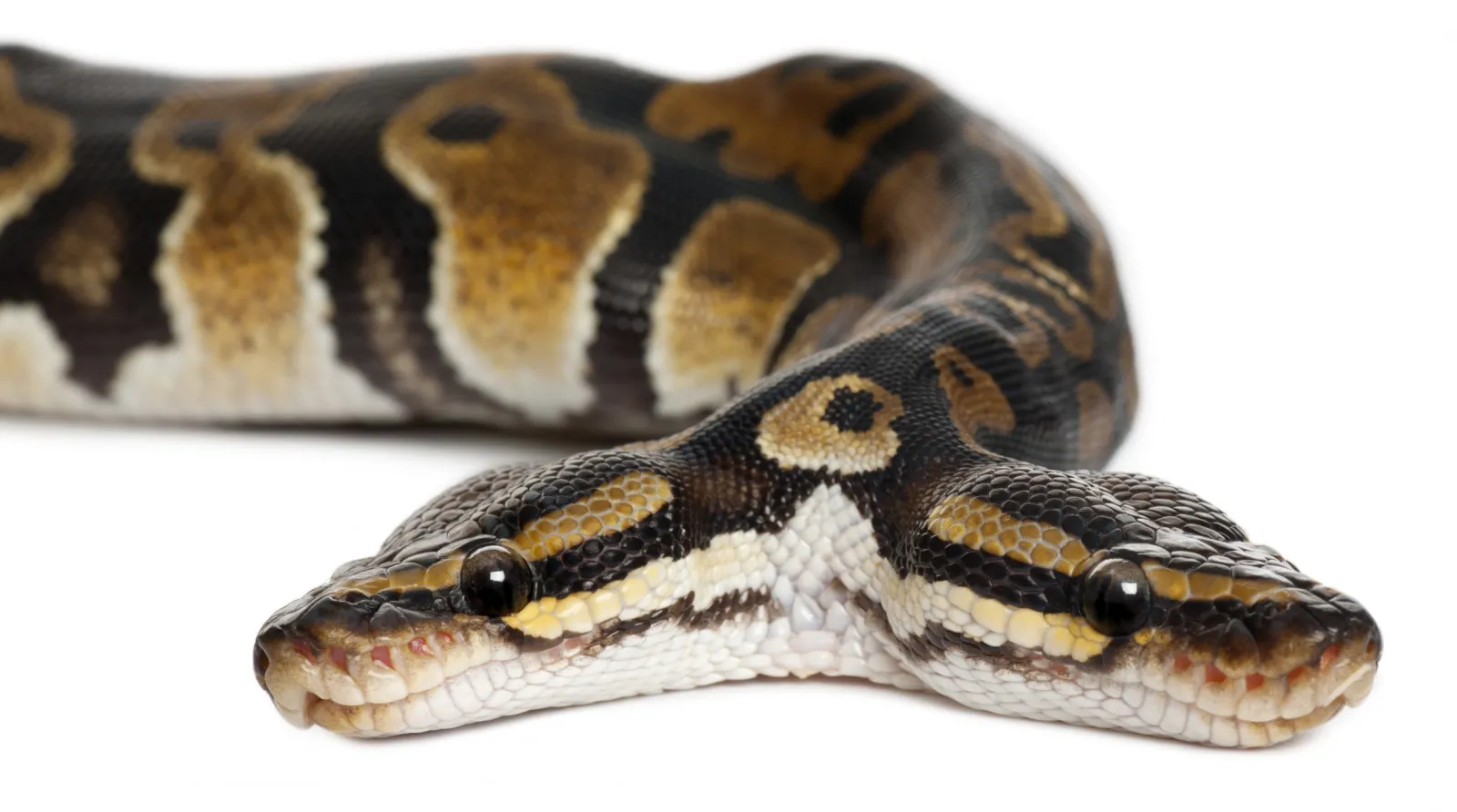
An extremely rare deformed snake with two heads has been found in the wild.
Animals that are born with two or more heads have a condition called polycephaly, which is more common in reptiles than in mammals. One possible cause of this condition is if the embryo doesn't entirely complete a division. Alternatively, two separate embryos may fuse together incompletely, creating the Orthrus-like creature.
A 2013 paper in the Journal of Comparative Pathology found that from a sample of 4,087 pit viper hatchlings, only three hatched with two heads.
Read More
For Every Burmese Python You See, There Are 100 to 1,000 You Don’t: Expert4 min read

‘Cheeky’ Baby Mamba Found by Washing Machine in South Africa Home3 min read

Giant Florida Burmese Python Had Hoofs in Stomach and Was Carrying 122 Eggs3 min read

Nick Evans, a South Africa-based snake rescuer, was asked to collect the two-headed Southern Brown Egg-eater—a harmless species—from a man who had come across the snake in his garden.
The man, who lives in Ndwedwe, a town north of Durban, didn't want anyone to harm the strange creature, so he put it in a bottle and asked Evans to take it away to safety.
There are cases of two-headed snakes that have hatched in captivity and occasionally in the wild, but it's very rare.
...
"It was such a strange sight, seeing this deformed snake," said Evans in a Facebook post. "It's a juvenile, around [a foot] in length. It was quite interesting to see how it moved. Sometimes, the heads would try to go in opposite directions from one another, other times, it would rest one head on the other. That seemed the most effective way of moving."
Animals with polycephaly do not often survive for very long, depending on the degree to which the two heads are split. Two heads with two different stomachs are more likely to fight over prey and starve than if the snake has just one stomach. However, one organ working across two bodies will put the animal under undue stress, which can reduce its lifespan.
According to Evans, the unique snake is now safely in professional care. He was surprised it had even survived up to the point he found it.
"There is no point releasing it. As far as I am aware, they don't generally live long. This one wouldn't last long at all in the wild. It can barely move, and when it does, it does so incredibly slowly. Very easy pickings for a predator."
Commenters on the Facebook post were glad to hear that the snake had been taken to safety.
"Poor thing. So grateful that it's safe," said one comment.
View 0 Comments
Submit Correction
View Editorial & AI Guidelines