...

By Maria Azzurra Volpe
Reporter
0
Share
Newsweek is a Trust Project member
See more of our trusted coverage when you search.Prefer Newsweek on Googleto see more of our trusted coverage when you search.
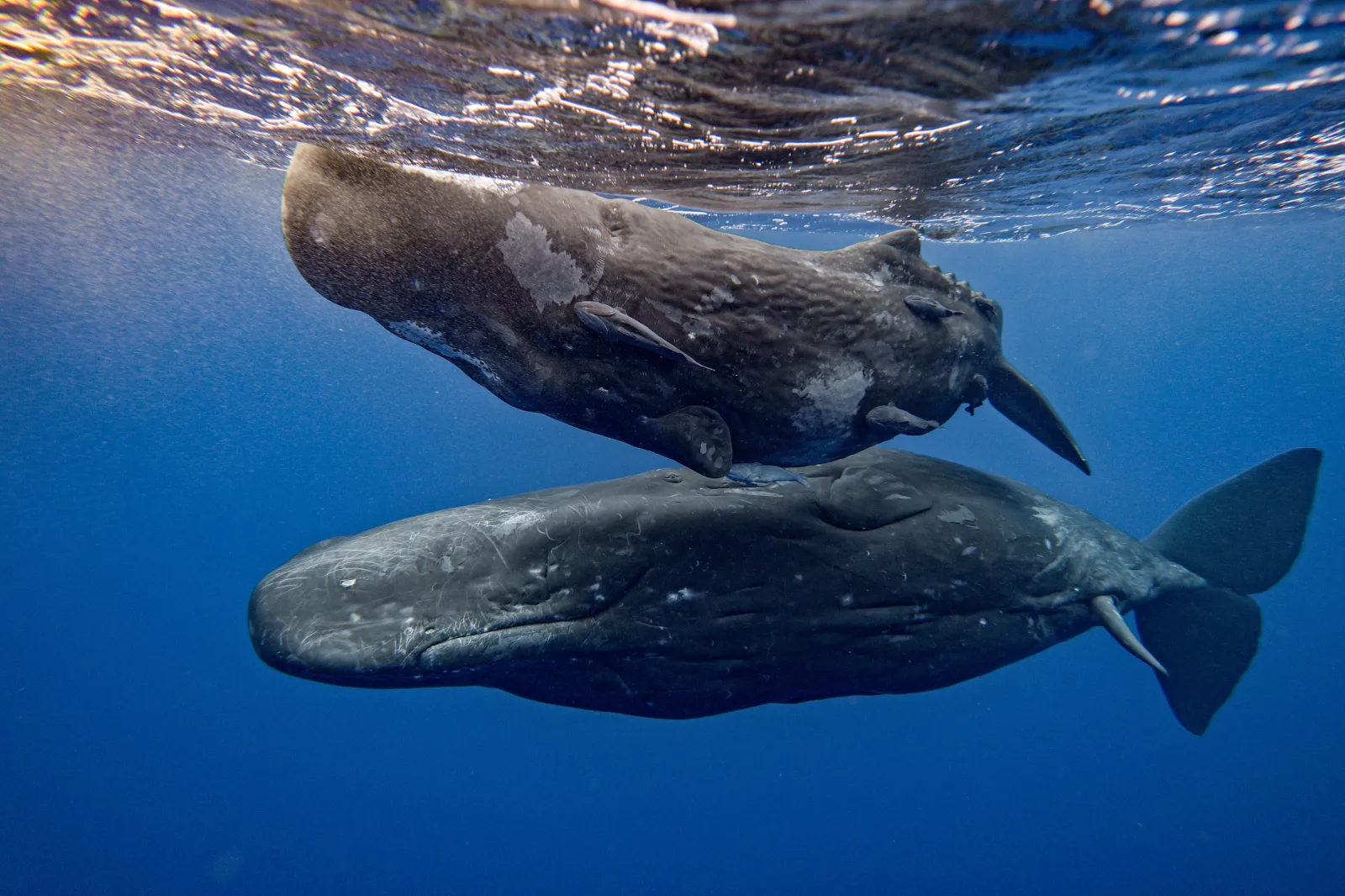
Sperm whales have been filmed headbutting each other for the first time ever, confirming 19th century reports of whales striking and sinking ships—accounts which helped inspire Herman Melville's 1851 novel Moby-Dick.
The behavior was captured by researchers from the University of St Andrews using drone footage taken during fieldwork in the Azores and Balearic Islands between 2020 and 2022.
While sailors have long claimed that sperm whales use their heads to strike ships, this is the first time that this behavior has actually been recorded and analyzed.
Read More on Science
In the footage, the whales can be see deliberately pushing and hitting one another with their heads.
Surprisingly, the interactions involved mainly younger whales on the cusp of adulthood – rather than large aduly males, as was previously hypothesised.
...
“It was really exciting to observe this behaviour, which we knew had been hypothesised for such a long time, but not yet documented and described systematically," said paper author and ecologist Alec Burlem in a statement.
The findings are raising questions about the purpose of this behavior. There is speculation as to whether the headbutting may have originated from physical contests between sperm whales.
It has also been hypothesised that this behaviour may be a widespread part of male–male competition among the large marine mammals, but normally occurs under the surface and is therefore difficult to observe from boats.
Some researchers have argued that habitually using the head as a weapon was unlikely to have been favoured by evolution, as it would endanger structures in the head which are vital for producing the sounds used for echolocation and social communication.
However, historical records have long hinted that sperm whales are capable of powerful head strikes. One of the most famous accounts is the whaleship Essex, which sank in 1820 after being hit by a whale—the event that influenced Herman Melville’s novel Moby Dick.
Owen Chase, the ship’s first mate, wrote in a report: "I turned around and saw him about one hundred rods [approx. 546 yards] directly ahead of us, coming down with twice his ordinary speed of around 24 knots, and it appeared with tenfold fury and vengeance in his aspect.
“The surf flew in all directions about him with the continual violent thrashing of his tail. His head about half out of the water, and in that way he came upon us, and again struck the ship."
Other ships, including the Ann Alexander and Kathleen, were also reportedly sunk during similar encounters.
Researchers say that more observations are needed to understand the full significance of the behavior, though advances in drone technology are expected to make it easier.
Burlem, now based at the University of Hawaii, added: “This unique overhead perspective for observing and documenting near-surface behaviour is just one of the ways drone technology is transforming the study of wildlife biology.
“It’s exciting to think about what as-yet unseen behaviours we may soon uncover, as well how more headbutting observations may help us to shed light on the functions the behaviour may serve. If there are people out there with similar footage, we would be very keen to hear from them”.
Do you have a science story to share with Newsweek? Do you have a question about sperm whales? Let us know via science@newsweek.com.
Reference
Burslem, A., Cerdà, M., Brotons, T., Rendell, L., Silva, M. A., & Prieto, R. (2026). Headbutting Behavior Between Sperm Whales Documented Using Unoccupied Aerial Vehicles. Marine Mammal Science, 42(2). https://doi.org/10.1111/mms.70153
View 0 Comments
Submit Correction
View Editorial & AI Guidelines