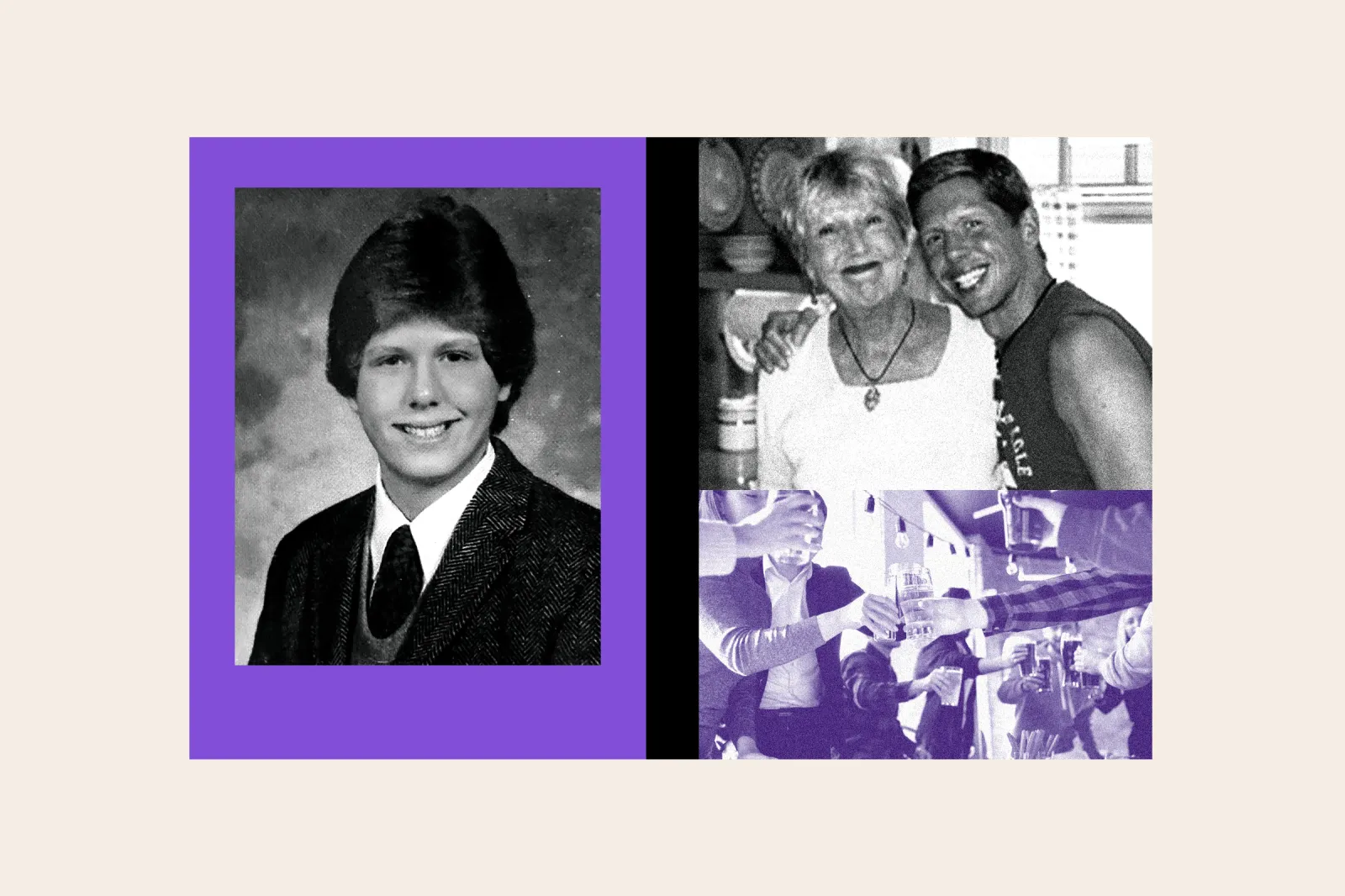
Photo-illustration by Newsweek/Getty/Courtesy of Wade Rouse

By Wade Rouse
0
Share
Newsweek is a Trust Project member
See more of our trusted coverage when you search.Prefer Newsweek on Googleto see more of our trusted coverage when you search.
Forty years ago, The Golden Girls first premiered on TV.
At that time in the fall of 1985, I was—on the surface—your stereotypical fraternity boy, just like the shirtless guys you see screaming every Saturday in the stands of college football games: I could chug a keg beer (often upside down), I was addicted to sports and MTV, I feathered my hair, I pulled all-nighters, I ate Domino’s Pizza at midnight.
The Golden Girls was not meant for a 19-year-old guy like me. I mean, four old women living together in a pink house in Florida versus 40 guys packed into a fraternity house?
Read More on My Turn
I Had Parental Controls on My Daughter’s iPad. An ‘AI Friend’ Still Found Her7 min read

My Neck Hurt After a Massage. 10 Days Later Terrifying Truth Was Revealed7 min read

I Gave My Nephews a Bow and Arrow for the Holidays—With One Condition. I Didn’t Expect Their Reaction7 min read

C’mon.
But it turns out Dorothy, Blanche, Rose and Sophia had a lot to say to a kid who was not only struggling to find his place in the world but also hiding a big secret: I was gay.
And despite the fact that I was the life of the party, I wanted to end my life.

...
Just a few years earlier, I decided to bury my secret just as I had buried by my older brother, Todd, who had died in a tragic accident. My brother was a true country boy who I believed would have given my parents everything they wanted: a daughter-in-law, grandchildren, a normal existence.
I believed God had made a mistake when my brother died. My life should have been taken instead. As a result, I believed the rest of my life should be dedicated to not creating another moment of pain for my parents and grandparents. They did not deserve that.
So I put on a mask and played pretend.
I had not wanted to go to college and leave my mother and grandmother alone. I was their best friend, and they were mine, but they both pushed me out of the nest and our small town, telling me a bigger world was waiting for me and my gifts.
Every two weeks, my working, poor grandmother would write me a letter (remember those?) with $20 inside. Every Sunday, my mother would call me on the pay phone (remember those?) at the end of the dormitory hall.
But the most profound way I bonded with my mother and grandmother in college was by watching The Golden Girls long distance with them, as I write about in my new novel, That’s What Friends Are For. I remember some sorority friends and little sisters in my fraternity talking about the show, and one Sunday I asked my mother and grandmother if they were watching it. They were. Of course. So, on Saturday evenings before the fraternity parties started, I’d stretch the cord of the rotary phone (remember those?) on the wall in the fraternity house until it snaked into my room and watch the show with the two women I loved most in the world, our laughter crossing the miles.

...
Though I didn’t realize it at the time, that sitcom bridged a cavernous divide between generations. It allowed me to see my mother and grandmother in a new light. It allowed them—eventually—to understand and accept me.
What was it about The Golden Girls? What could four old women say that would resonate with a 19-year-old boy struggling to find his place in the world?
Plenty, it turns out.
Because we were the same in so many ways: ostracized and overlooked. Diminished by society. Our voices and worth dismissed. Unloved by the world, due to age, status, power, shame, sexuality.

...
In fact, my mother referenced an episode of The Golden Girls after I came out. That particular show—which I also reference in the novel—centers on a friend of Dorothy’s who tells her she is gay. Dorothy, wrestling with that news and unable to sleep, wakes up her mother, Sophia.
Dorothy: “How would you react if you were told one of your kids were gay?”
Sophia: “Your brother Phil is gay? I knew it! When he was a kid we couldn’t keep him away from those Gladiator movies.”
Dorothy: “Ma, Phil is not gay.”
Sophia: “You mean you’re gay? What, your friend Jean is having some sort of membership drive?”
Dorothy: “Ma.”
Sophia: “Dorothy, I know you don’t get many dates, but stick with what you know! At your age, it’s very hard to break into something new. Good night.”
Dorothy: “Ma, I am not gay. I just wanted to get your reaction.”
Sophia: “I’ll tell you the truth Dorothy, if one of my kids were gay, I wouldn’t love him one bit less. I would wish him all the happiness in the world.”
I realized that when you laugh, you learn. You cannot preach at people. Laughter must bridge the divide. Then, and only then, can we begin to see each other.
One of the first times I ever went to a gay bar, it shut down its music promptly at 8 p.m. to play The Golden Girls.
At 8:30, the music came back on.
Community.
The gays and The Golden Girls were forced to find found family. Our individual strengths made each other stronger. Old women and the gay community, it turned out, were exactly the same.
The Golden Girls—like *That’s What Friends Are For—*is all about community, be it the family you’re born into or the one you create. It’s about friends who challenge you and complete you.

...
The novel is about what I call “living in drag,” much as I once did. We all don masks to present a certain image to society and those we love: Perhaps it is to play the part of the perfect mom or dad, the child who doesn’t want to disappoint, the spouse who puts on a smile every day despite being deeply unhappy. We do this to play a role we believe we are expected to play in society, and yet that is not truly who we are.
Age, life, loss, hate, honesty allow us to rip those masks off and be ourselves. But it takes a lot to overcome that fear that holds us hostage and keeps us playing pretend to the world.
Our elders and the gay community have gone through so much, and they no longer have to play any games. And that transparency—be it Pamela Anderson without makeup, or a drag queen in lots of makeup—is shocking to a large part of the population that has never been able to be honest with itself.
This book, like the sitcom, is painfully funny: It’s about how humor connects us, knocks down walls of hatred, brings people closer or keeps them at a comfortable distance. My elders were some of the funniest people I’ve ever known—their laughter eased their pain and hard lives—and so is the gay community, which has overcome hatred of society and self, as well as isolation, to find our friends, and use our voices and humor to change the world. Why are gay men funny? The same reason The Golden Girls were. We’ve been hurt, over and over and over again, and yet we refuse to give into that pain. We reclaim our voices through humor. It gives us strength. We understand that our commonality is found via laughter.

...
The Golden Girls tackled huge issues during its time on air—aging, family dynamics, friendships, LGBTQ+ issues, the search for meaning after marriage and children, mortality, fidelity, racism, depression, the HIV-AIDS crisis—and it did it all with humor. It’s what I’ve done my entire existence in life and writing: Lessen the pain with laughter. Teach and break down walls with humor.
The Golden Girls is still considered one of the most progressive shows ever to air on television, even decades later. The show enjoyed an epic rebound—ironically—during COVID, when so many younger people discovered the show as a way to understand what their isolated elders—many of whom would sadly die—were going through. They watched it together, as I did some 40 years earlier with my mom and grandma.
Great TV, like great books, connects us. The characters become our friends.
Though my mother, grandmother and The Golden Girls are all now gone, their memories and the show—with its legacy of humor, heartbreak and honesty—lives on.
Dorothy, Rose, Blanche and Sophia will forever be our friends, and isn’t that all we all truly seek in this world? A friend who will be there for us when we need them most.
Wade Rouse is a bestselling author whose new book, That's What Friends Are For*, inspired by* The Golden Girls*, comes out March 3, 2026.*
View 0 Comments
Submit Correction
View Editorial & AI Guidelines