...

By Sam Stevenson
Associate News Editor
0
Share
Newsweek is a Trust Project member
See more of our trusted coverage when you search.Prefer Newsweek on Googleto see more of our trusted coverage when you search.
California’s wide-open gubernatorial race is entering a volatile final stretch ahead of the June 2 primary, with no candidate close to locking in a spot in November’s runoff, according to a new poll.
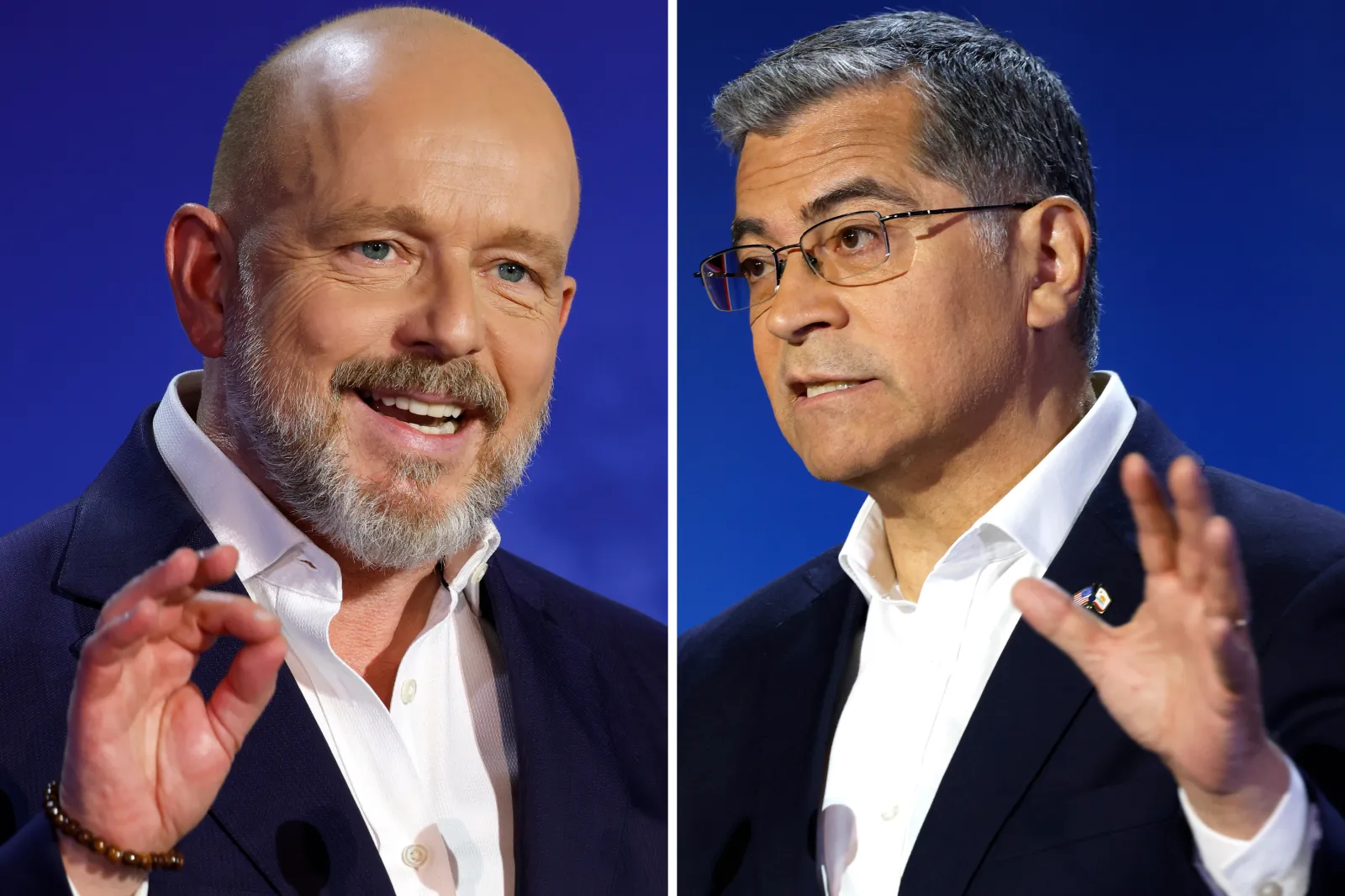
A new Public Policy Institute of California (PPIC) statewide survey shows Democrat Xavier Becerra leading the field with 23 percent support among likely voters, followed closely by Republican Steve Hilton, who has been endorsed by President Donald Trump, at 20 percent, with several other candidates in striking distance.
Referencing his Republican rival, Chad Bianco, Hilton told Newsweek in an emailed statement on Thursday morning: "This poll shows that the Doomsday scenario for California, two Democrats, in the top two—is still a very real possibility thanks to the split in the Republican vote."
"Chad Bianco obviously cannot make the top two, but unless Republicans now get behind the only change candidate with a realistic path to the general election, Californians could be denied the chance to vote for the change this state so desperately needs after 16 years of one-party rule that have given us the highest poverty rate, highest unemployment rate, and highest cost of living in America."
Read More on Politics
However, prediction market data suggests a different outlook for November, with traders overwhelmingly favoring a Democratic candidate to win the governorship.
Newsweek reached out to the other leading campaigns for comment via email outside of regular working hours on Thursday morning.
Key Points
- Five candidates are polling in double digits, increasing uncertainty
- The race is shaped by California’s "top-two" primary system
- Democratic voters are split across multiple candidates; Republicans are more consolidated
- Small shifts in turnout or late movement could decide who advances
Who Is Running?
With Governor Gavin Newsom term‑limited and leaving office, a crowded and ideologically diverse field of candidates has taken shape in the race to succeed him.
The leading candidates in the race include:
- Xavier Becerra (Democrat): Former U.S. health secretary
- Steve Hilton (Republican): Businessman, ex-Fox News host, and director of strategy for former British Conservative Prime Minister David Cameron from 2010 to 2012.
- Tom Steyer (Democrat): Billionaire investor and climate activist
- Chad Bianco (Republican): Riverside County sheriff
- Katie Porter (Democrat): Former U.S. representative
Several other candidates remain on the ballot, but polling suggests these five form the top tier.
How The Top-Two Primary Works
California uses a "top-two" primary system, sometimes called a jungle primary, in which all candidates appear on the same ballot regardless of party.
The two candidates who receive the most votes advance to the general election, even if they belong to the same party.
That creates two key dynamics: parties can be locked out of the general election entirely, and candidates do not need majority support—only enough to finish in the top two.
With a fragmented field and a top-two system, even small polling shifts could reshape which candidates advance to November.
Campaigns must now focus on consolidation rather than broad appeal, as vote-splitting—particularly among Democrats—could determine the final two.
...
Why It Matters
This race is less about who leads outright and more about who can survive the cutoff into the top two.
In a crowded field, candidates can advance with relatively modest support, turning the election into a contest shaped by vote distribution rather than traditional majority coalitions.
What To Know
A new PPIC Statewide Survey, conducted May 14—18, 2026, was based on interviews with 1,707 California adults, including 986 likely voters who form the basis of the gubernatorial results. Interviews were conducted online via Ipsos KnowledgePanel in English and Spanish.
Among those likely voters, Becerra led with 23 percent, followed by Hilton at 20 percent.
Steyer received 15 percent, Bianco 13 percent, and Porter 12 percent—placing five candidates within an 11-point range.
The margin of error for the likely voter sample is plus or minus 4.1 percentage points, meaning the three-point gap between Becerra and Hilton falls within the poll’s range and is not statistically definitive.
Partisan alignment remains strong. Most Republicans back Hilton (53 percent) or Bianco (33 percent), while Democratic voters are divided between Becerra (39 percent), Steyer (23 percent), and Porter (15 percent).
Independents are more fragmented, splitting their support across the top five candidates, with no clear leader.
That distribution is central to understanding Hilton’s path, because in a top-two system, a candidate does not need to win over the entire electorate—only to maintain enough support to avoid being squeezed out by competitors on their own side.
Recent movement in the race suggests consolidation is beginning. Since December, support has increased for both Becerra (from 14 percent to 23 percent) and Hilton (from 14 percent to 20 percent), indicating that voters are coalescing around leading options as the primary approaches.
What Prediction Markets Show
Prediction markets offer a different lens from polling, measuring what traders think will happen rather than current voter preference.
Recent data points clearly in one direction. On Kalshi, Xavier Becerra is priced at about 69 percent to win the governorship, compared with roughly 19 percent for Tom Steyer and 12 percent for Steve Hilton. Polymarket shows a similar picture, with Becerra around 67 percent and Hilton below 10 percent.
That gap reflects California’s political reality. While polling suggests a competitive primary shaped by vote-splitting, markets price in the general election—where Democrats have won every governor’s race since 1998 and retain a structural advantage.
Why Markets And Polls Differ
Polling captures a snapshot of the primary, where multiple candidates divide support. Prediction markets go further, factoring in likely November matchups and the state’s partisan lean.
That helps explain the disconnect: Hilton may be competitive for a top-two spot, but markets suggest his path to winning statewide remains narrow.
Prediction markets are best used as a complement to polling. They update in real time and reflect expectations about how a race will unfold, but they measure belief, not voter intention.
Taken together, both point to the same conclusion: the primary is fluid, but the broader environment still favors a Democratic win in November.
How The Race Has Shifted
The contours of the race have changed sharply over the past two months, moving from a fragmented and volatile field toward a clearer, if still unsettled, top tier.
Early in the campaign, Democrats faced a structural problem: a crowded field splitting the vote across several viable candidates, while Republicans were more consolidated behind Steve Hilton and Chad Bianco.
That dynamic raised real concerns among Democratic strategists about a potential "lockout" scenario, in which two Republicans could advance under the state’s top-two primary system.
Those fears began to ease after a series of campaign shake-ups altered the balance of the race.
Most notably, former Representative Eric Swalwell—who had been seen as a leading Democratic contender—exited the race in April after publicly denying allegations of sexual misconduct that were reported by multiple outlets.
His departure removed a major competitor from an already divided Democratic field and triggered a broader reshuffling of support.
Other exits and consolidation pressures followed, as lower-polling candidates struggled to maintain funding and momentum.
At the same time, the race was further jolted by Trump’s endorsement of Hilton, helping solidify Republican support behind a single leading contender.
That combination—Democratic consolidation after early fragmentation and Republican coalescence around Hilton—has helped clarify the race.
The latest PPIC data reflects that shift, with Becerra now leading and Hilton close behind.
Even so, the field remains unusually crowded for this late stage.
What Happens Next
With five candidates still polling in double digits, the underlying dynamics that once raised fears of a party lockout have not disappeared—they have simply narrowed, leaving a race where small shifts in turnout, late-deciding voters, or marginal vote-splitting could still determine which two candidates make it through.
Ballots were mailed to registered voters beginning in early May, with vote-by-mail options available ahead of Primary Election Day on June 2, when polls will be open statewide from 7 a.m. to 8 p.m.
View 0 Comments
Submit Correction
View Editorial & AI Guidelines