Newsweek

By Newsweek Editors
0
Share
Newsweek is a Trust Project member
See more of our trusted coverage when you search.Prefer Newsweek on Googleto see more of our trusted coverage when you search.
President Donald Trump's chief of staff, Susie Wiles, wasn’t giving her boss enough credit for his dogged tenacity when she told Vanity Fair last month: "I don't think he wakes up thinking about retribution. But when there's an opportunity, he will go for it."
The quest to secure criminal indictments against foes like New York State Attorney General Letitia James, former Special Counsel Jack Smith, former FBI Director James Comey, former National Security Adviser John Bolton, Democratic California Senator Adam Schiff, Federal Reserve Governor Lisa Cook, Democratic Arizona Senator Mark Kelly—among others—has turned the Justice Department into a legal Whac-A-Mole machine with motions getting knocked down nearly as fast as his prosecutor appointments.
Nevertheless, the efforts show no signs of slowing down. The targets are fighting back, the judges are increasingly skeptical, and the billable hours are ballooning. In this edition, CW looks at the current state of Trump's legal retribution campaign.
Read More on Opinion
Iyesata Marsh ⬇
Letitia James's longtime hairdresser was indicted in Louisiana for bank fraud involving a Land Rover purchase, and now federal prosecutors want to question her about $36,000 in payments from James's 2018 campaign—$22,000 for a studio rental, the rest for event management and a musical performance. When two grand juries refuse to indict your target, any first-year law student will tell you the next logical step is obviously to flip her hairstylist.
Edward R. Martin Jr. ⬆
Pushing many of these investigations has been Trump’s Pardon Attorney and director of the unironically named Weaponization Working Group at the Department of Justice. In August, he was photographed by the New York Post in a beige trench coat inspecting James's home in Brooklyn, where he told a confrontational neighbor: "I'm just looking at houses, interesting houses. It's an important house." Like a cross between Inspector Clouseau and the Energizer Bunny, he just keeps showing up.
John A. Sarcone III ⬇
Judge Lorna Schofield barred Trump's handpicked U.S. Attorney from the Letitia James investigation on Thursday, ruling he "was not lawfully serving" when he issued subpoenas, and declaring that "any of his past or future acts taken in that capacity are void or voidable." At least he had a nice run clogging the docket.
Lindsey Halligan ⬅➡
After she too was found to be unlawfully appointed, resulting in dismissals of charges against both James and Comey, a separate judge in Virginia ordered her to explain why continuing to sign court documents using the title of U.S. Attorney doesn’t warrant disciplinary action for professional misconduct. As a former real estate lawyer, surely she’s acquainted with the legal definition of squatting.
Abbe Lowell ⬆
The star defense attorney who’s previously represented Jared Kushner, Ivanka Trump, and Hunter Biden and now represents James, responded to the hairdresser investigation by saying it belongs in "the string of failures in carrying out President Trump's political vendetta" and an attempt to "shake down people based on their association with Ms. James." When your client's hairstylist needs a lawyer, Trump’s vendetta has officially become a full-employment program for high-end criminal lawyers.
Jack Smith ⬅➡
Of all the people on Trump’s enemy list, the career federal prosecutor who oversaw the cases against Trump for the January 6 attack on the U.S. Capitol and classified documents seized at Mar-a-Lago seems to have relished the opportunity to testify publicly under oath the most. But when Republican Representative Jim Jordan’s House Judiciary Committee subpoenaed him, it kept his eight-hour testimony on December 17 behind closed doors and waited to release the transcript and video until the afternoon of New Year’s Eve when more people were thinking about bubbly than election subversion.
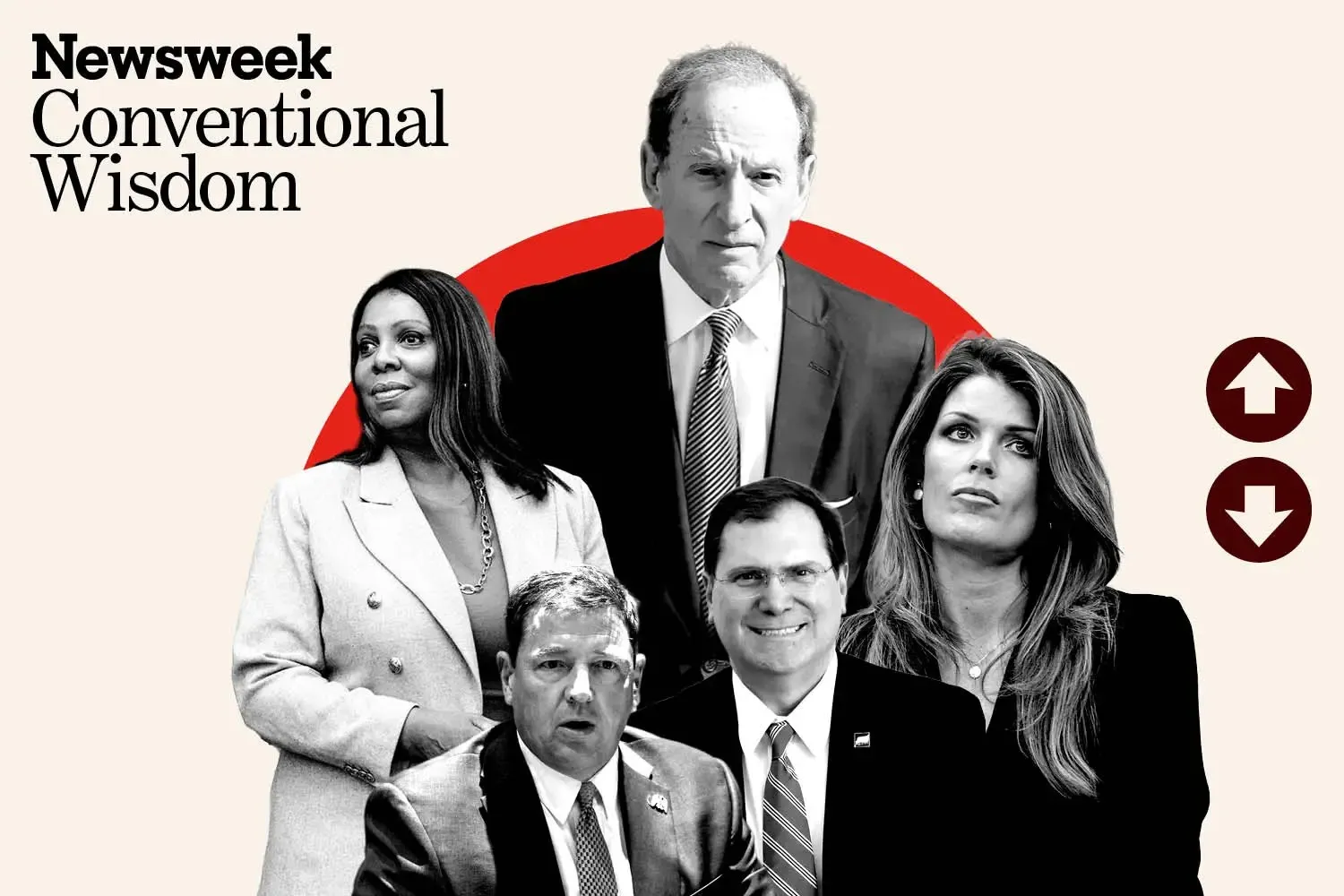
Originally a staple of Newsweek's print edition, Conventional Wisdom used arrows to track whose stock was rising or falling in the political circus. We're reviving it in the digital age because the problem it lampooned—hyperbole and partisan certainty masquerading as insight—has only intensified.
CW assigns arrows—up, down, or sideways—to the figures and forces shaping current events. The arrows don't predict the future or claim special insight. They capture the prevailing winds of the moment, uncluttered by tribal howling. In an era when partisan media reinforces rather than questions assumptions, CW operates from the center—skeptical of left and right alike, committed to puncturing inflated reputations and recognizing overlooked truths.
View 0 Comments
Submit Correction
View Editorial & AI Guidelines