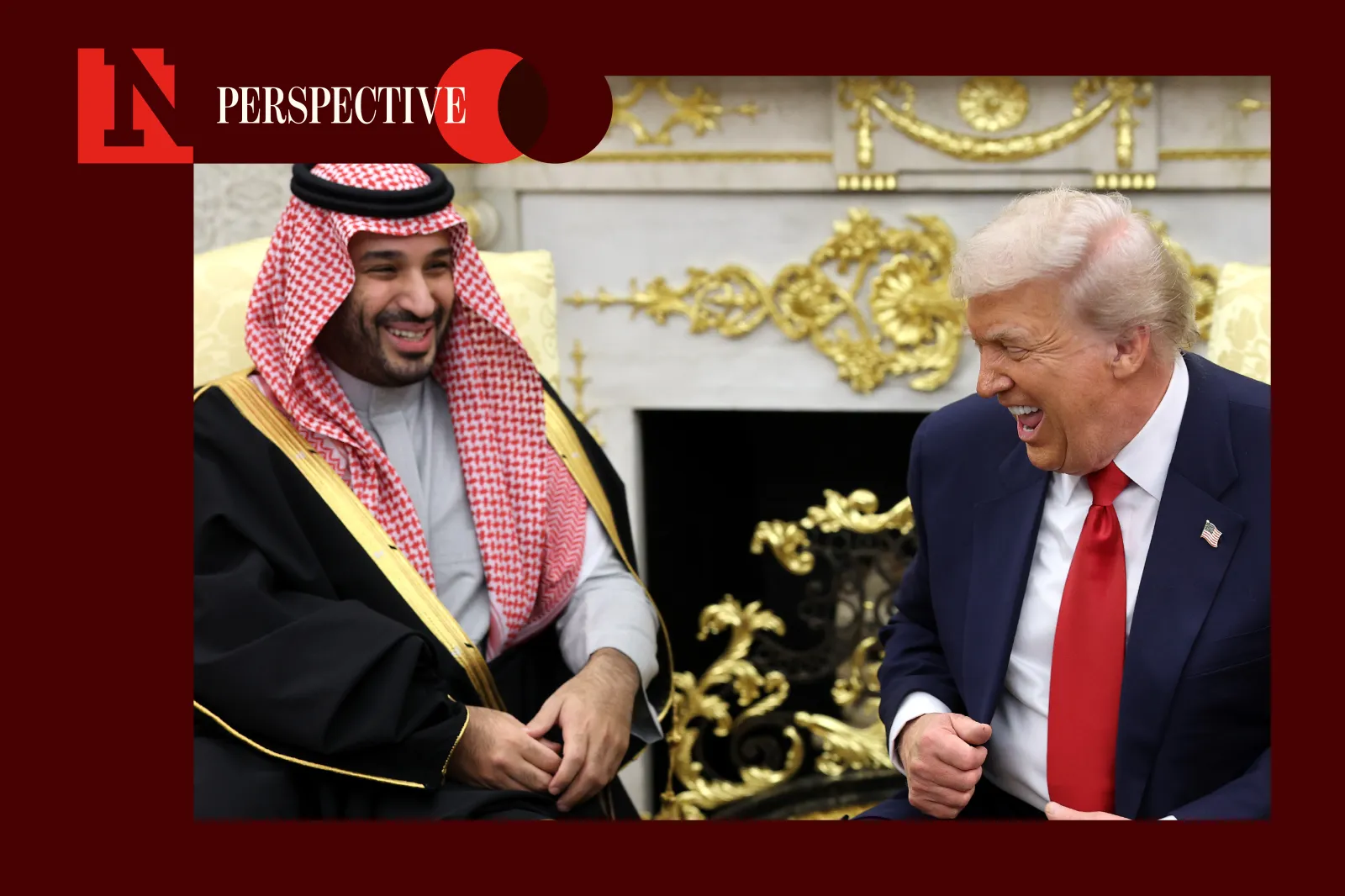
Photo-illustration by Newsweek/Getty

By Anna Rahmanan
0
Share
Newsweek is a Trust Project member
See more of our trusted coverage when you search.Prefer Newsweek on Googleto see more of our trusted coverage when you search.
President Donald Trump has spent his second term doing things that once would have revived a defining refrain from his first presidency—he is hostile to Muslims. So, it's strange that “Trump the Islamophobe” no longer carries the same political force it once did.
One of the likely reasons that refrain has quieted is that Trump is harder to place inside that old frame: He still uses inflammatory rhetoric and pursues restrictive immigration policies, but he has also built closer ties with some Muslim-majority governments while going to war with another, and he won support from a larger share of Muslim voters than he did during his first term. That makes the politics less straightforward than they were in 2017.
Back then, Trump entered office after calling in 2015 for a “total and complete shutdown of Muslims entering the United States.” He went on to restrict entry from several Muslim-majority countries, while insisting the policy was about terrorism and not religion. The political identity stuck. In a 2017 Pew survey, 74 percent of Muslim Americans described Trump as “unfriendly” toward them, while only 19 percent approved of his presidency. Just 8 percent of Muslim voters told Pew they had cast a ballot for him. The Democratic Party organized itself around the charge. Senate Minority Leader Chuck Schumer wept on camera denouncing the travel ban and moved within days to repeal it by legislation.
Read More on Analysis
Nine years later, Trump has supplied plenty of material for critics to make the same accusation. The difference is that the political coalition around him—and against him—no longer makes the charge quite as simple.

...
Trump Hasn’t Stopped Giving Critics Ammunition
Trump has hardly stopped giving his critics material on this issue.
After the November 2025 shooting of National Guard members, allegedly by an Afghan national, in Washington, D.C., the administration tightened immigration restrictions, later expanding entry limits covering dozens of countries, many of them Muslim-majority. The proclamation that took effect January 1 fully restricted entry from 19 countries and partially restricts 20 more, along with holders of Palestinian Authority travel documents. The State Department froze immigrant visa processing for nationals of 75 countries three weeks later. The president also returned to explicitly inflammatory rhetoric, calling Somalia “barely a country” and describing Muslim Representative Ilhan Omar and others as “garbage.” In July he shared a post mocking hijab-wearing kindergartners at a St. Paul charter school, which afterward reported threats.
Then he went to war. On February 28, American and Israeli forces launched roughly 900 strikes on Iran in 12 hours, killing Supreme Leader Ali Khamenei and dozens of other officials. At least 157 people died when a missile hit a girls’ school near a naval base at Minab, according to an estimate by the Associated Press. Trump announced Khamenei’s death on Truth Social, calling him one of the most evil people in history.

...
It was the largest American use of force against a Muslim-majority country in a generation, and almost nobody argued about it in those terms. The Democratic case was constitutional. Senator Tim Kaine forced repeated votes to constrain the president, calling the strikes dangerous and unnecessary. In June, Schumer, Senator Adam Schiff, Kaine and 35 colleagues wrote to Trump disputing his claim that hostilities had ended, calling the war unconstitutional and demanding the Justice Department opinion behind it. Months of bombing produced an argument about the separation of powers.
Muslim advocacy groups have continued to describe parts of Trump’s rhetoric and policy as anti-Muslim. The Council on American-Islamic Relations logged 8,683 discrimination complaints in 2025, the most in the 30 years it has published the count, and named Senator Tommy Tuberville an anti-Muslim extremist, the first time it has applied the label to a sitting senator. Dozens of Republican members of Congress belong to a Sharia-Free America caucus. A study published in April counted 1,111 anti-Muslim social media posts by Republican officeholders and eight related bills in 13 months.
Public sentiment moved with them. The Islamophobia Index compiled by the Institute for Social Policy and Understanding, which measures endorsement of five false stereotypes about Muslims, rose from 25 in 2022 to 33 in 2025 among the general public, with the steepest increases among white evangelicals and Catholics. One federal measure runs the other way: FBI-reported anti-Muslim hate crime incidents peaked at 307 in 2016 and stood at 228 in 2024.
The striking change is not that the accusation has disappeared; it is that it no longer seems to define Trump politically as it did during his first term.
Democrats Changed the Words They Use
The clearest evidence is legislative, though the trend is not entirely one-way. California Democratic Representative Judy Chu has introduced the NO BAN Act, which would prohibit religious discrimination in immigration decisions, in four consecutive Congresses. The House versions attracted 219 cosponsors in 2019, 159 in 2021, 86 in 2024 and 121 in the current Congress. The House approved the bill’s provisions 233-183 in 2020, with every voting Democrat and two Republicans in favor. By then, Trump’s entry restrictions already affected 13 countries.
When 61 House Democrats wrote to Trump in February condemning the expansion, they called it “a cruel and racist policy agenda disguised as national security.” The letter did not use the word “Islamophobic.”
Individual Democrats made the same substitution. Senator Mark Kelly, asked on Meet the Press about the permanent pause on migration from developing countries, said the administration’s message was that “they don’t want brown people coming to the United States.” Minnesota Governor Tim Walz said Trump had chosen to target “an entire community.” Senator Andy Kim called the June 2025 ban “rooted in bigotry, not security,” then pivoted to prices and health care.
Republicans were more specific, which suggests they recognized one of the underlying themes, even if Democrats did not name it. Tuberville called on the government to “IMMEDIATELY BAN all ISLAM immigrants.” Representative Chip Roy posted that the answer was to stop importing Islamists.
The contrast with 2017 is hard to miss. Then, Schumer said tears were running down the cheeks of the Statue of Liberty, and Trump mocked him by name the next morning for crying about it.
Muslim Voters No Longer Fit the Old Political Story
The first complication to the narrative is electoral. Muslim voters remain more Democratic than Republican, but they are no longer easily described as an anti-Trump bloc.
The Institute for Social Policy and Understanding found that 50 percent of Muslim voters backed Kamala Harris in 2024, while 31 percent voted for Trump and 12 percent for Jill Stein. Among Muslim men, 42 percent voted for Trump. Other surveys put the split differently. CAIR’s exit poll of 1,575 Muslim voters found Stein at 53 percent, Trump at 21 and Harris at 20. The Associated Press’s VoteCast had Harris at 63 percent. The three agree that Muslim support for Democrats collapsed and disagree about where it went. All of them put Trump well above the 8 percent Pew recorded in 2016.
Gaza played an important part in changing the old alignment.
Anger over the Biden administration’s support for Israel played a role during the Democratic primary in Michigan, where more than 100,000 voters chose “uncommitted.” Trump later led the field in Dearborn, where Arab and Muslim voters had been an important part of the Democratic coalition. Harris took 36 percent of the vote there, down from nearly 69 percent for Joe Biden four years earlier. (And just two years later, Michigan Democrats voted to send a Muslim candidate into one of America’s biggest Senate races.)
That does not mean Muslim voters embraced Trump, because most didn’t, but it does make Islamophobia a more awkward partisan attack when a substantial minority of the voters supposedly targeted by it are willing to vote for him.
Trump’s Muslim World Relationships Complicate the Picture
Trump’s foreign policy also sits uneasily with the image of a president primarily defined as hostile to Muslims.
The first major foreign trip of his second term took him to Saudi Arabia, Qatar and the United Arab Emirates. The administration announced a $600 billion Saudi investment commitment, $1.2 trillion in projected economic exchange with Qatar and more than $200 billion in new U.S.-UAE commercial deals.
Nine months later he was bombing Tehran. A president who deepens commercial ties with three Muslim-majority monarchies while decapitating the government of a fourth is difficult to assess according to a single religious motive.
Close relations with Muslim governments do not answer accusations about Trump’s treatment of Muslims at home. After all, Saudi Arabia, Qatar and the UAE are states, not stand-ins for American Muslims. Politically, however, the relationships complicate the picture. Trump can denounce Somali immigrants one month while embracing Arab rulers and courting Muslim voters the next.
…Or, Maybe, Americans Are Just Used to Trump
There is a simpler explanation for the dialed-back criticism. Exhaustion.
Trump has been at the center of American politics for more than a decade. Language that once shocked voters can lose its ability to generate a new political identity when the politician using it is already one of the most familiar people in the country.
Search behavior offers partial support. Google Trends data for the United States shows American interest in the phrase “Muslim ban” peaking in January 2017, the month of the first executive order, when it outran searches for “travel ban.” It has not registered a single month anywhere near that level since March 2025. Interest in “travel ban” stayed strong across the same period, rising when Trump restricted 12 countries in June 2025, again in December when he more than doubled the list, and again in February. Americans are still following the policy closely, but appear to have stopped attaching a religion to it.
However, there is no clear polling evidence showing that Americans have specifically become tired of accusations of Islamophobia, and the ISPU index points the other way: the sentiment is rising while the political language recedes. Muslim organizations also continue to use the term. In July, for example, CAIR accused Trump of amplifying anti-Muslim bigotry after he shared a social-media post involving Muslim schoolchildren.

...
Democrats use the word too, but about Republicans in Congress and about each other. In March, House Democratic Leader Hakeem Jeffries called Islamophobia “a cancer” after a run of anti-Muslim posts by Republican members. Speaking outside a Bronx mosque last October, days before he was elected mayor of New York, Zohran Mamdani said that in an era of vanishing bipartisanship, “Islamophobia has emerged as one of the areas of agreement.” He was describing attacks including by Andrew Cuomo and Eric Adams, both Democrats. The Reverend Al Sharpton, campaigning with him a week later, denounced the “ugly Islamophobia” in the race without naming who was responsible for it.
Fatigue is therefore plausible, but difficult to prove. The stronger evidence is that the politics around the accusation have become less simple.
What Would Make the Charge Stick Again?
The next elections will provide a test.
If Muslim voters who moved toward Trump in 2024 turn sharply against Republicans, particularly in Michigan, it would strengthen the argument that his second-term policies have revived the political consequences associated with his first-term rhetoric. Abdul El-Sayed won the state’s Democratic Senate primary this month by about a point against roughly $65 million in outside spending, and the attacks trialed against Mamdani are already being turned on him. The wider ground has shifted too: support for reducing immigration overall has fallen since the 2024 campaign.

...
If Muslim voters remain divided, the lesson may be different: Islamophobia could remain a serious accusation against particular Trump policies or statements without functioning as an all-purpose explanation of his relationship with Muslim Americans.
Perhaps that is what happened to “Trump the Islamophobe.” Trump did not change enough to kill the accusation, but the politics changed enough to blunt it: Muslim voters backed him, Muslim governments embraced him and Muslim politicians kept winning.
The charge survived. The political reality it once explained did not.
View 0 Comments
Submit Correction
View Editorial & AI Guidelines