
...

Brendan Cole
Senior Reporter
0
Share
Newsweek is a Trust Project member
See more of our trusted coverage when you search.Prefer Newsweek on Googleto see more of our trusted coverage when you search.
Thailand launched airstrikes along its disputed border with Cambodia as each side accused the other of breaking a ceasefire brokered by President Donald Trump.
Both Thailand and Cambodia have said that the clashes, which officials said had killed at least one Thai soldier and four Cambodian civilians, have displaced tens of thousands of people.
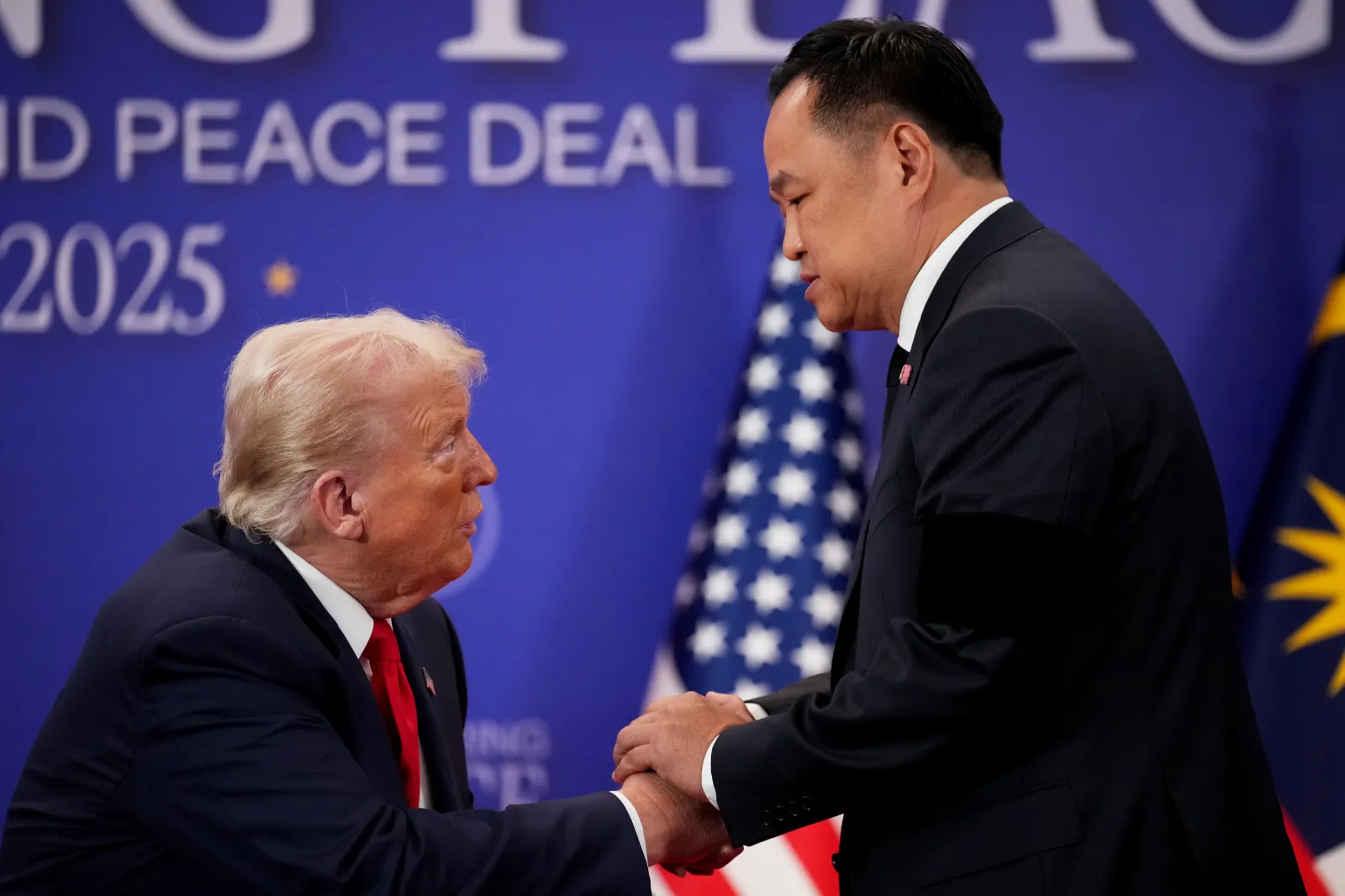
The fighting comes only six weeks after Trump, along with Malaysian leader Anwar Ibrahim, oversaw the signing of the ceasefire deal at a summit of the Association of Southeast Asian Nations (ASEAN) in Kuala Lumpur, in which the U.S. president was thanked for his role.
Read More on News
Ursula F. Ott, professor of business at Nottingham Business School, in England, told Newsweek Monday that while such a ceasefire was important, "Trump has a very short-term approach and sees a deal as the goal."
Aurélien Colson, academic co-director of the ESSEC Institute for Geopolitics & Business told Newsweek that Trump’s claims about resolving eight conflicts demonstrated “performative peacemaking” and that the resumed hostilities by the Thai /Cambodian border was “particularly revealing.”
The White House told Newsweek that Trump was committed to the continued cessation of violence.
Newsweek has contacted the foreign ministries of Cambodia and Thailand for comment.
...
Why It Matters
The conflict between Cambodia and Thailand was among the eight wars that Trump had boasted he had ended, and was used as leverage for his claim for the Nobel Peace Prize, that eventually was awarded Venezuelan opposition figure, María Corina Machado.
But the unraveling of a peace deal so soon, after such warm words from both the Cambodian and Thai prime ministers, could deal a blow to Trump’s foreign policy successes, with escalating hostilities posing a broader regional threat.
What To Know
The territorial claims between Cambodia and Thailand largely stem from a 1907 map drawn when Cambodia was under French colonial rule.
Bangkok has disputed a 1962 decision by the International Court of Justice, awarding sovereignty to Cambodia to an area that included the 1,000-year-old Preah Vihear temple.
In the long-running dispute, dozens of soldiers and civilians were killed in July during five days of combat. There have been tensions since a truce agreement signed in October, brokered by Trump, which have erupted into violence again.
Thailand's military said on Monday it had launched airstrikes in response to a Cambodian attack on Sunday on Thai soldiers who had been working on an engineering project in the border Si Sa Ket Province. Thai army spokesperson Maj. Gen. Winthai Suvaree said Cambodian troops fired first into Thai territory, killing at least one Thai soldier and wounding eight others. Thailand deployed aircraft to strike Cambodian military targets, he added.
But Cambodian Defense Ministry spokesperson Maly Socheata said it was the Thai military who attacked Cambodian troops first and that they did not retaliate during the initial attacks.

...
Neth Pheaktra, the Cambodian Minister of Information, said four Cambodian civilians were killed and around nine others were injured by Thai forces.
More than 50,000 people have left areas near the border for shelters, according to Thailand and Pheaktra said that tens of thousands of residents were displaced near the border, adding to concerns about an escalation.
The ceasefire was strained last month after Thai troops were injured by land mines, prompting Bangkok to announce that it would indefinitely suspend implementation of the agreement that Trump brokered.
Thailand's Prime Minister Anutin Charnvirakul said his country would "preserve its sovereignty" and appeared to rule out third party intervention involving Trump.
Nottingham Business School's Ott told Newsweek that as with all border conflicts there was always one party wanting to lead, and it was clear that Thailand was more powerful than Cambodia.
Colson said that the resumption of friction underscores that nothing was structurally resolved and that “a conflict that reignites so easily is the best proof that no real peace architecture was ever built.”
Ott added that the kind of ceasefire that Trump helped facilitate was important but there were many more complex negotiation strategies needed.
A White House spokesperson said that Trump expected the governments of Cambodia and Thailand "to fully honor their commitments to end this conflict."
International SOS, a security service firm, told Newsweek Monday that the clashes had been ongoing since late Sunday and called for people to defer all travel within 30 miles of the countries’ border, especially where there were military assets.
The affected areas include the Cambodian provinces of Banteay Meanchey, Oddar Meanchey, Preah Vihear. In Thailand the provinces of Buriram, Sisaket, Surin and Ubon Ratchathani were all affected, it added.
What People Are Saying
Cambodian Defense Ministry spokesperson Maly Socheata: "Cambodia urges that Thailand immediately stop all hostile activities that threaten peace and stability in the region."
Thailand's Prime Minister Anutin Charnvirakul said regarding the U.S. president intervening again, "no, it's about Thailand and the other parties."
Ursula F. Ott, professor at Nottingham Business School: "A ceasefire is always important, yet there are much more complex negotiation strategies needed. Trump has a very short-term approach and sees a deal as the goal."
Aurélien Colson, academic co-director of the ESSEC Institute for Geopolitics & Business told Newsweek: “Trump conflates temporary restraint with conflict resolution, preventing war is not about momentary deterrence or symbolic mediation—it is about addressing root causes, guarantees, and enforcement.”
What Happens Next
As of Monday morning, the Trump administration had not commented but the suggestion by the Thai prime minister was that Bangkok would not be seeking third party diplomacy to solve the latest round of hostilities.
Update 12/9/25, 3:29 a.m. ET: This article has been updated with a White House statement.
View 0 Comments
Submit Correction
View Editorial & AI Guidelines