10
Loading video...

By Mandy Taheri
Reporter
0
Share
Newsweek is a Trust Project member
See more of our trusted coverage when you search.Prefer Newsweek on Googleto see more of our trusted coverage when you search.
For Bahar, a control engineer in Iran in her mid-20s, education abroad was a chance to build a future beyond the limitations and “difficulties” she faces at home.
Her dream of enrolling in a data science master’s program in Canada and building her career internationally is now on hold after a new round of U.S. sanctions announced by President Donald Trump last month.
Scheduled to take the TOEFL, an English-language test required for admission to many universities abroad, later this month, she was abruptly informed on August 25 that her exam had been canceled and would no longer be offered in Iran.
Read More on World
“I'm really looking for other opportunities because in Iran we really face difficulties and education is my only way out to the world that is free and I can do whatever I want,” she told Newsweek from Iran.
Bahar, who has been offered a pseudonym for security reasons, is one of thousands of Iranians who spent years preparing for entrance exams and international university admissions, but are now, more than six months into the United States' war in Iran, seeing their plans for the future reach new levels of uncertainty.
Aspiring engineers, doctors, lawyers, and researchers are caught in the middle of a geopolitical standoff between Trump and Ayatollah Mojtaba Khamenei, with educational opportunities that once seemed within reach suddenly put on hold as access to standardized tests like TOEFL and the LSAT has been suspended in the country.
While TOEFL exams are still available abroad, accessing them often requires costly travel, turning a single test into a trip that can cost hundreds of dollars in flights, hotels and fees. For many Iranian families, already grappling with sanctions, inflation and a weakened Iranian rial, the expense is out of reach.
The path to the LSAT is even difficult for those with Iranian heritage living outside of Iran. Applicants with Iranian dual citizenship, or information linking them to Iran on their profiles, have reported having their accounts locked.
The Trump administration's measures are part of its broader pressure campaign against Tehran with the aim of halting a nuclear program that Washington believes had put it on the threshold of building nuclear weapons. Iran has denied such ambitions. A U.S. Treasury spokesperson told Newsweek earlier this month in response to the new sanctions, “Unfortunately, the Iranian regime has chosen to prioritize its nuclear ambitions over the well-being of its people.”
The statement continued, “The regime cannot continue to attack U.S. interests and benefit from access to the United States, whether financially, academically, or culturally. The biggest threat to the Iranian people remains the regime itself.”
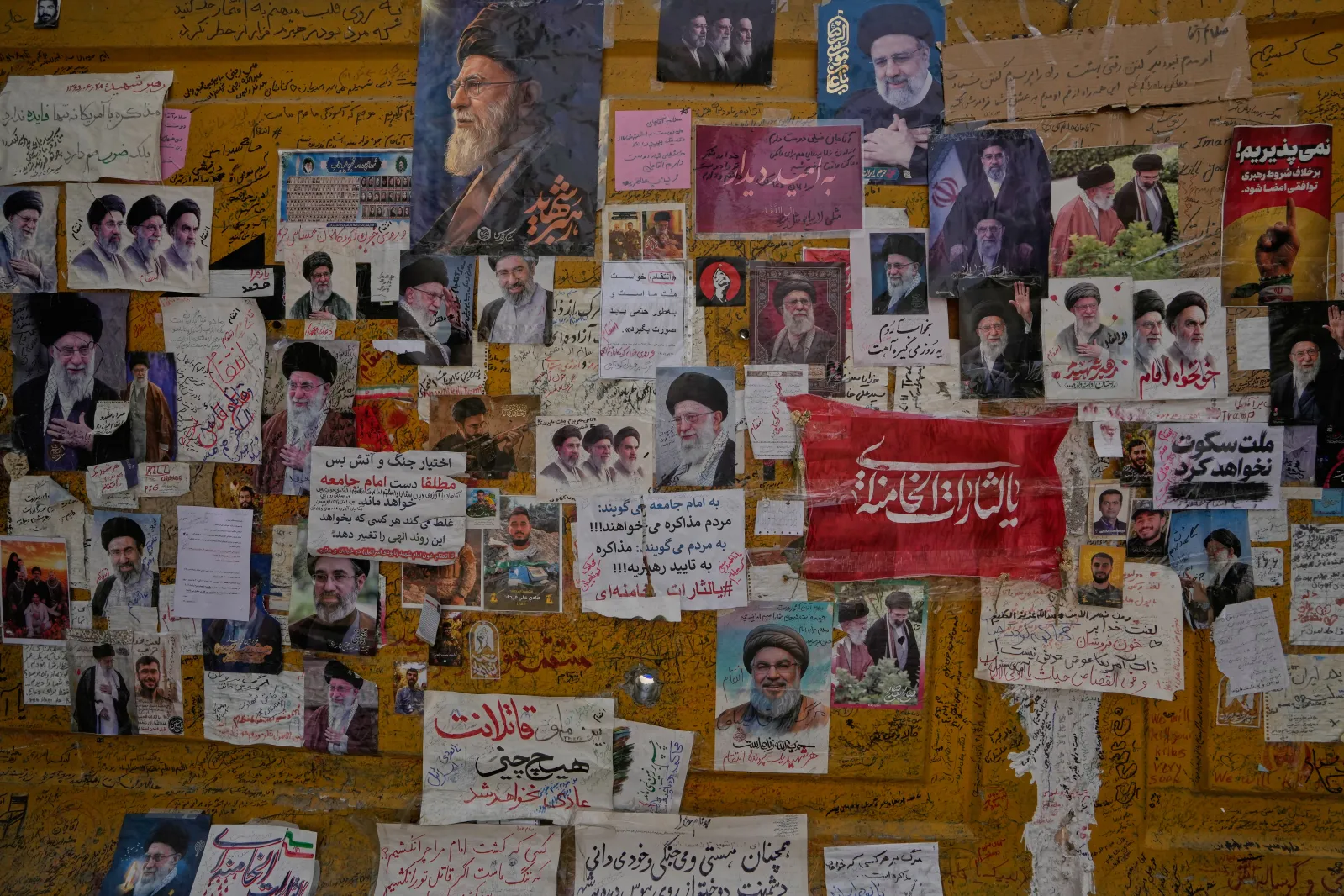
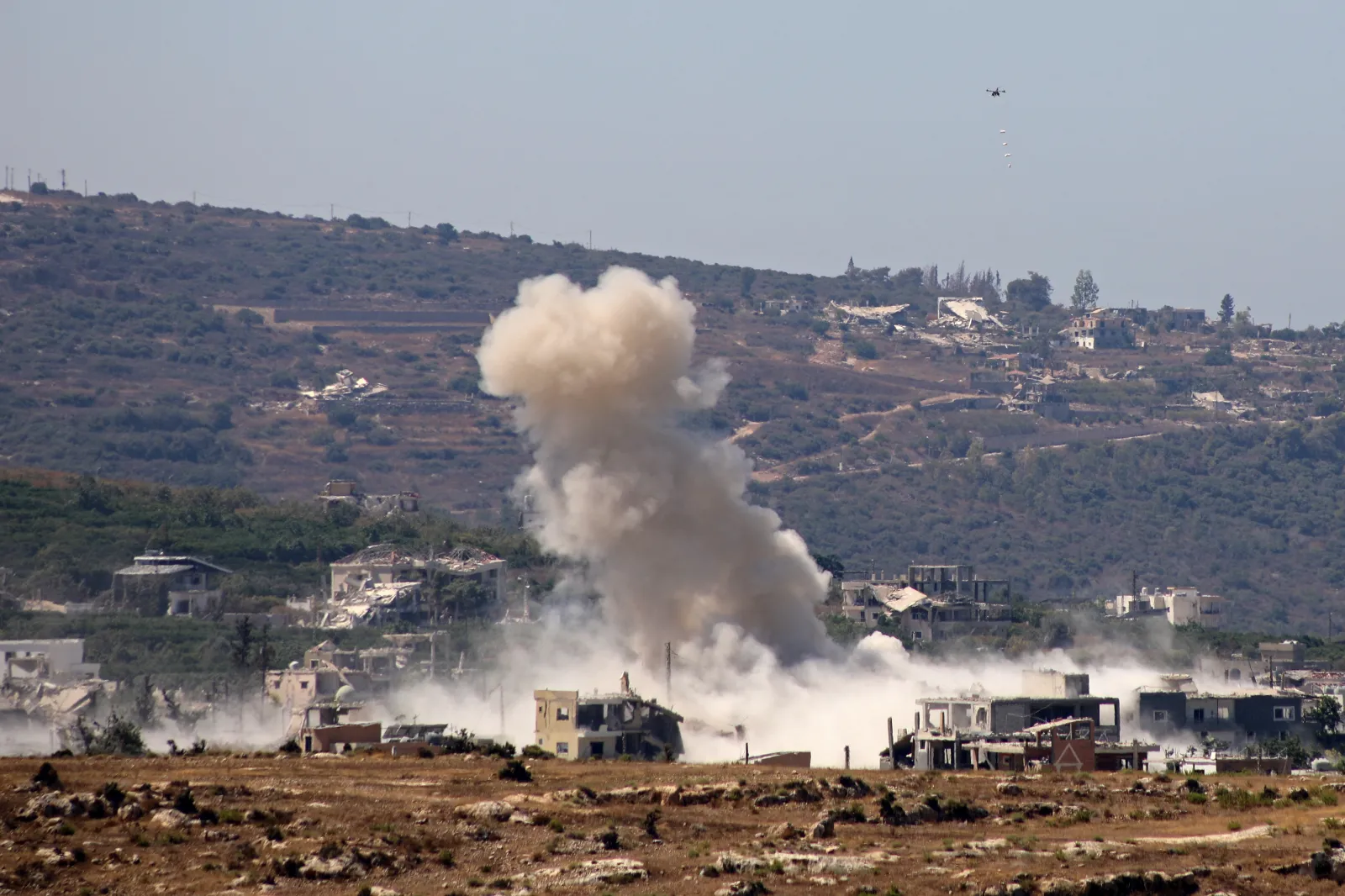
The U.S. launched coordinated attacks with Israel on Iran on February 28, subsequently killing Ayatollah Supreme Leader Ali Khamenei. In the months following, hostilities have continued, with the U.S. and Iran trading missile fire and the Strait of Hormuz emerging as a key flashpoint in the conflict.
...
A New Barrier to Higher Education
General License G, which is typically exempt from U.S. sanctions regulations, permits a range of academic exchanges and educational services, including processing university applications, tuition, and administering entrance exams for people in Iran who are ordinarily residents. The freeze was announced on August 24, with a wind-down period until September 8.
The indefinite suspension closes pathways that thousands of Iranian students have relied on to access universities abroad, including standardized tests like TOEFL and Duolingo English exams within the country.
A representative of Educational Testing Service (ETS), the parent company of the GRE and TOEFL, told Newsweek that following the Treasury Department’s General License G suspension, “ETS has paused administration of the TOEFL and GRE tests within Iran effective immediately. This action is required to comply with U.S. sanctions law. All affected test appointments within Iran will be cancelled, and ETS will contact test takers directly regarding applicable refunds and next steps.”
The indefinite education restrictions are just one piece of a wider sanctions effort to economically isolate Iran.
Trump has called the sanctions part of "the most crushing economic operation ever” against Tehran. Washington has imposed varying sanctions on Iran for more than four decades, beginning after the 1979 Iranian Revolution and the Iranian Hostage Crisis, with additional measures added over the years by both Republican and Democratic administrations.
“Their [sanction’s] application and effects are broad,” sanctions lawyer Mohsen Farshneshani told Newsweek about the new ones levied against Iran, adding that in addition to the General License G suspension and broad sanctions that prohibit "most direct and indirect transactions involving Iran," there are also "separate targeted sanctions against specifically designated people and entities.”
He added that the “comprehensive” Iran framework is “materially different from the Russia sanctions program, which is more targeted around designated persons, sectors, and specified Russia-linked activity rather than a comprehensive country-based sanctions regime.”
Related Story
Iran War Nears $40B as Half of Voters Say Sending US Troops Was a Mistake
Farshneshani, a principal attorney at the Sanctions Law Center, added, “Shelving General License G does nothing to target Washington's adversaries, this admin is frankly out of options.”
The impact of U.S. sanctions on ordinary Iranians has long been debated. Critics argue the measures have imposed high economic and social costs on civilians while failing to achieve their ultimate goal of pressuring Iran's government into certain negotiations and diplomacy, while supporters argue they are a necessary means of exerting economic and diplomatic pressure on Iran's government.
The updated sanctions come as Iranian students already face mounting obstacles in pursuing education abroad. Since January 31, Iranians have been unable to take IELTS, one of the world's most widely accepted English-language proficiency exams for university admissions and immigration applications, after test administrator IDP Education suspended testing in the country, citing "financial and regulatory circumstances beyond our control."
Duolingo, the popular language-learning app, has also ended access to its English proficiency exam for people testing in Iran, as well as Iranian nationals abroad, as a result of the new sanctions. The test is vital to some applying for various international scholarships and research grants, among other academic pursuits.
A spokesperson for Duolingo told Newsweek in September that due to the sanctions, “Duolingo is required to stop offering the Duolingo English Test to people testing in Iran or using Iranian government-issued identification beginning September 1. This includes people outside Iran who need to use Iranian government-issued ID.”
The restrictions also come against the backdrop of a decades-long exodus of Iranian talent. April 2020 research from Stanford University's Iranian Studies Program found that the number of Iranian-born emigrants grew from roughly 500,000 before the 1979 revolution to about 3.1 million in 2019.
The study estimates that around 700,000 Iranian-born individuals have attended foreign universities, with the United States, Canada, Germany and the United Kingdom among the most common destinations. Researchers point to a mix of economic hardship, political repression, corruption and limited opportunities at home as key drivers of Iran's ongoing "brain drain."
...
A Costly Journey for Opportunities Abroad
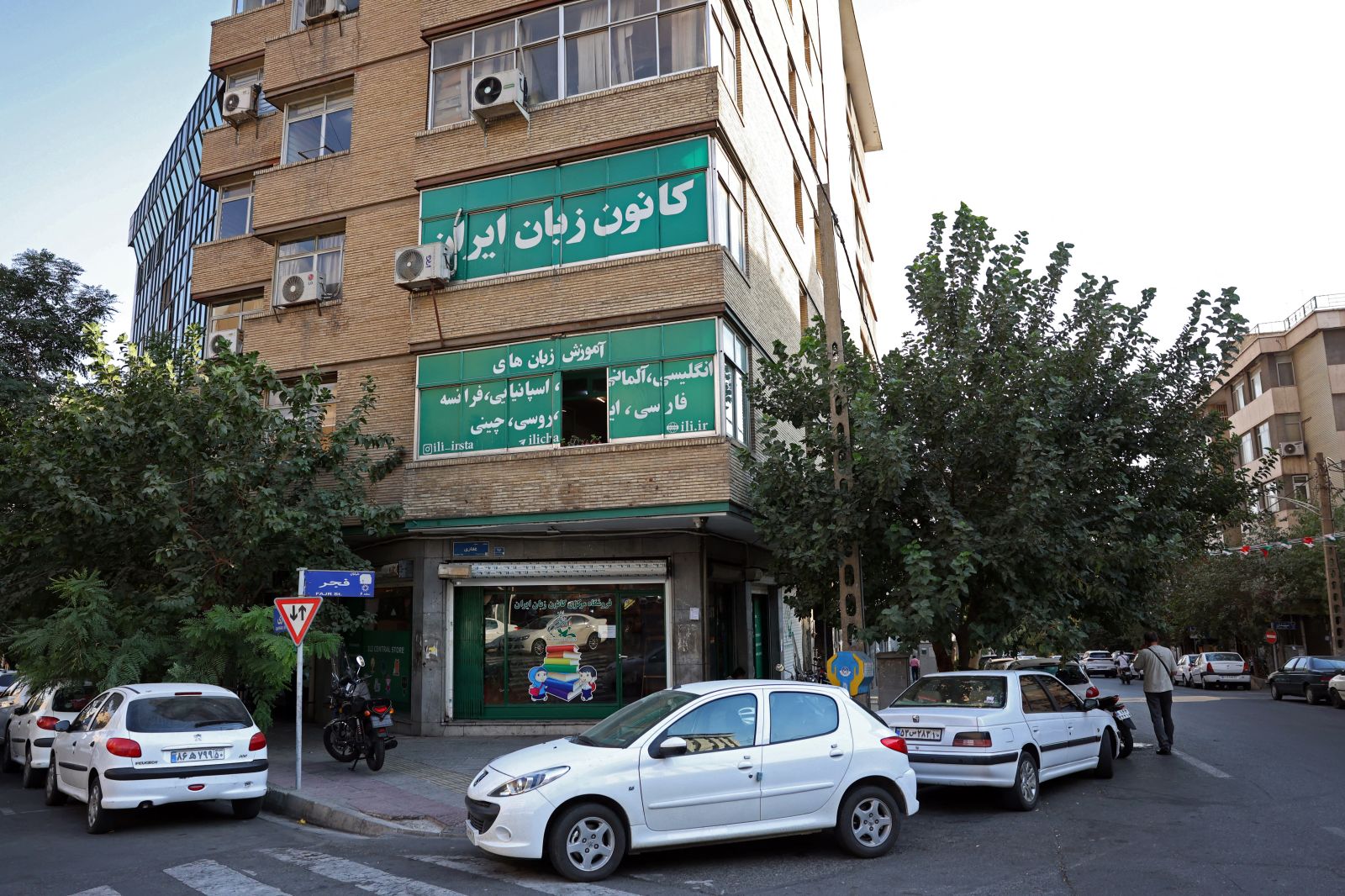
Bahar, like many Iranians, started learning English as a child. Now, after years of study, she has spent the past month preparing for the TOEFL exam she needs to secure a place in a Canadian master's program in data science. The university has already offered her conditional admission, she said, with only her TOEFL score standing between her and the next chapter of her life.
The English exam may take only a few hours, but for many Iranians, reaching the testing center can take days.
To finalize her acceptance, Bahar is weighing a long road trip to Yerevan, Armenia, nearly 16 hours by car from Tehran. Flights, while faster, have become increasingly unreliable amid recurring disruptions tied to military activity in the region, leaving Bahar and her friend to choose the road instead, despite an expected four- to five-hour wait at the border.
An ETS representative confirmed to Newsweek that the “restriction applies to testing within Iran,” but “Iranian nationals may take the TOEFL or GRE test at available testing locations outside Iran, subject to applicable registration requirements and appointment availability in the selected location.”
Frustrated by the cancellations and fueled by conversations in a Telegram group crowded with students facing the same uncertainty, Bahar launched a petition calling for the return of TOEFL and GRE testing in Iran. By Thursday, it had drawn more than 7,400 signatures.
As delays, cancellations, and uncertainty continue to reshape students' plans, many say they feel trapped by circumstances beyond their control. For Bahar, that frustration has become a constant presence.
“Helpless and angry most of the time,” she described her state as she continues to find a path forward and pursue reimbursement for her test cancellation. “This situation is completely out of our control, and we shouldn’t be affected by that.”
Despite the logistical hurdles and increased financial burden, Bahar feels compelled to keep pursuing her plans abroad. Staying in Iran and forgoing the test, she said, would leave her with far fewer options for the future.
“Unfortunately, having a job, and a good paying one, there are not enough in Iran," she said.
An Iranian biomedical engineering Ph.D. student in Australia told Layla Saghafian of the Bourse & Bazaar Foundation that the test cancellations and sanctions-related restrictions have been "devastating." Some of her friends in Iran, including highly qualified applicants like Bahar, need only an English-language certificate to secure spots at foreign universities, she said. Instead, they are "watching their future opportunities disappear in front of them."
Saghafian said in a statement to Newsweek, “The sanctions also go beyond international institutions canceling language exams. Iranian graduate students and academics have reported facing sanctions-related barriers to publishing their research as many Western journals often reject articles with Iranian authors or those associated with sanctioned universities in Iran. This causes significant setbacks in their research and makes it difficult for them to build stronger CVs compared to researchers abroad who do not face such publication restrictions.”
Restrictions Extend to Iranians Abroad
The sanctions’ impacts and limitations have extended well beyond Iran's borders. Some members of the Iranian diaspora have also encountered new barriers, with Iranian citizens and some former residents abroad finding themselves unable to register for exams such as the LSAT, which is administered by the Law School Admission Council (LSAC).
“The problem we’re seeing is called overcompliance, which is a recurring problem with sanctions,” Farshneshani told Newsweek.
He added that, with a rule change, institutions often “adopt the most risk-averse interpretation possible,” which has led to more individuals being wrongly prohibited from taking the exams.
“At worst, it’s lazy compliance lawyering; at best, it’s avoiding the problem entirely by refusing to take any chances,” he added. Farshneshani is “preparing to file suit over what we view as clear discrimination.”
“Folks who are US citizens or lawfully living in the US were denied service because they also identified as Iranian nationals. This is a categorical denial of service based on Iranian nationality,” he told Newsweek.
Dozens of people with Iranian dual citizenship, or some tie to the country, took to social media in mid-September, posting photos of being locked out of their accounts and subsequently blocked from taking the exams.
Shirin Basiri, a 23-year-old Canadian national who has dual Iranian citizenship, was among them. Basiri, who lived in Iran for a short period as a child more than a decade ago but is not an Iranian resident, told Newsweek she had been scheduled to take the LSAT on September 12.
The legal assistant, who hopes to attend law school and study family law, needs the LSAT to apply to schools in both Canada and the United States. On September 9, she was notified that her account had been locked. The schools she is applying to do not accept any alternative admissions tests.
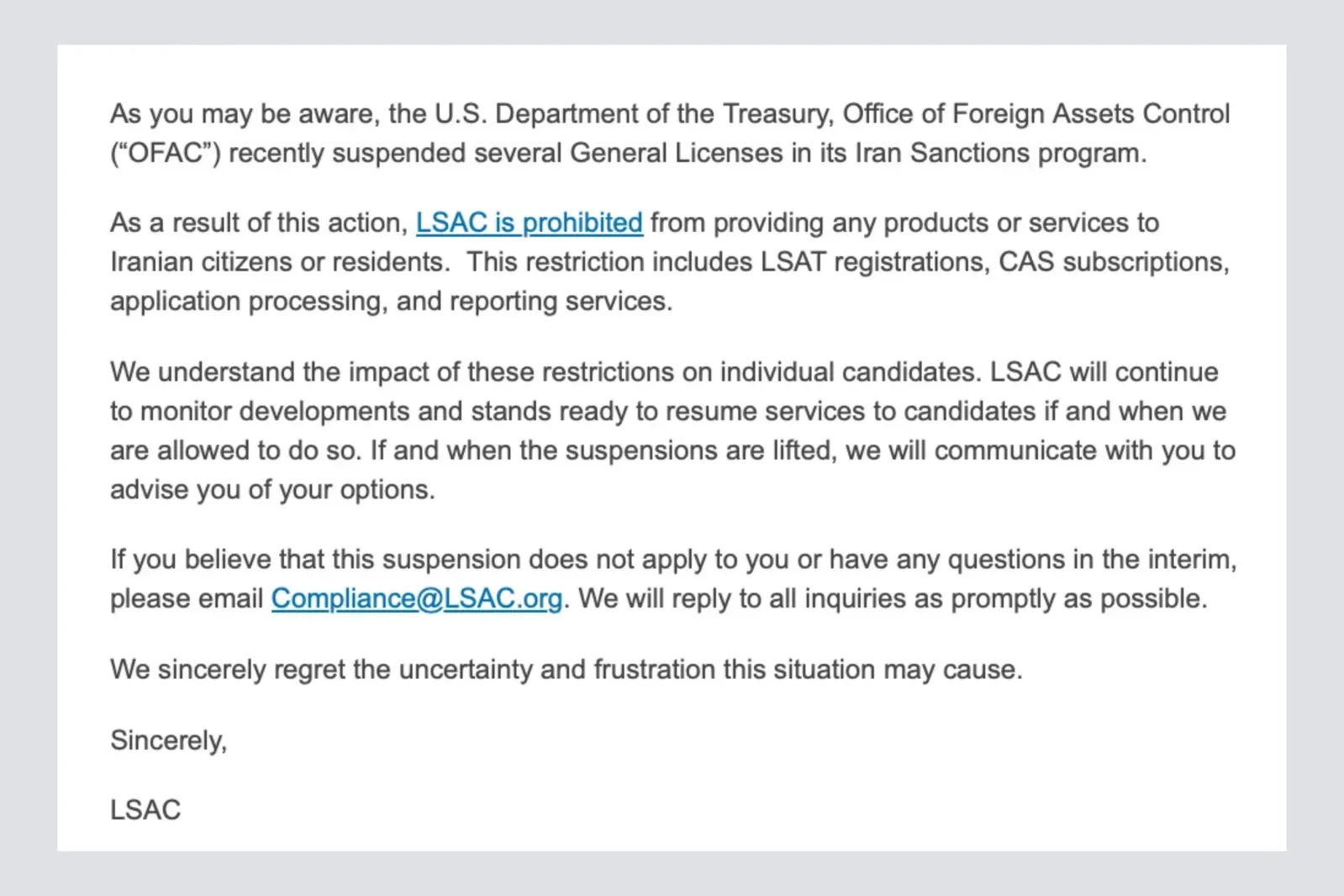
“So anyone who had anything about Iran on their profile got this email,” she said, showing Newsweek an official LSAC email that states her account's suspension, saying, “As a result of this action, LSAC is prohibited from providing any products or services to Iranian citizens or residents. This restriction includes LSAT registrations, CAS subscriptions, application processing, and reporting services.”
...
The notification arrived during the start of the September testing cycle. Wednesday marked the first day of the exam period, September 8 and was also the final day LSAC could operate under the existing pre-sanctions license.
Locked accounts prevent prospective students from taking the exam but also block other services. Basiri explained, “It wasn't just LSAT; it was all of their [LSAC’s] services. It means people can't apply for law school in America. They can't have their transcript process, their references can't upload their letters. So, they couldn't even apply for a law school, let alone take the LSAT.”
Basiri was among a group of test takers who contacted LSAC to explain their circumstances and provide documentation showing why they believed their accounts should not have been restricted. In her case, she submitted a copy of her Canadian passport and proof of citizenship along with an explanation of her situation. Several hours later, she said, LSAC restored access to her account and unlocked her exam. Newsweek reviewed the email exchanges.
LSAC told Newsweek in an email, “To comply with U.S. sanctions on Iran, LSAC is currently restricted from providing services to certain individuals in Iran or Iranian citizens. We have notified potentially affected candidates and have restored services for those who provided documentation showing exemption from the restrictions. We will continue to do so as appropriate. We understand the uncertainty this may cause and are strongly encouraging affected candidates who meet exemption criteria to contact us promptly.”
The Trump administration and its supporters have backed the use of sanctions as a necessary tool to pressure Tehran and advance U.S. security interests. Yet, as tensions and attacks continue with no clear resolution on the horizon, many Americans have questioned the mounting costs and effectiveness of the U.S.-Iran war and the administration's sanctions policy.
Contact Newsweek editors on this story: Jason Lemon and Sam Wilson.
View 0 Comments
Submit Correction
View Editorial & AI Guidelines