...

By Newsweek Editors
0
Share
Newsweek is a Trust Project member
See more of our trusted coverage when you search.Prefer Newsweek on Googleto see more of our trusted coverage when you search.
Don’t let the arcane procedural language obscure the drama unfolding around the SAVE America Act. The Senate is heading into a heavyweight brawl right in the middle of a swamp.
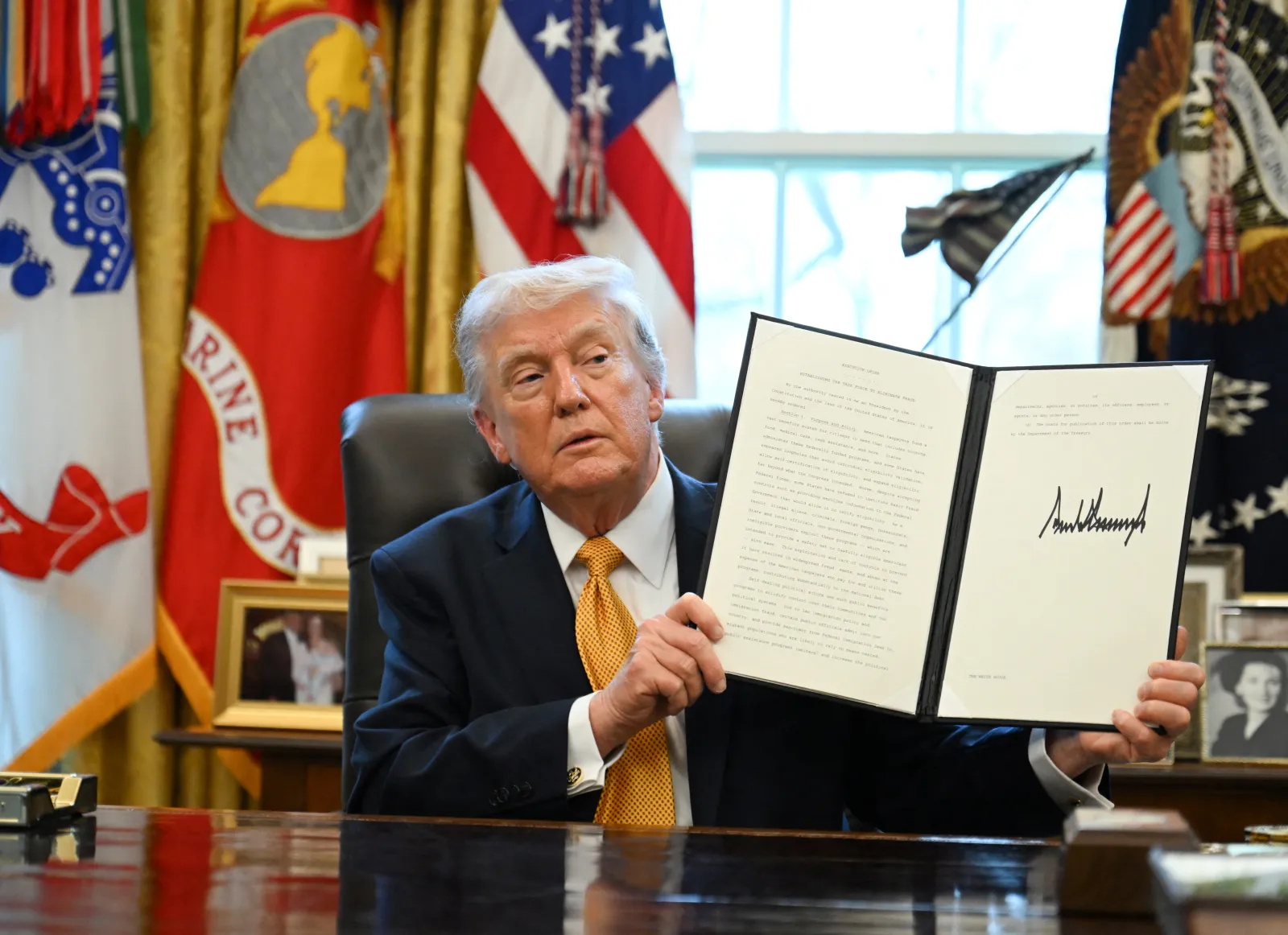
President Donald Trump is pitching this bill as a defining test for the republic, arguing it would curb election fraud and restore trust in democracy, and pointing to polling that shows most voters want its new rules in place.
Democrats counter that it would disenfranchise eligible voters, particularly poorer Americans and minorities, by requiring documentation that many do not readily have.
Read More on Analysis
Both arguments are familiar. What’s new is how openly this confrontation is being staged as a nakedly political exercise rather than a legislative one.
On Tuesday, Senate Republicans will begin a floor fight over the SAVE Act, which would require proof of citizenship to register to vote and tighten voter identification rules, while also increasing scrutiny of mail-in ballots.
The party lacks the 60 votes needed to overcome a filibuster. But leaders are not pretending otherwise.
Instead, Republicans are preparing for an extended debate, a leadership-managed stretch of floor time designed to force votes, frame the issue, and draw sharp contrasts ahead of crucial midterm elections.
That dynamic turns the filibuster from a procedural hurdle into the central character in the story. To Trump and his MAGA movement, the SAVE Act is drowning in Washington’s “swamp,” and the filibuster is a deadly creature lurking in its depths.
The Filibuster Face Off
The Senate’s Rule XXII, which governs cloture, requires 60 votes to end debate on most legislation. In practice, that means a unified minority can block a bill even if a majority supports it.
For Trump and his MAGA allies, that rule is not just some obscure procedural obstacle; it is a fundamental part of the argument.
They have cast the filibuster as evidence that Washington’s institutional rules prevent majoritarian change, allowing Democrats to block policies Republicans say are broadly popular without a simple-majority vote.
That is a politically potent message, even if incomplete. In fact, the filibuster has long been defended by both parties as a safeguard for minority rights.
Many Republicans remain wary of weakening it, knowing the same rule could constrain them in the future.
Still, the SAVE Act fight illustrates how Senate procedure can shape outcomes before the policy debate is fully engaged and in defiance of voters' wishes.
Republicans can force votes and generate a record, but without 60 votes, the bill’s trajectory is constrained from the start.
That reality does not necessarily weaken Trump’s position. It maybe even sharpens it: A blocked bill can be presented as proof that the system is broken. Or, as MAGA might put it, stuck in a swamp.
Thune’s Balancing Act
Republican Senate Majority Leader John Thune is navigating a narrow path between competing pressures inside his own party.
Trump has pushed aggressively for action, including publicly pressuring GOP lawmakers and warning of political consequences for those who do not support the bill.
At the same time, many Republican senators remain committed to preserving the filibuster, wary of setting precedents that could empower a future Democratic majority.
The result is a strategy calibrated for confrontation without escalation.
Republicans can advance the bill with a simple majority to open debate, keep the Senate floor active for days, and stage a series of amendment votes aligned with Trump’s priorities.
But they are unlikely to take the more drastic step of rewriting Senate rules to ensure passage.
That approach allows the party to demonstrate effort—and conflict—without triggering a broader institutional fight that could consume the chamber’s agenda.
It is, in effect, a controlled burn.
What Actually Gets Delivered
If the SAVE Act is unlikely to become law, what does this process produce?
Votes.
Republicans are expected to force votes on amendments that go beyond the bill’s core provisions, including stricter requirements on mail-in voting and other politically charged issues.
Many of these measures are not expected to clear the 60-vote threshold, but that is beside the point.
In a filibuster-era Senate, legislative fights often generate political assets rather than policy outcomes. Each vote creates a record. Each record becomes campaign material.
Republicans will argue that Democrats blocked “election integrity” measures. Democrats will argue that Republicans sought to restrict access to voting and federalize election rules traditionally left to the states.
The underlying policy dispute remains unresolved, but the political utility is immediate.
The Democratic Counterargument
Democrats are advancing a two-part case against the bill.
First, they argue that noncitizen voting in federal elections is already illegal and very rare.
Second, they believe requiring documentary proof of citizenship could burden eligible voters, particularly those without easy access to passports or birth certificates, and complicate election administration.
Those arguments are substantive, but the procedural context complicates their delivery.
Democrats are, in effect, relying on the filibuster to stop a bill they say is dangerous, while also inheriting the optics of using an anti-majoritarian tool they have criticized when it blocked their priorities.
That tension grows as the public story shifts from “what would the bill do?” to “why won’t the Senate vote?”
As the debate moves from policy to process—cloture votes, quorum calls, and amendment maneuvers—the optics can favor the side arguing that the system itself is the problem.
That may be an oversimplification. But it is a powerful one that MAGA has wielded successfully before.
MAGA Litmus Test
The Texas Republican Senate primary offers a live case study in how the SAVE Act has become a political litmus test for MAGA.
MAGA favorite Attorney General Ken Paxton has aggressively used the bill, and the filibuster blocking it, as a dividing line against incumbent Senator John Cornyn, casting support for dismantling Senate rules as proof of loyalty to Trump.
After Cornyn finished narrowly ahead in the March primary, Paxton escalated the pressure by publicly offering to consider dropping out of the runoff if Senate Republicans agreed to lift the filibuster and pass the SAVE Act.
It effectively turned a Texas intraparty race into a referendum on Senate procedure.
That gambit worked, at least politically.
Trump openly signaled that his endorsement decision hinges in large part on the fate of the SAVE Act, while Cornyn—long a defender of the filibuster—abruptly reversed course, saying he would support “whatever changes to Senate rules” are necessary to pass the bill.
The result is a striking inversion. A senior senator reshaping his institutional views under primary pressure, and a challenger leveraging legislative gridlock for his campaign.
In Texas, the SAVE Act is a proxy for whether Republican candidates are willing to confront the Senate itself in Trump’s name.
The Point of the Fight
Republicans cannot clear the 60-vote threshold. Democrats can stop the bill without converting the other side. The result is a legislative process that rewards confrontation and message-setting over resolution.
That is not new. But it is becoming more explicit.
The SAVE Act showdown is, in many ways, a referendum on the Senate itself. And to the MAGA hunters stalking the swamp, perhaps that’s the point all along.
Hey gang, Carlo Versano here. I hope you enjoyed this article. As Newsweek's Director of Politics and Culture and editor of the 1600 newsletter, I'm keen to hear what you think. Now, Newsweek is offering a new service to allow you to communicate directly with me in the form of a text message chat. You can sign up and get a direct line to me, as well as the reporters who work for me. You can shape our coverage.
As a Newsweek member, we're offering this service to you for free. You can sign up below, or read more about how it works here. Let's talk!
View 0 Comments
Submit Correction
View Editorial & AI Guidelines