10
Loading video...

By Jesus Mesa
Reporter
0
Share
Newsweek is a Trust Project member
See more of our trusted coverage when you search.Prefer Newsweek on Googleto see more of our trusted coverage when you search.
Some Michigan voters who helped return President Donald Trump to the White House in 2024 plan to vote for Democrat Abdul El-Sayed for U.S. Senate, a crack in the president's coalition that could matter in a race most polls show is separated by a few points.
Several of them live in Dearborn, a majority Arab American city that broke for Trump two years ago, largely out of anger over U.S. support for Israel's war in Gaza, and residents who backed him told The Washington Post this week that El-Sayed is now the one carrying the "America First" banner.
El-Sayed, a physician and former Wayne County public health director, is running against Republican former Representative Mike Rogers for the seat Democratic Senator Gary Peters is giving up. He will be the first Muslim in the U.S. Senate if he wins.
Read More on Politics
Michigan hasn't sent a Republican to the Senate since 1994. Rogers nearly ended that streak in 2024, losing to Democrat Elissa Slotkin by less than a percentage point on the same night Trump carried the state.
Newsweek reached out to the El-Sayed and Rogers campaigns for comment via email.
Mike Rogers vs. Abdul El-Sayed: Latest Polls
El-Sayed has led every major public poll released in the last two weeks, mostly by margins inside the error range.
His best number came from Glengariff Group, which surveyed 600 likely voters for The Detroit News and WDIV-TV from October 19-22 and found him ahead 51 percent to 45 percent. Four percent were undecided.
Independents moved, too. For the first time this cycle, Glengariff had El-Sayed winning them, 45.5 percent to 40 percent.
"The margin you're leading by among independents tends to be the margin that you win by," pollster Richard Czuba told The Detroit News.
The survey even put El-Sayed slightly ahead in the Upper Peninsula and northern Michigan, Trump country for years.
Other polls are closer. Marist University had the race at 50 percent for El-Sayed to Rogers' 48 percent among 1,185 likely voters polled October 15-18. InsiderAdvantage, surveying 1,200 likely voters October 21-22, found El-Sayed up by a point, 47 percent to 46 percent, with four minor-party candidates at 1 percent apiece.
A Michigan State University Institute for Public Policy and Social Research survey conducted with YouGov over a longer window, October 2-19, showed El-Sayed up 48 percent to 46 percent among 836 likely voters.
Related Story
Newsweek Webinar: How the Politics of AI Could Shape Midterms
Why Some Michigan Voters Who Chose Trump in 2024 Are Backing Abdul El-Sayed
Trump took about 42 percent of the vote in Dearborn in 2024, beating then-Vice President Kamala Harris in a city Democrats had treated as safe. Green Party nominee Jill Stein pulled roughly 18 percent there, much of it a protest vote over Gaza.
Among Arab Americans nationally, the mood has since shifted. In a Washington Post-Schar School poll, 58 percent said they support Democrats for Congress, after the group split evenly between Trump and Harris. Two-thirds of Arab Americans who voted for Trump still approve of the job he's doing overall. On Israel's war in Gaza, 54 percent disapprove.
The Post interviewed three Dearborn residents who voted for Trump in 2024 and now back El-Sayed. They said the president failed to end wars in Lebanon and Yemen and bring down prices. Mustapha El-Jaroudi, a two-time Trump voter, said Rogers would “put Israel first.” None regret their Trump vote, but all three said El-Sayed now best reflects “America First.”
Campaign finance records reviewed by Newsweek show where Dearborn’s loyalties sit. Donors in Dearborn and Dearborn Heights gave El-Sayed about $131,000 in itemized contributions from mid-July through September, from 212 people, according to Federal Election Commission filings. Rogers listed 11 donors from the same two cities who gave him about $9,100.
The money kept coming after the primary. Dearborn-area donors gave El-Sayed roughly $45,700 in July, ahead of his August 4 primary win, and about $45,000 in September, after the general election campaign was underway. Among them were physicians, pharmacists, attorneys and small business owners, and a Dearborn Heights city councilman.
El-Sayed has gone looking for these voters. One of his ads ran only on Fox News and Newsmax and stitched together clips of conservative hosts—Tucker Carlson and Jesse Watters among them—saying kind things about him. On the campaign trail, he blames Trump's war with Iran for what Michiganders pay at the pump, where a gallon of unleaded gasoline averaged $4.59 this month against $2.88 a year ago, according to AAA Michigan figures cited by The Detroit News.
...
Latest Developments in the Michigan Senate Race
Health and Human Services Secretary Robert F. Kennedy Jr. pushed the fight over El-Sayed's faith further on Monday. Campaigning in Grand Rapids for Rogers and Republican gubernatorial nominee John James, Kennedy told the crowd that "talking about the Muslim Brotherhood is not Islamophobia," then turned to Arabs as a whole.
"There's 500 million Arabs in the world. And yet they don't produce science," Kennedy said. "They don't win the Nobel Prize. They don't win the Fields Prize."
Egyptian chemist Ahmed Zewail won the Nobel Prize in Chemistry in 1999, Egyptian novelist Naguib Mahfouz won the literature prize in 1988 and Yemeni activist Tawakkol Karman shared the 2011 Peace Prize. Michigan has the highest share of residents reporting Arab ancestry of any state, about 2.2 percent, according to Census Bureau data.
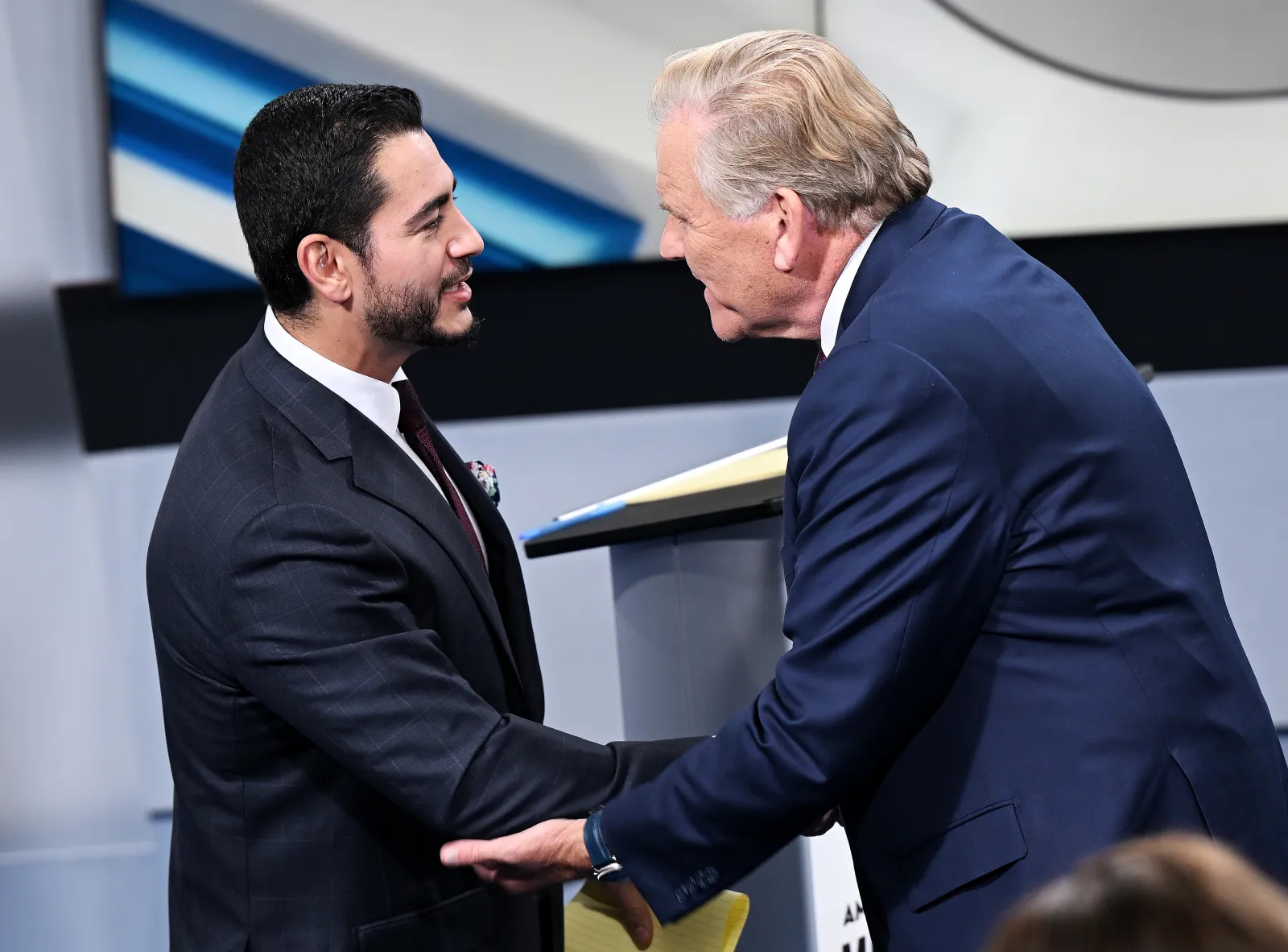
Kennedy spoke about a race in which El-Sayed's religion has become a central line of attack. Rogers has repeatedly tied him, without evidence, to the Muslim Brotherhood, and pressed it again at their final debate on October 21: "Are you for America, or are you for these terrorist groups overseas?"
Trump himself has mocked El-Sayed's middle name, Mohamed, and told reporters on his way to a Port Huron rally on October 25: "We don't want to see a jihadist senator."
El-Sayed, who has disavowed the group, called Rogers' question "shameful." Democrats and Muslim advocates describe the attacks as Islamophobic, an effort to cast the man who would be the first Muslim senator as less than fully American. Former President Barack Obama made that case at a Detroit rally on October 24, comparing it to the birther conspiracy once aimed at him.
"This stuff didn't work on me," Obama said. "Not in Michigan. It's not going to work on Abdul."

...
El-Sayed has hit back. He calls Rogers a Trump "sock puppet," told debate viewers to play "MAGA bingo" with his answers and has made the pro-Israel lobby a recurring target.
"That's what you get when you have an AIPAC-backed politician," he said during the debate.
AIPAC's super PAC, the United Democracy Project, is sending up to $9 million to a pro-Rogers super PAC after the pre-election disclosure deadline, The New York Times reported. Asked about the group's help, Rogers said: "I'll take all of that help."
El-Sayed has also drawn criticism for his own words. After an attack on a Detroit-area synagogue this year by a man who had lost relatives in an Israeli strike on Lebanon, El-Sayed said that "hurt people hurt people." He later apologized, saying: "To anyone who feels like my comments might have been hurtful, I'm really sorry."
El-Sayed practically dared Trump to come to Michigan, betting that the visit would remind voters whose candidate Rogers is. Port Huron is in a part of the state Trump carried with more than 66 percent of the vote in 2024. Rogers has edged away from the president on at least one issue, the tariffs on Canada, which he said hurt Michigan's auto industry.
The money keeps coming. Federal Election Commission filings show that El-Sayed raised about $30.7 million from mid-July through September, more than three times Rogers' $9.7 million. Republicans hold the edge on television, $105 million to $76 million in ad spending, according to AdImpact data reported by Axios, and Bridge Michigan counts more than $205 million in total disclosed spending on the race.
Jewish Opposition to Abdul El-Sayed May Not Matter in Michigan Race
The Muslim voter advocacy group Emgage estimates that there are more than 200,000 registered Muslim voters in Michigan. By comparison, Michigan is home to roughly 105,000 Jewish adults, about 1.4 percent of the state's electorate, according to the American Jewish Population Project at Brandeis University. Republican-aligned estimates run higher, up to 130,000.
"It is important to remember that no state has a higher percentage of Arab-American residents in the U.S. than Michigan. The Jewish population is less than half that of the Arab-American population there," Jim Kessler, executive vice president for policy at the centrist Democratic think tank Third Way, told Newsweek.
Arab American and Muslim are overlapping but distinct groups. Many of Michigan's Arab American residents are Chaldean and other Christians, while the state's Muslim community also includes South Asian and Black Muslims.

...
Turnout narrows the gap, Kessler warned. Jewish voters participate at high rates, while Muslim turnout has historically lagged. In the 2018 midterms, 50 percent of registered Muslim voters in Michigan cast ballots, according to Emgage.
In 2024, a Council on American-Islamic Relations exit poll of Michigan Muslim voters found that Stein received 59 percent support, Trump 22 percent and Harris 14 percent. Trump won more than 42 percent of the vote in Dearborn, where more than 55 percent of residents are of Middle Eastern descent, up from 30 percent four years earlier. Many others sat out. Early voting turnout was 25 percent in Dearborn and 24 percent in Hamtramck, against 44 percent statewide.
Those voters already delivered for El-Sayed once. In the August primary, he received 16,265 more votes than Michigan Representative Haley Stevens across Dearborn and Dearborn Heights alone, more than his statewide margin over her of a little more than 14,000 votes, in unofficial results.
Why Is the Michigan Senate Race Important in the 2026 Midterms?
Democrats need a net gain of four seats to flip the Senate, where Republicans hold 53.
The Cook Political Report rates Michigan a toss-up, the only Democratic-held seat with that rating, which makes it the likeliest place for Republicans to make up ground lost elsewhere.
Election Day is November 3.
Contact Newsweek editors on this story: Jenna deJong and Dave Siminoff.
View 0 Comments
Submit Correction
View Editorial & AI Guidelines