...

By Gabe Whisnant
News Editor
0
Share
Newsweek is a Trust Project member
See more of our trusted coverage when you search.Prefer Newsweek on Googleto see more of our trusted coverage when you search.
The Trump administration is considering a plan to punish certain NATO allies it views as insufficiently supportive during the war with Iran, including by relocating U.S. troops away from countries seen as unhelpful, according to administration officials cited by The Wall Street Journal.
The proposal under discussion would shift U.S. forces out of some NATO member states and move them to countries judged to have backed the U.S. military campaign more strongly, the Journal reported. While the plan would stop short of President Donald Trump’s recent threats to fully withdraw the United States from NATO—a move that would require congressional approval—it would represent a significant escalation in tensions within the alliance.
Newsweek has reached out to the White House via email on Wednesday evening for additional comment.
Read More on World
...
According to U.S. officials, the idea has circulated among senior White House and national security officials in recent weeks but remains in early stages and is one of several options being discussed to pressure NATO allies, the Journal reported. The deliberations underscore a growing rift between the Trump administration and European partners following the president’s decision to launch the war against Iran without broader allied backing.
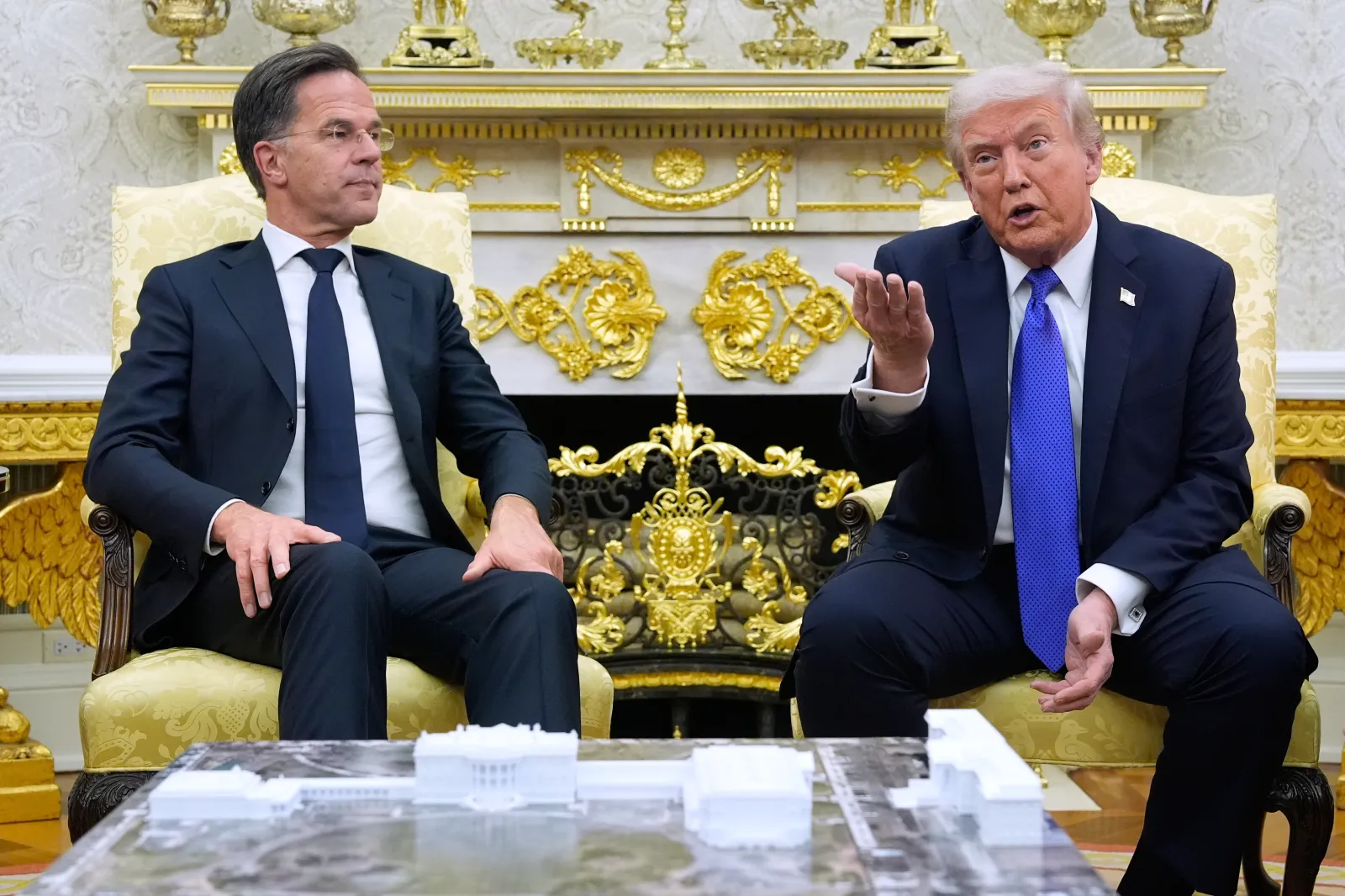
Donald Trump-Mark Rutte Meeting: What to Know
NATO Secretary‑General Mark Rutte traveled to Washington this week for talks with Trump, as officials sought to manage strains within the trans‑Atlantic alliance. White House press secretary Karoline Leavitt said Trump planned a “frank and candid” conversation with Rutte on Wednesday and accused NATO allies of failing to support the American people despite long‑standing U.S. defense commitments.
In response to a question from Newsweek's Leonardo Feldman during Wednesday's press briefing, Leavitt said Trump plans to discuss the extreme measure of NATO withdrawal directly with Rutte during talks at the White House.
“It’s something the president has discussed, and I think it’s something the president will be discussing in a couple of hours with Secretary-General Rutte,” Leavitt said when asked whether Trump remains open to leaving the alliance.
After his meeting with Rutte, in an all-caps message on Truth Social Wednesday night, the president echoed broader attacks on NATO over the Iran war and repeated his frustration with Denmark and the alliance over Greenland.
He posted, "NATO WASN’T THERE WHEN WE NEEDED THEM, AND THEY WON’T BE THERE IF WE NEED THEM AGAIN. REMEMBER GREENLAND, THAT BIG, POORLY RUN, PIECE OF ICE!!! President DJT"
Rutte, speaking Wednesday night to CNN's Jake Tapper, said his meeting with Trump was a "very frank, very open discussion, but it was also a discussion between two good friends.” He said on The Lead that the president is "clearly disappointed” with NATO allies.
Rutte met separately with Secretary of State Marco Rubio on Wednesday morning at the State Department ahead of the White House talks. In a statement, the State Department said the two discussed the war with Iran, U.S. diplomacy aimed at ending Russia’s war in Ukraine, and what it described as “increasing coordination and burden shifting with NATO allies.”

...
Trump's Growing NATO Feud
Trump has repeatedly criticized the 32-member NATO alliance.
Those tensions have intensified since the Iran war began in late February. Trump has repeatedly argued that securing the Strait of Hormuz is primarily the responsibility of countries that rely most on Middle Eastern oil flows, not the United States.
“Go to the strait and just take it,” Trump said last week, criticizing allies for what he described as a lack of initiative.
His frustration has been compounded by decisions from allies, including France and Spain, to restrict or deny U.S. access to their airspace or military facilities for operations related to the Iran war. While those countries and others have signaled willingness to participate in a post‑conflict international effort to secure Hormuz, they declined to support active combat operations.
British Prime Minister Keir Starmer, whom Trump has criticized publicly in recent days, was scheduled to travel to the Gulf region on Wednesday to support the fragile ceasefire and advance plans for a long‑term security arrangement for the strait. British officials say London has been working on proposals to protect navigation in the narrow corridor between Iran and Oman once the fighting ends.
U.S. Military Presence in NATO Countries
The United States has roughly 84,000 troops stationed across Europe, according to the Council on Foreign Relations, citing U.S. European Command (EUCOM). During the Iran conflict, some European governments placed limits on U.S. military access, including Italy’s temporary restriction on use of an air base in Sicily and France’s conditions on flights landing at a base in southern France.
Beyond troop repositioning, the administration is also weighing closing at least one U.S. base, possibly in Germany or Spain, according to officials cited by the Journal. Countries viewed as supportive—including Poland, Romania, Lithuania and Greece—could see increased U.S. troop presence. Those nations have higher defense spending levels and were among the first to support international efforts to safeguard shipping through the Strait of Hormuz.
Updates: 4/8/26, 7:48 p.m. ET: This article was updated with new information and remarks.
View 0 Comments
Submit Correction
View Editorial & AI Guidelines