
Getty Images

By Tom O'Connor
Deputy Editor, National Security and Foreign Policy
0
Share
Newsweek is a Trust Project member
See more of our trusted coverage when you search.Prefer Newsweek on Googleto see more of our trusted coverage when you search.
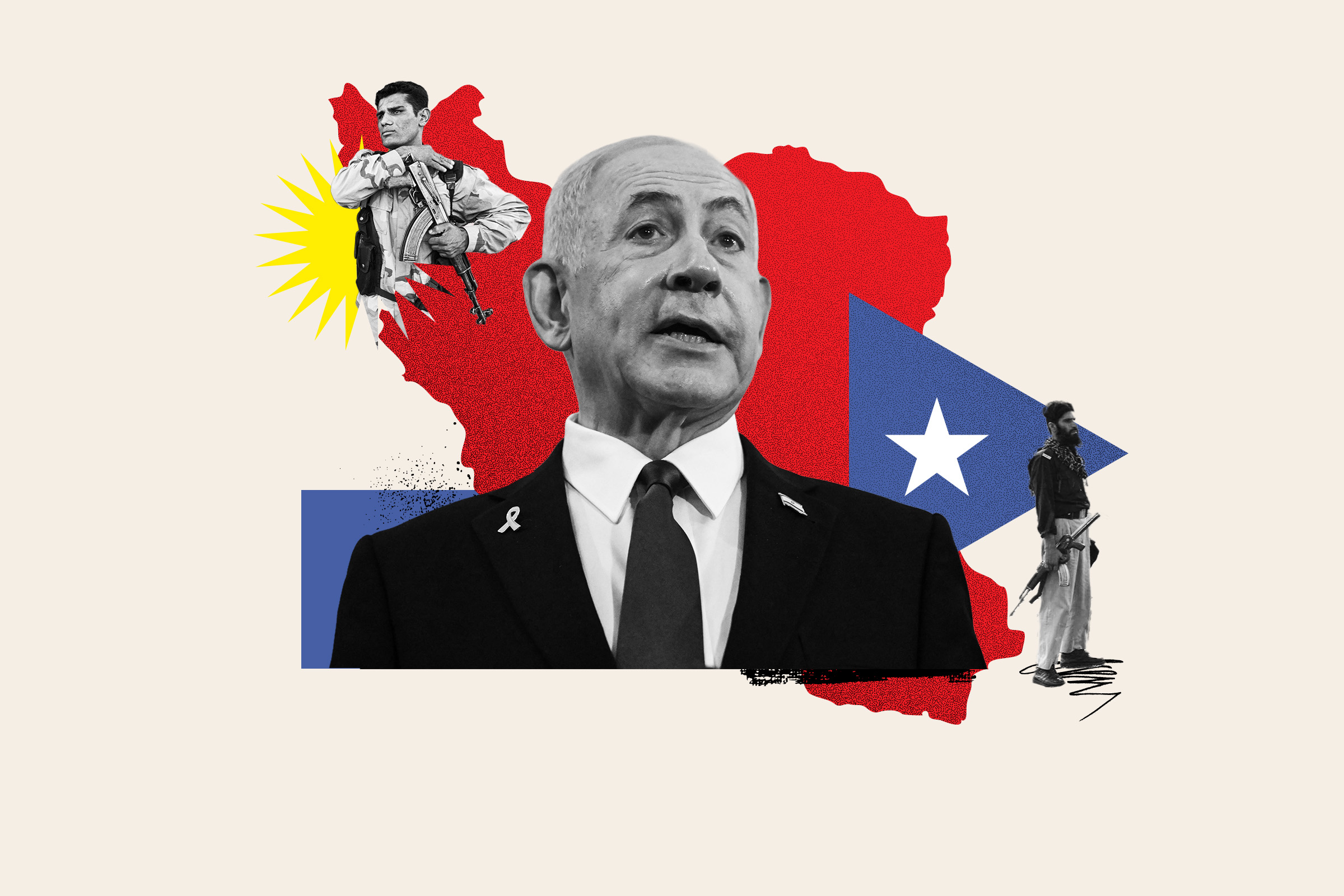
As the United States and Israel wage a devastating campaign against Iran from the air, reports are mounting of White House efforts to exploit Iran's ethnic divisions by providing direct support to Kurdish insurgents on the ground.
“I think it’s wonderful that they want to do that, I’d be all for it,” Trump said of a possible Iranian Kurdish offensive during an interview with Reuters on Thursday, declining to specifically confirm reports of CIA support already reaching the rebel groups primarily based in neighboring Iraq.
Such a move would follow the establishment, amid Iran's nationwide protests in January, of a new alliance known as the Coalition of Political Forces of Iranian Kurdistan, composed of the Democratic Party of Iranian Kurdistan (KDPI or PDKI), the Kurdistan Freedom Party (PAK), the Kurdistan Free Life Party (PJAK), the Organization of Iranian Kurdistan Struggle (Khabat) and the Komala of the Toilers of Kurdistan.
Read More on World
A sixth group, the Komala Party of Iranian Kurdistan, has since joined the pact, while a seventh, the Komala Kurdistan Organization of the Communist Party of Iran, has not yet signed. All share the overarching objective of driving Iranian security forces out of strategically critical northwestern regions comprising Iranian Kurdistan, known to Kurds as Rojhelat.
"The primary goal of these parties is to liberate Kurdish areas from the Iranian regime, establish local self-rule, participate in toppling the regime, and help rebuild a democratic Iran," Kamal Chomani, editor-in-chief and founder of The Amargi news outlet focused on Kurdish and regional affairs, told Newsweek. "They have Peshmerga forces ready to fight, and in the event of a security vacuum following regime collapse, they aim to protect their people and territories."
The Kurdish-language term "peshmerga," widely translated as "those who face death," is often used to describe Kurdish fighters of various movements, including those also present in Iraq, Syria and Turkey. Kurdish groups have at times demonstrated some of the most effective organizational capabilities in conflicts across the region.
Yet a new partnership with the U.S. and Israel also bears risks of blowback among the general Iranian public and neighboring states because of fears of potential separatist tendencies.
"The Iranian public will unite against any threat to Iran’s sovereignty, regardless of their political views," Shahed Ghoreishi, a former U.S. State Department official specializing in the Middle East, told Newsweek. "This is a red line for them. Iranians readily recall historic land losses from the 19th century with lament, let alone a modern threat to Iran’s borders."
"Iran’s military has already targeted Iraqi Kurdistan in response, and this is a risk for Iraq’s stability as well," Ghoreishi said. "If this were to make any progress, Türkiye would likely step in as well, creating further instability in the region rather than regime change in Iran."
Getty Images
A U.S.-Kurdish Playbook
Such an endeavor also poses substantial risks to Kurds, who have found their political aims cast aside in past military partnerships with Washington.
"Any support from Israel or the United States would significantly accelerate their mobilization and likely bring thousands of new recruits, as the Kurdish political future would become clearer," Chomani said. "However, these parties need strong political backing, not only military support."
Following Iraq's 1990 invasion of Kuwait, Iraqi Kurds staged a rebellion amid U.S. calls for a national uprising against then-President Saddam Hussein and won de facto self-rule over the north after the U.S. intervened directly in the First Gulf War the following year, establishing a no-fly zone. This autonomy became formalized after the 2003 U.S.-led invasion of Iraq, though Washington later opposed a 2017 referendum in Iraqi Kurdistan calling for independence.
Today, many Iranian Kurdish factions operate from across the border in northern Iraq, where Iran has conducted several missile strikes over the years targeting alleged rebel headquarters and suspected U.S. and Israeli spy installations. As Iraq finds itself drawn into the current war, with Iran and its allied Islamic Resistance in Iraq militias conducting strikes against U.S. bases, Baghdad has sought to affirm its neutrality in the conflict.
"There are three political constants of the government," an Iraqi government spokesperson told Newsweek. "It does not interfere in the affairs of neighboring countries. The government does not accept that Iraq be a base, passage, or launching point for attacking any of the neighboring countries. It rejects wars and seeks to resolve differences through dialogue, understanding, and negotiation."
"No party from inside Iraq has attacked any neighboring country," the spokesperson said, "and we do not accept that."
The U.S. has also partnered directly with Syrian Kurds, helping to form the Syrian Democratic Forces (SDF) in 2015 amid the war against the Islamic State militant group (ISIS). As then Syrian President Bashar al-Assad's government waged a separate campaign with aid from Russia and Iran against ISIS and various rebel groups in the midst of civil war, the SDF emerged as the Pentagon's top partner on the ground, assuming control of nearly one-third of the nation in largely Kurdish lands, referred to by Kurds as Rojava.
But this dynamic has shifted significantly since Assad was toppled by an insurgent coalition that brought current President Ahmad al-Sharaa to victory in December 2024. The Trump administration has ramped up pressure on the SDF to integrate into the central government despite lingering Kurdish concerns over the Islamist orientation of the ruling forces in Damascus, which also have the full backing of Turkey, a NATO ally long engaged in battle against Kurdish insurgencies.
Newsweek has reached out to the White House and the Turkish Embassy to the U.S. for comment.
In Iran, Kurdish factions have a long history of armed struggle against both the former West-backed monarchy and the Islamic Republic that toppled it in 1979. Throughout the Iran–Iraq War launched by Hussein the following year, some Iranian Kurdish groups collaborated with Baghdad, while some Iraqi Kurdish factions sided with Tehran, which has long accused both the U.S. and Israel of fomenting unrest through Kurdish contacts.
In October 2022, almost exactly one year before an attack led by the Palestinian Hamas movement against Israel would plunge the Middle East into a regional war, the Iranian Mission to the United Nations responded to Newsweek's interview with the head of the Komala Party of Iranian Kurdistan by questioning Washington's motives for fostering ties with a group the Islamic Republic holds responsible for the deaths of hundreds of Iranians.
"If the U.S. administration is committed to fighting terrorism," the Iranian Mission said at the time, "there should not be any adequate means and facilities for political activities and meetings at the disposal of this group."
With reports of Trump recently speaking directly to Iranian Kurdish leaders, Chomani said the president's "call came at an important time, because in Rojava similar political clarity did not come early enough."
"Recent developments in Syria and U.S. engagement with Ahmed al-Sharaa have made many Kurds cautious and disappointed," Chomani said. "Therefore, any cooperation between Kurdish forces and the U.S. or Israel would require clearer political guarantees."

...
A State Within a State
Thus far, suspicion persists within the ranks of Iranian Kurdish movements, though they have already begun setting the stage to seize the moment as the Islamic Republic's security forces struggle to deal with an overwhelming U.S.-Israeli air campaign that has disproportionately targeted northwestern provinces claimed by Kurds.
"The Kurds in Iran studied the Kurdish situation in Syria in January and want to make sure they, too, are not thrown under the bus by the West when the dust is settled," Diliman Abdulkader, founder of the American Friends of Kurdistan advocacy group, told Newsweek. "While the Kurds are eager for the regime to collapse, they will specifically focus on liberating what they view as their historical land, Rojhelat or Eastern Kurdistan."
"It is highly unlikely that they will march to Tehran as some have speculated," Abdulkader said. "The goal here is to inspire the rest of the country to rise against the Islamic regime, not for the Kurds to lose thousands of lives across Iran, like in Syria, only to be betrayed at the end."
In pursuing these aims, Abdulkader argued that the Iranian Kurdish front would seek to replicate the level of U.S. support provided in Iraq, along with the autonomy that ensued and lasting guarantees against anticipated opposition from Turkey.
"The Kurds are hoping to gain their autonomy, similar to that of the neighboring Kurdistan Region, with the full backing of the United States," Abdulkader said. "Of course, there are major risks and concerns, but they’re willing to take the chance. They’re fully aware of the threats that will emerge from Turkey, but that is part of the guarantee they’re requesting from the United States, to restrain their NATO ally not just for now during the conflict, but for 10, 20, and 30 years from now."
"The Kurds in Iran would likely request a no-fly zone, similar to what the Kurds in Iraq received during the first Gulf War, so that not only Turkey, but even Iran cannot penetrate," he added.

...
Divide and Conquer
Kurds are one of several ethnic minorities in majority-Persian Iran, where separatist movements have also emerged over the decades among Arab, Azeri and Baloch communities. The recently formed People's Fighters Front is led by Baloch Islamist militant group Jaysh al-Adl, considered a terrorist organization by both the U.S. and Iran, as well as neighboring Afghanistan and Pakistan, which are currently engaged in their own clashes over allegations of harboring militant groups.
But such a status did not prevent the U.S. from supporting Kurdish groups linked to the Kurdistan Workers' Party (PKK), also designated a terrorist organization by Washington and the primary focus of Ankara's military efforts against Kurdish insurgency across Turkey's borders. A number of fighters of Syria's SDF and many other Kurdish movements openly bear the symbols of the PKK and its leader Abdullah Öcalan, who remains imprisoned in Turkey.
Kurdish and Baloch movements in Iran have also received renewed attention from Israel over the past year as Prime Minister Benjamin Netanyahu mounted a campaign in support of another regional minority, the Druze, in Syria.
Such tactics have proved controversial among Iran's 90 million people, whom Trump and Netanyahu are calling on to carry out the task of ousting their government. Even one of the most prominent opposition figures abroad, Reza Pahlavi, son of Iran's last shah who was overthrown in the Islamic Revolution nearly half a century ago, has weighed in against the Kurdish coalition.
"Few forces mobilize Iranian nationalism more quickly than the fear of territorial fragmentation," Ali Vaez, Iran project director at the International Crisis Group, told Newsweek. "Even many Iranians who despise the regime recoil at the prospect of the country breaking apart. Rumors of partition are already shifting sentiment—turning some who once hoped foreign intervention might rid them of their tormentors against the war."
"Washington and Jerusalem may calculate that a regime preoccupied with restoring internal territorial control will be less able to project power abroad," Vaez said. "But that is a risky wager. Kurdish instability in western Iran could quickly draw in Turkey and spill over into Iraq, injecting yet another layer of volatility into an already fragile region."
Update 9:06 p.m. ET: This article has been updated to include additional information and to reflect a newer affiliation for Kamal Chomani.
In a polarized era, the center is dismissed as bland. At Newsweek, ours is different: The Courageous Center—it's not "both sides," it's sharp, challenging and alive with ideas. We follow facts, not factions. If that sounds like the kind of journalism you want to see thrive, we need you.
When you become a Newsweek Member, you support a mission to keep the center strong and vibrant. Members enjoy: Ad-free browsing, exclusive content and editor conversations. Help keep the center courageous. Join today.


View 0 Comments
Submit Correction
View Editorial & AI Guidelines