Getty Images

By Andrew Stanton
Reporter
0
Share
Newsweek is a Trust Project member
See more of our trusted coverage when you search.Prefer Newsweek on Googleto see more of our trusted coverage when you search.
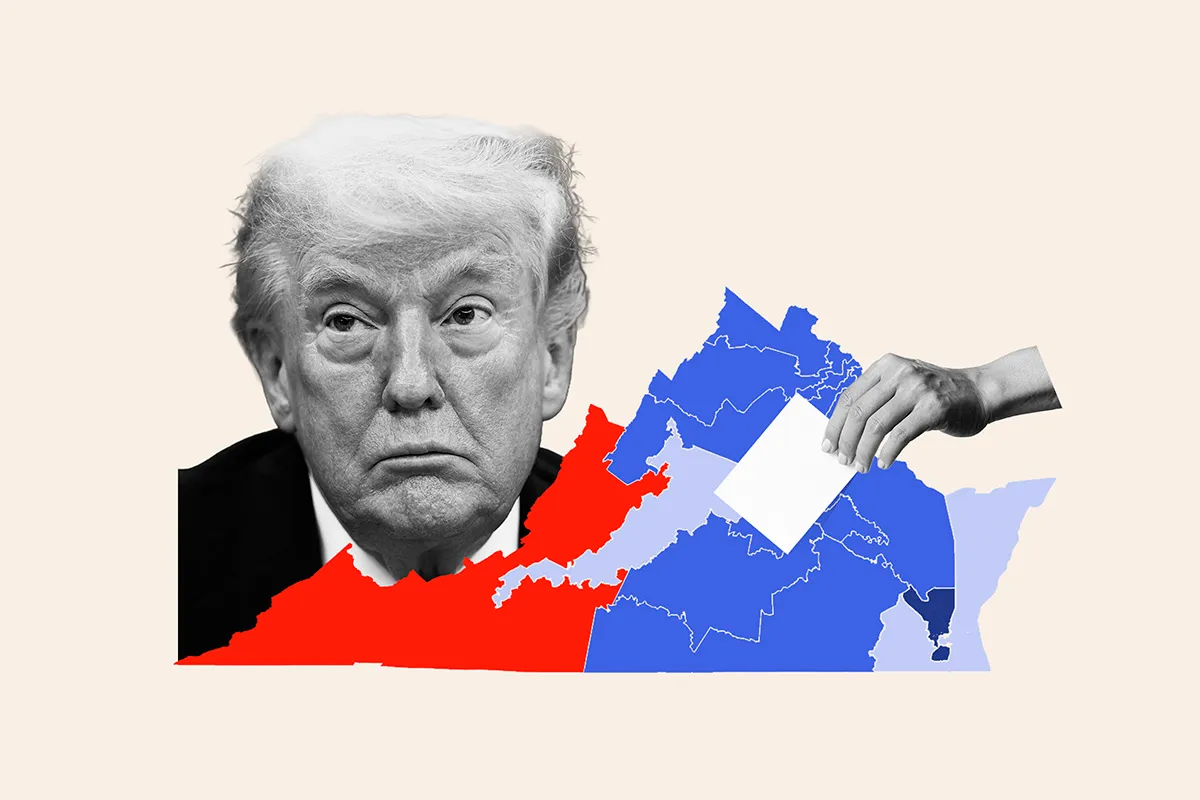
Virginia voters approved a constitutional amendment reshaping the state’s congressional map on Tuesday, dealing a setback to President Donald Trump’s mid‑decade redistricting push ahead of the 2026 midterm elections.
The decision could help Democrats flip multiple House seats, blunting Republican efforts to redraw maps in GOP‑led states such as Texas and North Carolina.
Democrats are now favored to flip up to four new seats in the Virginia map and five in California, erasing potential Republican gains in states like Texas, North Carolina and Missouri, all of which redrew their maps to favor the GOP in hopes of mitigating Democratic pickups in a November “blue wave.” Trump’s redistricting push has largely backfired on Republicans, as Democrats may end up outright winning the battle.
Read More on Politics
Political scientist Larry Sabato told Newsweek the results are a “disaster” for Trump.
“It isn’t just the War with Iran. Here’s another disaster brought about by Trump’s inability to look beyond step one and understand the consequences of his actions. Did he think Democrats were just going to unilaterally disarm? Sometimes they do, but not when it involves their congressional seats,” he said.
Newsweek reached out to the White House for comment via email.
Why It Matters
Redistricting typically occurs once per decade after the Census. But mid‑cycle map changes—rare in modern politics—have reshaped the 2026 House battlefield as both parties race to lock in partisan advantages ahead of an expected volatile midterm.
The redistricting arms race began in Texas. Republicans sought to redraw the state’s map to make five districts held by Democrats more conservative to offset potential Democratic gains in the November election. Historically, the party in the White House loses seats in the midterms, and Trump’s declining approval rating threatens to weaken Republicans in competitive races.
Getty Images
How Trump's Redistricting Strategy Unraveled
The passing of the Virginia redistricting amendment means Democrats have offset Republican gains in states like Texas. In fact, Democrats could even end up picking up a few extra seats based on redistricting if things go particularly well for them in the midterms.
Republicans have hoped to pick up five seats in Texas, one in North Carolina, one in Missouri and two in Ohio, giving them a total of 9 potential pickups due to redistricting ahead of the midterms. Democrats, meanwhile, could pick up five seats in California, four in Virginia and one in Utah—giving them 10 potential redistricting pickups.
Forecasters view some of these seats are likely flips for the midterms, but some of these races are still considered competitive.
Mid-decade redistricting has accomplished “nothing” for Trump, Stephen Farnsworth, political science professor at the University of Mary Washington, told Newsweek on Wednesday.
“President Trump has lost another election in Virginia, and this one may cost Republicans their House majority this fall,” he said.
Shawn Donahue, a political science professor at the University at Buffalo, told Newsweek that Democrats have “at least come out even.”
“It feels that whenever Trump and Republicans started this, they didn’t anticipate the aggressive pushback by Democratic states, and in particular Virginia,” he said.
White House press secretary Karoline Leavitt addressed why Trump did not campaign more actively against the referendum on Wednesday.
“The president has a lot on his plate, a lot on his schedule. He did host a telephone call prior to the election, the night before,” Leavitt said.
States That Have Redrawn Their Maps
California
California Democrats sought to draw out GOP Representatives Kevin Kiley, David Valadao, Ken Calvert, Darrell Issa and the late Representative Doug LaMalfa. The Cook Political Report favors Democrats in all but one of those seats. The district held by Valadao in the Central Valley is viewed as a toss-up where both Democrats and Republicans have a roughly even chance of winning in November.
Missouri
For Republicans, the Missouri redraw is their safest—the Kansas City-based district held by Democrat Emanuel Cleaver was redrawn to have backed Trump by 18 points in 2024 and is not expected to be competitive.
North Carolina
North Carolina Republicans targeted North Carolina’s First District, held by Democratic Representative Don Davis, in the eastern region of the state that has become more conservative in recent years. It backed Trump by nearly 12 points in its current configuration. Republicans are favored, but the race is still viewed as potentially competitive, according to election forecasters.
Texas
In Texas, Republicans are favored to pick up two of the Democrat-held seats redrawn to become more conservative.
The suburban Dallas seat held by Representative Julie Johnson and the Houston seat held by Representative Al Green both easily backed Trump in 2024 in their new form.
The Central Texas seat held by Representative Greg Casar is also viewed as a likely pickup for Republicans, though it’s less red than the other two seats.
Three other seats are less solid for Republicans in South Texas, once a Democratic stronghold that shifted rightward in 2024. The GOP sought to draw out Democratic Representatives Henry Cuellar and Vicente Gonzalez.
Although Trump did well here in his most recent election, there have been signs that Hispanic voters could be reverting back to Democrats. Both seats got a bit more red in redistricting, but not so red that Republicans are favored to flip them in major forecasters.
Donahue said Republicans may have fallen into a “trap” where they believe Hispanic voters would only get more Republican after 2024, when that is not necessarily the case. The seat vacated by former Representative Tony Gonzales, who resigned from Congress earlier this month, is one that could be more vulnerable for Republicans due to redistricting.
Ohio and Utah
Ohio and Utah are different cases; they were both required to redraw their maps due to court orders. In Ohio, Republicans hoped to draw out Democratic Representatives Greg Landsman, who represents Cincinnati, and Marcy Kaptur, who represents Toledo and northwest Ohio. Both seats got slightly more red in redistricting but are still competitive.
Democrats are heavily favored to pick up a seat in Utah based around Salt Lake City.
Why Republicans Lost Virginia Redistricting Fight
The Virginia referendum is the latest blow to Republicans in the redistricting arms race that could cost Republicans several seats in the midterms. Following the vote, the Republican Party faced scrutiny from some of its own voters over its approach to the referendum.
“I didn’t see a single Republican ad combatting the redistricting of Virginia. Hate to say it but the GOP totally dropped the ball in Virginia,” conservative activist Laura Loomer wrote in a post to X Wednesday morning.
Indeed, Democrats did spend significantly more on ads to pass the referendum. AdImpact showed that $56.4 million was spent on ads in favor of the amendment, compared to $24.6 million spent on ads against the referendum.
While Republicans have garnered scrutiny over ad spending, Representative Marjorie Taylor Greene said she believes Republicans lost for another reason.
“It’s the absolute failures of Republicans to pass the agenda that the American people voted for in 2024 and it’s the complete and total campaign betrayals by President Trump of him going to war and Iran and fighting the release of the Epstein files and protecting the elite pedophiles,” she wrote to X.
Farnsworth told Newsweek that the “yes” side made Trump the issue here, successfully simplifying the question for voters.
“The vote margin was far closer than the race for governor last year, in part because Virginia had passed a previous constitutional amendment to end gerrymandering not that long ago. The argument to reverse that decision in light of the re-redistricting pushed by President Trump in Texas and elsewhere was not the easiest case to make to voters,” he said.
Virginia had passed a bipartisan redistricting commission in November 2020 to avoid gerrymandering. Its current map was drawn by that commission and has been viewed as a fair map by both Democrats and Republicans.
Republicans made a “mistake not to have redirected” more funding to the referendum, he said.
The vote was close in Virginia, viewed as a light blue state that has narrowly backed Democrats in most recent races. The “yes” side won by only about three points, according to the Associated Press. That’s a notable shift from November, when Democrat Abigail Spanberger won the gubernatorial race by about 15 points.
The map still must survive a legal challenge before November.
Trump played a major role in the amendment's passing, Jeremy Mayer, a George Mason University political science professor, told Newsweek.
“Virginia is still a purple state. But it turns blue if the topic is Trump. Virginia is also a very educated state. Educated people often look at the words that Trump posts, the things that he says, and have a visceral reaction of disgust at the lack of cognition on display,” he said.
Trump’s “war on the federal bureaucracy has made him anathema in much of Virginia, particularly Northern Virginia,” he said.
“Add to that the Iran War, and his low approval ratings almost guaranteed this outcome. If he hadn’t attacked Iran, the Republicans would have had a better shot at winning the election,” he said.
Trump had vocally opposed the redistricting amendment.
“VIRGINIA, VOTE 'NO' TO SAVE YOUR COUNTRY!” he wrote to Truth Social on Tuesday.
Donald Trump Responds to Virginia Election Results
Trump responded to the election results in a post to Truth Social on Wednesday, describing it as “rigged.”
“All day long Republicans were winning, the Spirit was unbelievable, until the very end when, of course, there was a massive ‘Mail In Ballot Drop!’ Where have I heard that before — And the Democrats eked out another Crooked Victory,” Trump wrote. “Six to five goes to ten to one, and yet the Presidential Election in November was very close to a 50-50 split. In addition to everything else, the language on the Referendum was purposefully unintelligible and deceptive.”
Which Virginia House Races Shifted After the Vote
Elections forecaster Sabato’s Crystal Ball gave Democrats an advantage in four GOP-held seats in Virginia following the referendum.
Virginia’s Second District, held by GOP Representative Jen Kiggans, shifted from a toss-up to Leans Democratic. This was a seat that became a bit more blue but was expected to be targeted by Democrats regardless. Under the new map, it backed former Vice President Kamala Harris by nearly five points.
Virginia’s First District, held by GOP Representative Rob Wittman, shifted from Likely Republican to Likely Democrat. Democrats hoped to target this seat, which backed Trump by only a few points in its current form, though Republicans have been favored. It backed Harris by nearly 8 points on the new map.
Virginia’s Fifth District, held by GOP Representative John McGuire, shifted from Safe Republican to Likely Democratic. It backed Harris by nearly nine points.
Virginia’s Sixth District, held by GOP Representative Ben Cline, is now viewed as Leans Democratic. It backed Harris by about three points.
Kiggans has confirmed she’s running in her current district, but incumbents’ intentions in other seats have been less clear.
“But as we are writing right now, Democrats appear to have the upper hand in the overall redistricting battle, which now includes new maps in seven states: California, Missouri, North Carolina, Ohio, Texas, Virginia, and Utah,” Sabato’s Crystal Ball Managing Editor Kyle Kondik wrote in the update.
Lindsey Graham Urges South Carolina to Redraw
South Carolina Senator Lindsey Graham, a Republican, called on his home state to redraw its own map following the Virginia vote.
“After the Virginia Democrats’ efforts to redistrict in order to increase Democrat seats in the House of Representatives, South Carolina should consider fighting fire with fire. I would encourage South Carolina’s next Republican governor and the Republican legislature to seriously look at what our state’s response should be to Democrats in Virginia. Republicans in South Carolina should consider being bold and fighting back,” he wrote.
In South Carolina, Republicans currently hold a 6-1 delegation majority in the House.
Democratic Representative James Clyburn has represented South Carolina’s Sixth District since 1993. It is one seat that could potentially be impacted if the U.S. Supreme Court rolls back parts of the Voting Rights Act, but it’s not clear if the district could be substantially redrawn as long as it is still in place.
Florida Republicans Eye Redistricting
Florida Republicans have not ruled out redistricting and could pursue it following Democrats’ win in Virginia, with the hopes of picking up a few extra seats in the Sunshine State.
The map is already viewed as favorable to Republicans, but some in the GOP hope to pick up extra seats in the Tampa, Orlando and South Florida areas.
House Minority Leader Hakeem Jeffries, a New York Democrat, warned Republicans against redistricting in Florida in a statement to Punchbowl News.
“If Florida Republicans proceed with this illegal scheme, they will only create more prime pick-up opportunities for Democrats, just as they did with Trump’s dummymander in Texas. We will aggressively target for defeat Mario Díaz-Balart, Maria Elvira Salazar, Carlos Giménez, Kat Cammack, Anna Paulina Luna, Laurel Lee, Cory Mills and Brian Mast. We are prepared to take them all on, and we are prepared to win,” he wrote.
DeSantis responded to Jeffries on X, writing: "Hakeem Jeffries campaigning in Florida would be an early Christmas gift for Republicans in Florida. Happy to roll out the red carpet!"
But it’s not clear that all Republicans are on board for redistricting, as it could leave some incumbents in more precarious positions in November, particularly if there is a “blue wave” that allows Democrats to win in more conservative areas.
According to Donahue, whether Florida Republicans can successfully redistrict is tied to whether the electorate in the midterms resembles that of 2024, when it backed Trump by double-digits, or 2020, when it backed him by only about three points.
“Is it going to be that really, really friendly electorate to Trump or is it going to be more competitive?”
Reversion among Hispanic voters, as well as recent Democratic victories in Florida special elections, could complicate redistricting in the state.
“That has to feel like a little bit of a warning sign,” Donahue said.
A Civic Data & Research Institute report, first reported by Florida Politics, found that more aggressive redistricting in the state “may paradoxically increase Republican vulnerability to adverse electoral conditions.”
Also looming is the Supreme Court decision in Louisiana v. Callais, which could weaken the Voting Rights Act to the point that it would no longer require states in the South to draw Black-majority seats. If that is overturned, Republican states in the South could drastically redraw their maps to favor Republicans.
The redistricting has “backfired on all sides,” according to Mayer, of George Mason University.
“The overall impact is further polarization, further hatred, in American politics,” he said.
What Happens Next
The new Virginia congressional map faces a legal challenge that must be resolved before ballots are finalized for November. Meanwhile, Republicans in Florida and other GOP‑led states are weighing whether to pursue additional redistricting efforts, a move that could further reshape the House battlefield ahead of the 2026 midterms.
View 0 Comments
Submit Correction
View Editorial & AI Guidelines