...

By John Feng
China Editor
0
Share
Newsweek is a Trust Project member
See more of our trusted coverage when you search.Prefer Newsweek on Googleto see more of our trusted coverage when you search.
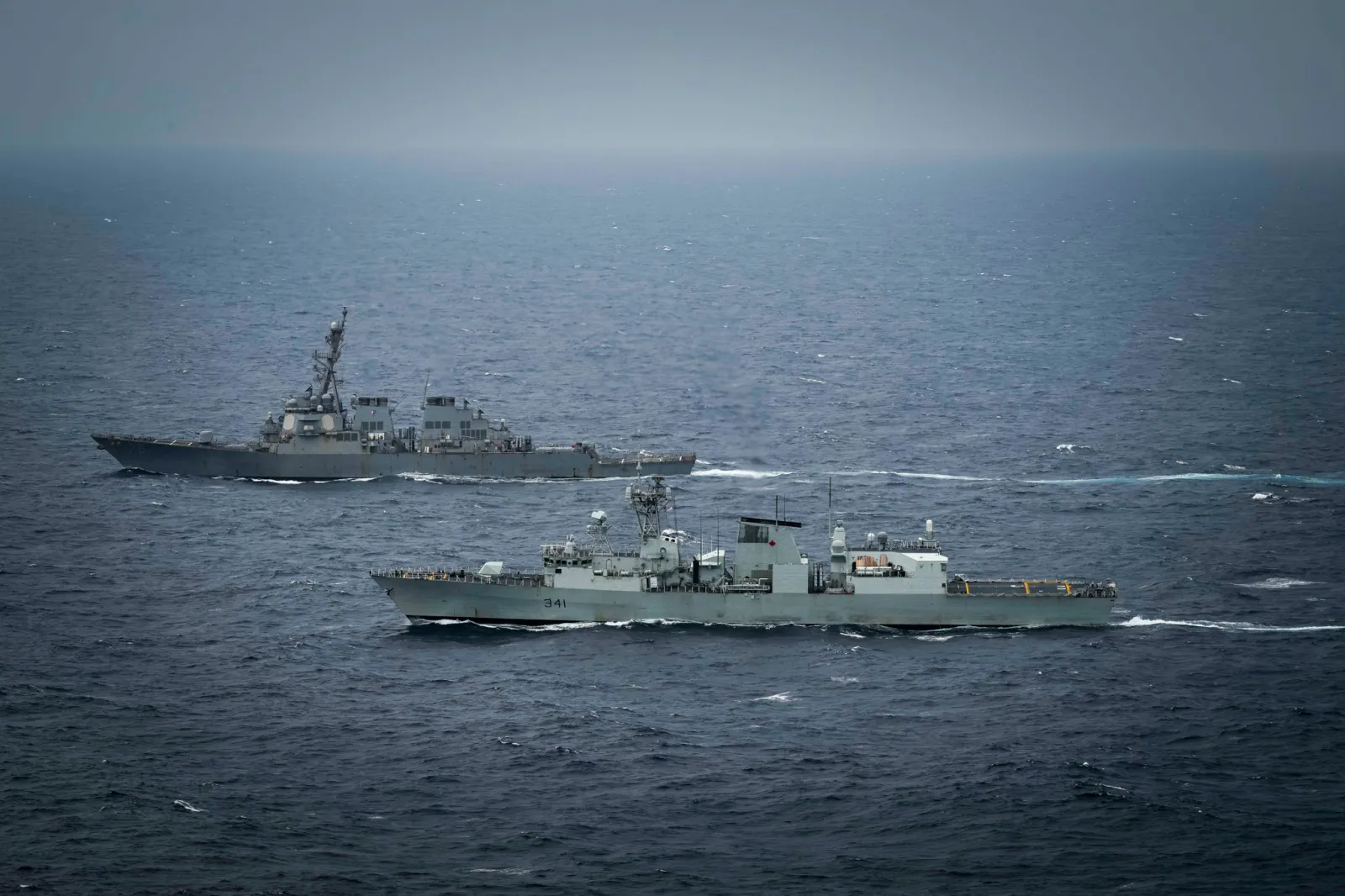
China said it deployed naval and air force on Friday to monitor a pair of U.S. and British warships sailing through the Taiwan Strait, a busy shipping lane it claims as its own.
The American ship USS Higgins and British vessel HMS Richmond "provoked trouble" in its coastal waters, a Chinese military spokesperson said.
Major Jason Welch, a spokesperson for the U.S. Indo-Pacific Command, told Newsweek in an emailed statement: "The U.S. Navy Arleigh Burke-class guided-missile destroyer USS Higgins (DDG 76) and a Royal Navy frigate conducted a routine Taiwan Strait transit Sept. 12 (local time) through waters where freedoms of navigation and overflight apply in accordance with international law."
Read More on World
"The ships transited through a corridor in the strait that is beyond the territorial sea of any coastal state," Welch said
China's Defense Ministry could not be reached for comment after hours.
Why It Matters
The Taiwan Strait separates China from democratically governed Taiwan, which Beijing claims as its own despite Taipei's objections. The waterway—just 80 miles wide at its narrowest point—has for decades kept the longtime foes at arm's length of one another, but the United States fears China could soon use its overwhelming military advantage to make good on its longstanding territorial ambitions.
The U.S. and other Western navies have periodically sent warships to the strait in shows of force to preserve the status quo, and to openly reject the Chinese government's recent assertions that foreign military vessels should not be allowed to operate in the waters without its permission.
Last week, Beijing issued a similar warning to Canada and Australia after the allies similarly sailed warships to the area.
What To Know
Shi Yi, a spokesperson for the Eastern Theater Command of the Chinese People's Liberation Army, said the U.S. and British governments "send wrong signals and undermine peace and stability across the Taiwan Strait."
Shi said Chinese forces were mobilized to monitor the ships throughout their passage, according to a brief statement released online.
...
The Higgins and the Richmond, a Type 23 frigate*,* both were pictured earlier this week sailing alongside the aircraft carrier HMS Prince of Wales, the British navy flagship, in rare maneuvers in the Western Pacific.
The Prince of Wales is on the homeward leg of a months-long deployment to the Indo-Pacific region that began in April. It did not sail through the Taiwan Strait despite previous discussions about what would have been a largely symbolic move.
A spokesperson for the British Defense Ministry told Reuters that the Richmond's transit through the strait was "a routine passage" as part of the carrier strike group's movements.
On Thursday, a satellite photo captured China's most advanced aircraft carrier, the yet-to-be-commissioned Fujian, operating in the same waters.
The Higgins is home-ported in Yokosuka, Japan, and is a member of Destroyer Squadron 15 of the Pacific Fleet. Last month, Beijing claimed it had expelled the ship from near Chinese-controlled territory in the contested South China Sea.
What People Are Saying
Ely Ratner, former assistant secretary of defense for Indo-Pacific security affairs in the Biden administration, now a principal at the Marathon Initiate think tank, said on X: "Terrific to see U.S. and U.K. combined Taiwan Strait transit, also on the heels of Australia and Canada transit."
"Critical to keep demonstrating that countries in and outside of the Indo-Pacific are committed to peace and stability in the Taiwan Strait."
Major Jason Welch, USINDOPACOM spokesperson, told Newsweek: "Higgins' transit through the Taiwan Strait demonstrates the United States' commitment to upholding freedom of navigation. Navigational rights and freedoms in the Taiwan Strait should not be limited. The United States rejects any assertion of sovereignty or jurisdiction that is inconsistent with freedom of navigations, overflight, and other lawful uses of the sea and air."
What Happens Next
The Trump administration has dialed down the frequency of its public challenges to China's maritime claims in a bid to stabilize relations, but a quiet U.S. and allied military presence off Chinese shores is likely to continue.
Update 9/13/25, 2:50 a.m. ET: This article was updated to include a statement from the U.S. Indo-Pacific Command.
View 0 Comments
Submit Correction
View Editorial & AI Guidelines