
...


By Alice Gibbs and Hannah Parry
0
Share
Newsweek is a Trust Project member
See more of our trusted coverage when you search.Prefer Newsweek on Googleto see more of our trusted coverage when you search.
The Trump administration has increasingly blamed vandalism for problems at the newly renovated Lincoln Memorial Reflecting Pool—alleging that individuals used chemicals and even cut a “350-foot” gash into the lining.
On Wednesday, President Donald Trump shared more details about the alleged vandalism, warning that people trying to destroy or damage the pool could face a decade in prison.
While arrests have been made and security tightened, authorities have now released CCTV images and video as part of an active investigation, the public evidence available so far does not appear to show actions consistent with the most serious claims. A review of the timeline shows algae and peeling emerged almost immediately after reopening, before the most serious sabotage claims were made.
Read More on U.S.
How The Story Started
Trump announced in April that he wanted the Reflecting Pool resurfaced with a swimming-pool-style coating in what he called “American flag blue,” saying the site had become dirty and neglected and promising a quick, dramatic fix.

...
By June 4 and June 6, Trump was publicly declaring the work effectively finished. Local and national outlets reported that the final protective coat had been added and that the pool was being refilled, with the administration presenting the makeover as complete just days before the problems now at the center of the controversy became visible.
Algae and Paint Peeling
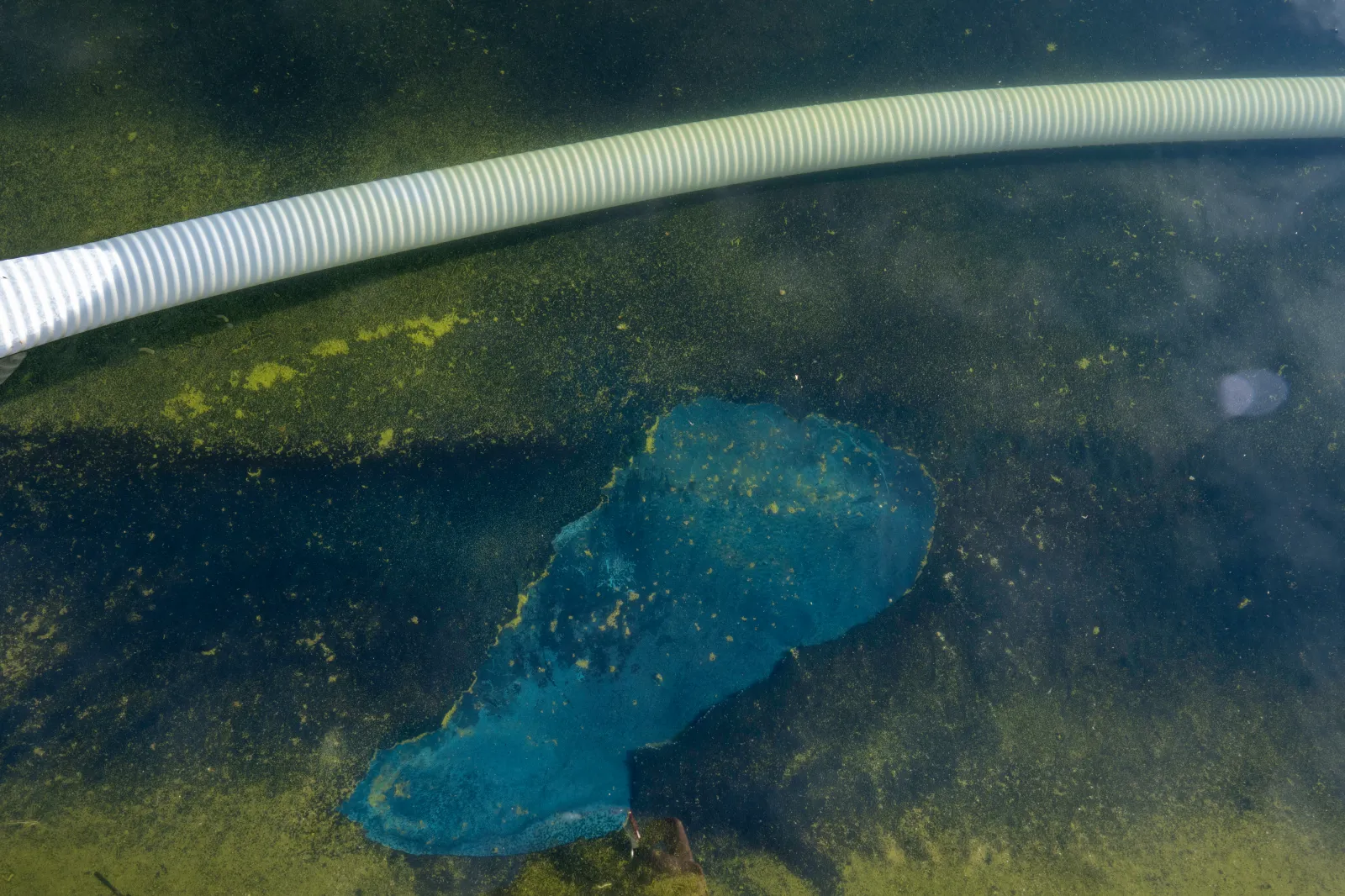
Within days, however, the first problems emerged. By June 14, the water had turned green, with officials attributing the bloom to residual algae in supply lines and deploying hydrogen peroxide and ozone treatments to try to fix it.
Experts, however, pointed to potential elements that can impact algal growth, including residual algae, but also the “American flag blue” coating and underlying infrastructure issues.
Alla Silkina, an algal biotechnology expert at Swansea University, told Newsweek: “Darker surfaces can absorb more solar radiation and increase local water temperatures. This may create more favorable conditions for algal growth.”
On June 18, a second issue became visible: the blue coating itself was peeling away from the pool floor. Experts pointed to a range of possible causes—including trapped moisture, adhesion issues, chemical treatments and environmental stress—rather than a single clear trigger.
Experts again pointed to multiple causes for potential peeling, including algae growth, chemical treatments, adhesion problems and environmental stress.
R. Douglas Hooton, professor emeritus of civil and mineral engineering at the University of Toronto, told Newsweek trapped water could be a culprit.
“Either the concrete was not sufficiently dry when the coating was applied, or that there is water rising up through the slab from the ground below. The coating is meant to be water proof, so any trapped water will cause it to de-bond,” he said.
Trump Discusses 'Gash'—and Then Ups the Size
Trump’s description of the alleged physical damage has also evolved.
He initially described a “250-foot gash” in the pool lining. That later became a “290-to 300-foot slit,” and on June 23 he called it a “350 ft slip in the form of lots of little slips,” which he said was created using a knife or similar tool.
“The reflecting pool looks fantastic,” Trump said in one interview, before adding: “Somebody went in with a knife and cut it. Real horrible stuff.”
Trump has also mocked critics as “pro‑algae” activists, sharing images of demonstrators—including one holding a sign reading “First they came for the algae…”—as he framed opposition to the project as politically driven.
Vandalism Accusations
Trump first accused vandals of damaging both the grounds and the interior of the pool on June 20, alleging the use of chemicals similar to those cited in a separate incident involving grass on the National Mall.
During a White House meeting with NATO Security General Mark Rutte on Wednesday, Trump went into more detail, accusing the alleged vandals of taking a box cutter or razor blades to the lining.
"They took razor blades and knives and they cut patches like 350ft long," he said, "They came in and they cut it. And then they grabbed it and they pulled it up. That's why it's all ripped," he added, saying that the vandals might be suffering from "Trump Derangement syndrome."
In a June 24 court filing, National Park Service Deputy Director Frank Lands stated that: "On June 9, 2026, after the rehabilitation project was substantially complete, the U.S. Park Police responded to an NPS report of damage to the reflecting pool, including a caulk over the foam sealant that was cut with a sharp knife or razor and destruction of delaminating surface material. In addition, approximately 70 fence post tops were thrown into the pool."
The president said that six people had already been arrested for allegedly attempting to destroy or damage the Lincoln Memorial Reflecting Pool, and warned anyone else trying to do the same could face a 10-year prison sentence under "a statute that I signed when I had my first term."
"These people should go to jail for a long time," he added.
...
First Arrests
The same day multiple arrests and citations were made in connection with alleged vandalism or tampering, including former Olympian David Hearn.
Press secretary Karoline Leavitt said there had been multiple incidents, citing “17 police reports” and “six arrests,” and describing the vandalism as “very real.” At the same time security around the pool was visibly increased, including the presence of National Guard members, U.S. Park Police patrols and fencing.
Hearn was one of those arrested after interacting with material in the pool. "I did nothing wrong," Hearn told Newsweek in light of the misdemeanor charge of destruction of government property he now faces.
...
Fact Check: Can Trump Sentence Vandals To Decade in Prison?
Claim: Trump warned on Wednesday that people who attempted to destroy or damage the Lincoln Memorial Reflecting Pool could face a 10-year prison sentence.
"You know, there's a statute that I signed when I had my first term that if you do anything to hurt statues or monuments, fountains in Washington, D.C. or federal fountains—it's actually federal all over the country—but you go to jail for 10 years," Trump told the press during a White House meeting with NATO Secretary General Mark Rutte on Wednesday.
Trump said he had introduced the statute after protesters toppled or vandalized monuments across the country in 2020—many of them of statues of Confederate soldiers. "It's very tough statute and so tough that it really hasn't been used very much over the years," he said. "That's still in play. They could go to jail for 10 years. They better be careful. "
Fact Check: Trump has previously cited the Veterans' Memorial Preservation and Recognition Act, 2003 George W. Bush era law aimed at protecting public memorials that honor the service of members of the U.S. Armed Forces. Under the statute, a person who willfully damages or destroys a veteran memorial, which can include structures, plaques, statues and monuments, can face up to ten years in prison and/or a federal fine.
However, the Lincoln Memorial Reflecting Pool is not a veterans memorial and as such, would not be covered by the statute.
Trump also signed an executive order, in June 2020, directing federal authorities to prosecute monument vandalism aggressively.
But the order does not create a new statute or 10-year prison sentence. Criminal penalties generally come from laws passed by Congress. Whether a particular act of vandalism qualifies for a 10-year penalty depends on the facts of the case, the property involved, and the charges prosecutors bring. Meanwhile, the only statute the order refers to is former President Bush's.
What Videos Do–and Don't–Show
The biggest unresolved question is whether acts of vandalism caused the main visible failures.
The U.S. Park Police on Wednesday released CCTV images and video from June 19 as part of what it described as a “destruction of government property” investigation, showing an individual kneeling beside the pool and reaching into the water. Authorities have not identified the person as a suspect and have said they are seeking help from the public to identify them.
The footage does not appear to show anyone cutting the liner, using tools, or introducing chemicals of the kind described by Trump. Officials have also not publicly detailed findings or evidence substantiating claims about a large gash or deliberate chemical contamination.
That does not mean no misconduct occurred. It means only that the publicly released footage and evidence so far have not established the explanation advanced by Trump and some administration allies.
In the National Park Service Deputy Director Frank Lands' June 24 court filing, he stated that officials plan to begin draining the reflecting pool after Independence Day to carry out repairs and assess damage to its lining.
Newsweek reached out to the Department of the Interior for comment.
Contact Newsweek editors on this story: John Fitzpatrick and Emma Lee-Sang.
Update 06/25/26, 10:10 a.m. ET: This story was updated with new information about footage released by U.S. Park Police.
View 0 Comments
Submit Correction
View Editorial & AI Guidelines