...

By Newsweek Editors
0
Share
Newsweek is a Trust Project member
See more of our trusted coverage when you search.Prefer Newsweek on Googleto see more of our trusted coverage when you search.
Donald Trump has never been subtle about the historical lens through which he views conflict. Invoking Pearl Harbor—even jokingly—to defend the logic of surprise attacks, while echoing the defiant, victory-or-nothing rhetoric associated with Winston Churchill, he has repeatedly framed today’s crises in the language of World War II.
That instinct has spilled into his criticism of allies. Trump said he was "disappointed with Keir [Starmer]" over the British prime minister’s initial refusal to send aircraft carriers to the Middle East, adding: "Unfortunately Keir is no Winston Churchill."
On Friday he said America's Nato allies were "cowards" for refusing to help reopen the Strait of Hormuz.
Read More on Analysis
In Trump's worldview, enemies are existential and decisive force is the path to security. This helps explain an Iran policy that can seem contradictory but, through a 1940s lens, follows a clearer logic.
Iran as an Existential Adversary
Within this framework, Iran is not merely a difficult regional actor. It is cast in the role of an ideological enemy, more akin to the Axis powers than to a conventional rival state. Trump has consistently suggested that failing to confront Iran early invites greater danger later, a logic that mirrors the pre-emptive thinking often associated with total war.
This helps explain the enduring appeal of "maximum pressure." Sanctions, diplomatic isolation, and military threats are not calibrated tools designed to shift behavior incrementally. They are instruments of coercion intended to force capitulation. The implicit goal is not coexistence, but defeat.
The Appeal of Decisive Force
Trump's emphasis on speed, surprise, and overwhelming force flows naturally from this worldview.
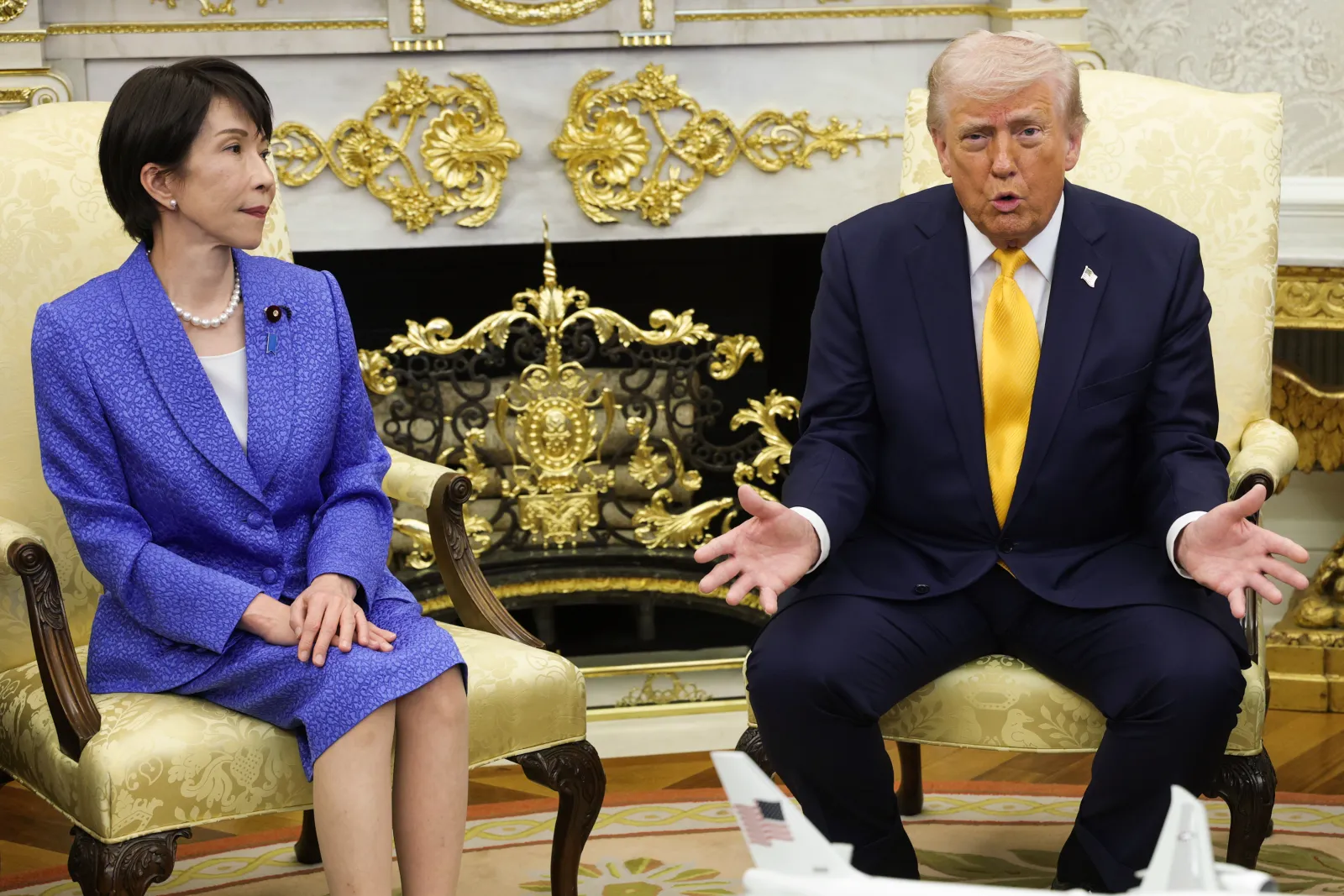
When asked on Thursday by a Japanese journalist why the U.S. had not given its allies advanced warning it was about to launch huge airstrikes on Iran on February 28, Trump replied: "Who knows better about surprise than Japan? Why didn't you tell me about Pearl Harbor?" The Japanese prime minister looked somewhat taken aback.
The invocation of Pearl Harbor, controversial as it is, underscores a belief in the strategic value of striking first and striking hard. In this sense, recent escalations are less a break from past policy than a continuation of a long-standing instinct: that conflicts should be resolved through decisive action.
Yet this approach sits uneasily with contemporary realities. Iran is not Nazi Germany or Imperial Japan, and the Middle East is not a unified battlefield. Modern conflicts are diffuse, asymmetric, and constrained by political and economic interdependence. The idea that a single, decisive blow can fundamentally reshape the strategic landscape is far less plausible than it was in 1945.
Trump Invokes Churchill
Trump has escalated his row with Starmer by invoking Britain’s iconic wartime leader against him. The U.S. president said he was "not happy" with the UK and complained that "this is not Winston Churchill that we’re dealing with," accusing Starmer of hesitation over allowing U.S. strikes on Iran from the Diego Garcia base.
The criticism reflects deeper frustration in Washington over Britain's reluctance to be drawn into a wider conflict. Starmer has insisted the UK will not be pulled into a broader war, instead pushing for a "viable, collective plan" with allies, particularly around reopening the Strait of Hormuz.
For Trump, however, such caution looks like weakness. By contrasting Starmer with Churchill, he is framing the moment as one demanding decisive wartime leadership—and casting the UK as falling short.
The clash underscores a widening trans-Atlantic divide between Trump’s demand for full military backing and Starmer’s more measured, coalition-focused approach.

...
Trump's view of World War II is strikingly unilateral. Speaking at Davos in January, he told a largely European audience that "we won it big," adding that, without the United States, "you’d all be speaking German…and a little Japanese." The remark reflects a long-running tendency to downplay the Allied nature of victory.
And mocking France's V-E Day commemorations in May, Trump quipped that the U.S. "did a little more to win the war," even joking about Hitler at the Eiffel Tower. The comments underscore a worldview in which American power, not collective effort, defines both past victories and present expectations.
Total War Meets Limited Reality
Trump's rhetoric implies total victory: regime change, strategic transformation, a definitive end to the Iranian threat. But his instincts stop short of the commitments such outcomes require. He has shown no appetite for long-term occupation or nation-building, raising fundamental questions about what "winning" actually entails.
That contradiction is increasingly visible. Initial signals of expansive goals have given way to narrower objectives focused on degrading Iran's capabilities. The result is a strategy that invokes total war but operates within the constraints of a limited one.
Allies, Isolation, and No Churchillian Coalition
World War II was, above all, a coalition war. Its success depended on deep alliances and shared purpose. Trump's more transactional approach to alliances complicates any attempt to replicate that model. Key partners remain cautious, reluctant to be drawn into a conflict they did not help shape.
This exposes a core weakness in the historical analogy. A Churchillian vision of conflict without a Churchillian coalition is difficult to sustain. The moral clarity of 1941, when Churchill and President Franklin D. Roosevelt signed The Atlantic Charter, cannot easily be translated into the fragmented geopolitics of 2026.
A Strategy Shaped by History
Ultimately, Trump's Iran policy reflects more than immediate calculations. It reflects a particular reading of history. By drawing on the imagery of Pearl Harbor and the rhetoric of Churchill, he frames the present as a moment demanding decisive action against a dangerous adversary.
But that clarity comes with risks. It simplifies a complex conflict, encourages escalation, and obscures the long-term consequences of war.
The danger is not just that the analogy is imperfect. It is that it may be pushing U.S. policy toward a model of conflict that belongs to a very different century.
Hey gang, Carlo Versano here. I hope you enjoyed this article. As Newsweek's Director of Politics and Culture and editor of the 1600 newsletter, I'm keen to hear what you think. Now, Newsweek is offering a new service to allow you to communicate directly with me in the form of a text message chat. You can sign up and get a direct line to me, as well as the reporters who work for me. You can shape our coverage.
As a Newsweek member, we're offering this service to you for free. You can sign up below, or read more about how it works here. Let's talk!
View 0 Comments
Submit Correction
View Editorial & AI Guidelines