
10
Loading video...

By Andrew Stanton
Reporter
0
Share
Newsweek is a Trust Project member
See more of our trusted coverage when you search.Prefer Newsweek on Googleto see more of our trusted coverage when you search.
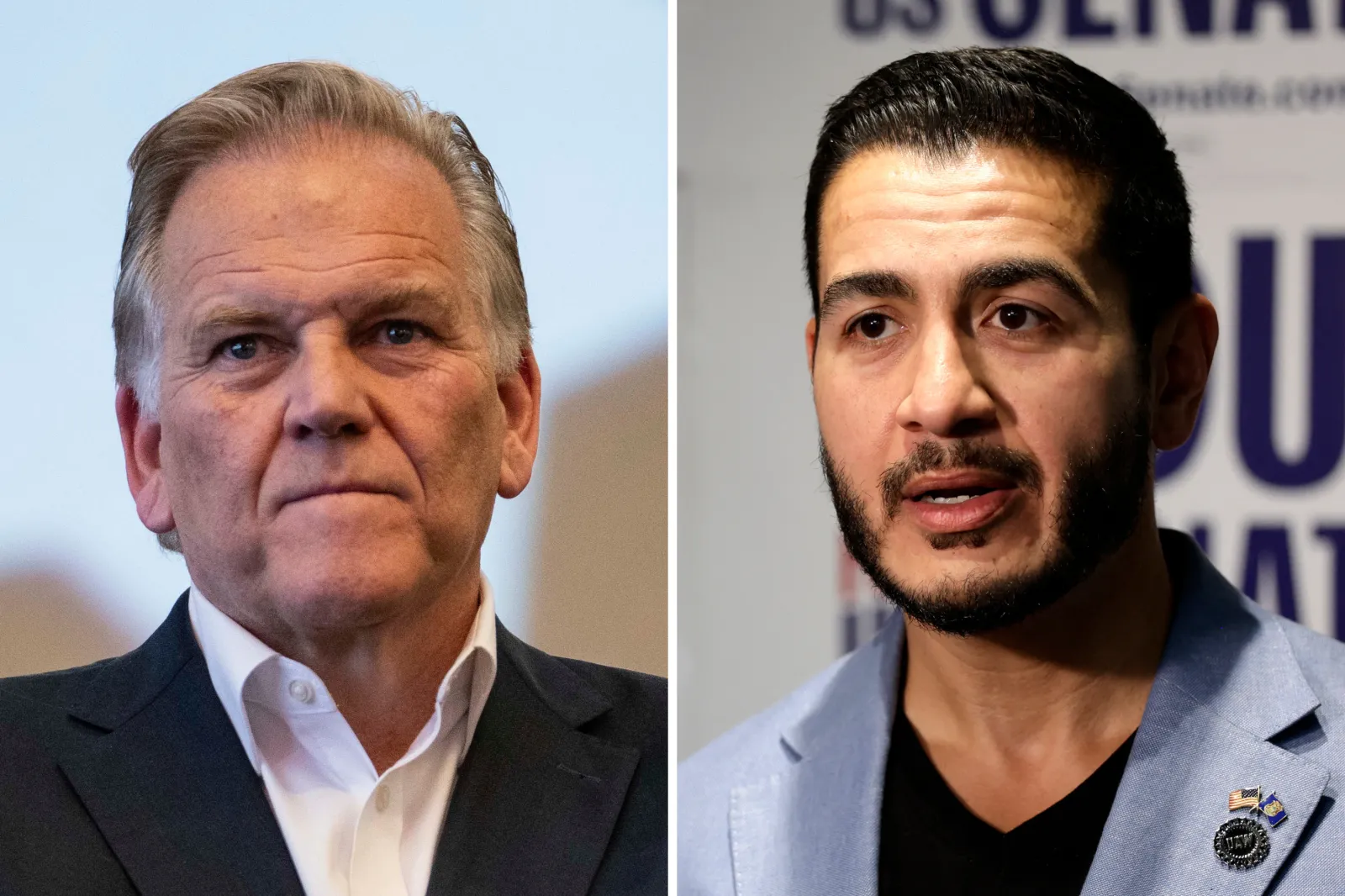
Abdul El-Sayed was dealt a polling blow in the Michigan Senate race, with a new survey showing him trailing former Representative Mike Rogers by a single point, a statistical tie, in the battleground state.
The new Glengariff Group poll highlights how competitive the Michigan Senate race is. Democratic Senator Gary Peters’ retirement left the seat open in the state that backed President Donald Trump by about two points in 2024.
Democrats believe the national environment, driven by Trump’s poor approval ratings and frustration over the economy, will help carry El-Sayed, a progressive backed by Vermont Senator Bernie Sanders and New York Representative Alexandria Ocasio-Cortez, across the finish line. Republicans, however, believe El-Sayed’s left-wing policies could alienate moderates and give them a chance to flip the seat this November.
Read More on Politics
The Michigan Senate race also carries key implications for the progressive movement. Some Democrats have cast doubt on whether progressives like El-Sayed can win in competitive states like Michigan and that more centrist candidates are more suited to purple areas. El-Sayed's candidacy will test whether the progressive wave that has swept over the Democratic primaries can translate to the general election electorate in a state that voted for Trump.
Newsweek reached out to the El-Sayed and Rogers campaigns for comment via email.
...
El-Sayed, Rogers in Close Race, Polls Find
The new poll, published in The Detroit News, showed a statistical tie in the Michigan Senate race.
Rogers received 45.8 percent support in the poll, while 44.4 percent of respondents said they would vote for El-Sayed. Nine percent of respondents were still undecided, the poll found.
Among independent voters, a critical voting bloc in the state, El-Sayed led by 14 points, according to the poll. However, among those who are “definitely” going to vote, El-Sayed held a slight lead, 46.7 percent to 44.4 percent.
El-Sayed’s favorability rating is 8 points underwater, with 42 percent viewing him unfavorably and 34 percent favorably. Meanwhile, Rogers is 9 points underwater, 28 percent viewing him favorably and 37 percent unfavorably, the poll found. But among independents, 43.5 percent viewed El-Sayed unfavorably, and 29 percent viewed Rogers unfavorably.
It surveyed 600 likely general election voters in Michigan from August 31 to September 3, 2026.
Another new poll from CNN released on Wednesday, however, gave El-Sayed a slight lead. His support stood at 47 percent to Rogers' 44 percent. It polled 843 likely voters from August 31 to September 6 and had a margin of error of plus or minus 4.1 percentage points.
In the poll, views of El-Sayed were split. Forty percent each said they viewed him favorably and unfavorably. Rogers was less popular, with 42 percent viewing him unfavorably and 35 percent favorably.
Related Video

00:44
El-Sayed Labels Trump the ‘Worst Symptom’ of America’s Political Crisis
Mike Rogers vs. Abdul El-Sayed: What Other Polls Show
A flurry of recent polls have shown El-Sayed with a slight lead over the past few weeks after the primaries.
An EPIC-MRA poll showed El-Sayed up by 4 points, 47 percent to 43 percent. It surveyed 600 likely voters from August 22 to 28, 2026 and had a margin of error of plus or minus 4 percentage points.
A Michigan State University poll showed El-Sayed with a 5-point lead, 50 percent to 45 percent. It surveyed 779 likely voters from August 10 to 20, 2026.
A Susquehanna Polling & Research Inc. poll, which surveyed 800 likely voters from August 11 to 17, 2026, showed El-Sayed up by 7 points, 46 percent to 39 percent. The margin of error was plus or minus 3.46 percentage points.
An AARP poll, conducted by Fabrizio Ward and Impact Research, showed El-Sayed up only one point, 48 percent to 47 percent. It polled 877 likely voters from August 9 to 11, 2026 and had a margin of error of plus or minus 3.3 percentage points.
Marjorie Sarbaugh-Thompson, a political science professor at Wayne State University, previously told Newsweek that the Senate race is likely to come down to turnout.
“Whose base is most strongly motivated to show up and cast a ballot? Is there going to be a blue wave as there was at the midterms during Trump's first term [2018]?” she said.
What Prediction Markets Show
El-Sayed had a slight lead in prediction markets as of Wednesday, with a 62 percent chance on Kalshi and a 66 percent chance on Polymarket.
Prediction markets let traders buy and sell contracts tied to political outcomes and current events, aggregating real-money wagers into probability estimates. Prices fluctuate as traders react to polling, fundraising, candidate developments and broader political trends. They measure trader sentiment at a given moment but do not always predict the future accurately.
Can El-Sayed Unite Democrats?
El-Sayed faces a challenge of uniting a fractured Democratic Party after a contentious primary against Representative Haley Stevens, a moderate from the Detroit suburbs.
Some moderate Democrats have withheld support from El-Sayed over his positions on issues like health care and foreign policy. El-Sayed supports Medicare for All and has been a critic of Israel, opposing further aid over its actions in Gaza.
Representative Hillary Scholten, a Democrat representing the Grand Rapids, Michigan, area, declined to endorse El-Sayed because of his ties to Hasan Piker, a streamer who has become a lightning rod for controversy and criticism among establishment-aligned Democrats.
Piker recently drew backlash after remarks that if American Jews “keep putting this idea out there that they are singularly invested in Israel,” someone will “come around and take action” against them, adding that it is “dangerous” for them. The comments drew a wave of criticism toward Piker and El-Sayed.
Jeremy Moss, a state senator running for Congress in a suburban Detroit district, afterward wrote in a statement that there is “still work ahead to unite our ticket despite our differences.”
“I will not be lectured by a California podcaster about what Oakland County, Michigan's Jewish community should and shouldn't believe,” he wrote.
El-Sayed wrote in a statement that he believes “all Americans deserve the right to advocate for what they believe without fear of violence.”
“My commitment to Jewish safety is the same as my commitment to the safety of my own daughters," he wrote. "Antisemitism is a scourge, and we need to address it in all its forms. And I stand against any rhetoric that puts the community at risk.”
Michigan Is Key Battleground
Michigan has become one of the most competitive electoral battlegrounds over the past decade.
Former President Barack Obama won the state twice, by more than 16 points in 2008 and by just under 10 points in 2012. But Trump flipped it in 2016, carrying it by less than half a percentage point.
Trump made gains across the state because of his strong showing among white voters in rural areas who backed Obama.
He lost ground in the suburbs around Detroit and parts of Western Michigan around cities like Grand Rapids, but rural gains made up for it. Democrats struggled to win back those rural voters in significant numbers in recent cycles but continued to make gains in the suburbs.
Michigan flipped back to Democrats in 2020, when Biden carried it by just under 2 points. But Trump won it again in 2024 by about 1.4 points—the strongest showing for a Republican presidential candidate since 1988.
Who Is Abdul El-Sayed's Wife, Sarah Jukaku?
El-Sayed is married to Dr. Sarah Jukaku, a psychiatrist.
El-Sayed and Jukaku met at the University of Michigan and were featured in a 2006 article in the college's student publication, The Michigan Daily.
Jukaku has been featured in some of El-Sayed’s campaign material, including in a video speaking about support from her union when she had medical complications after childbirth. She was a medical resident at the time. She said she and El-Sayed discuss unions positively.
“You don’t realize you need the union until you need it,” she said. “In my case, having that advocate was really important when I wasn’t sure where to turn.”
What Happens Next
The Michigan Senate race will continue to be watched as one of the most competitive races of the midterms, with forecasters like the Cook Political Report and Sabato’s Crystal Ball classifying the race as a toss-up.
Overall, Democrats are hoping to flip the Senate but face a tough race. Republicans hold a 53-47 Senate majority, so Democrats must flip four seats to win control if they win every race in a seat they currently hold. Vice President JD Vance serves as the tiebreaker in a split Senate.
In addition to Michigan, Democrats are defending a seat in one other Trump-won state, Georgia, where Senator Jon Ossoff has been leading polls.
Democrats view GOP-held states in Maine, which Trump lost by 7 points in 2024, and North Carolina, which he won by 3 points, as top flip opportunities.
No other Senate races are in Harris-won or single-digit Trump states, meaning Democrats must expand the Senate battleground and compete in more conservative areas if they want to win the majority. They are targeting GOP-held seats in Alaska, Iowa, Ohio and Texas as potential states to flip. The Cook Political Report classifies those four races as toss-ups.
Contact Newsweek editors on this story: Jason Lemon and Sam Wilson.
View 0 Comments
Submit Correction
View Editorial & AI Guidelines