...

By John Feng
China Editor
0
Share
Newsweek is a Trust Project member
See more of our trusted coverage when you search.Prefer Newsweek on Googleto see more of our trusted coverage when you search.
Viral social media videos from China’s robot Olympics gave U.S. audiences fresh laughs online this week, but they ended with one big message: America is seriously missing out. By walling itself off from Chinese technology, the most it can hope for is to be the best of the rest.
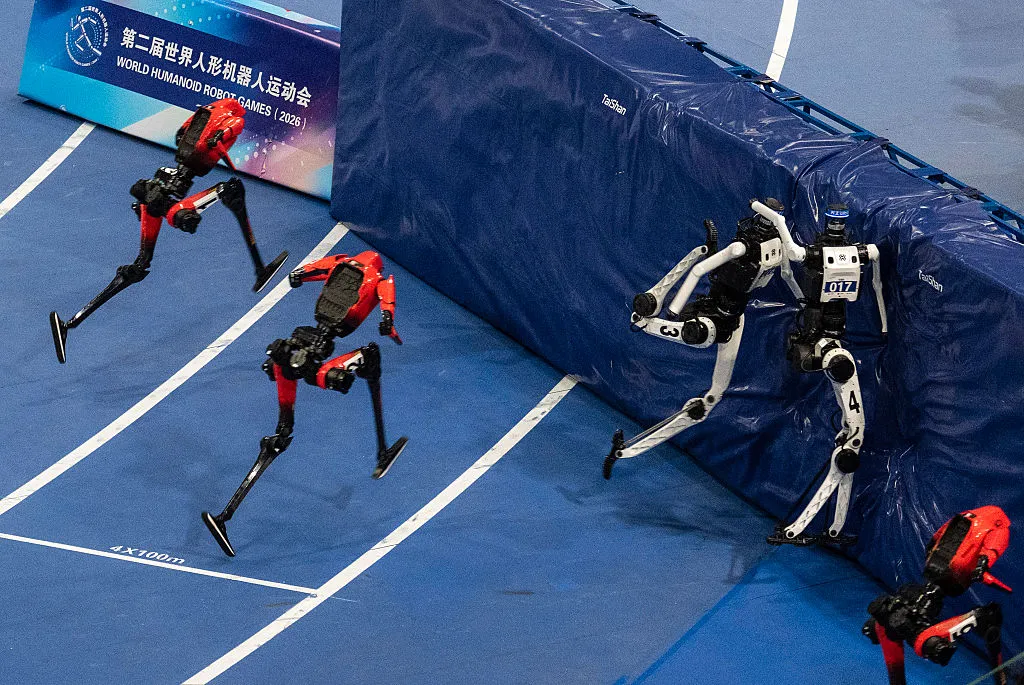
Beijing hosted its second World Humanoid Robot Games from August 22 to 26. Although teams from over a dozen nations including the United States took part, China’s robotics industry is so large, it basically was competing against itself.
America used to know this feeling, but now the world’s top manufacturers of robotic devices are all from China, and they’re projected to ship up to 60,000 units this year. By 2027, the industry could be worth nearly $3 billion, but U.S. companies won’t see much of that money.
Read More on World
On China’s most popular social media apps, Chinese users were laughing too as bipedal robots tipped over or broke in half. But it was a different kind of laugh. They know they’re winning, and that the robotics race may already be over.
More Than Just Games
The robot Olympics are about much more than entertainment. More than 600 teams used 2,000 robots in dozens of events this year to demonstrate proofs of concept alongside viable commercial products.
Audiences were naturally drawn to headlining track and field events such as sprints and the high jump, but what investors really turned up to see was progress in real-world commercial applications in the retail and service space.
Service robots competed in tasks including hotel housekeeping, office cleaning and store shelf restocking. AGIBOT, one of China’s leading designers, won gold for a firefighting robot and another for a library book organizer.
There are real financial benefits to being a successful first mover in any market, and big and small players in China’s robot industry are pitching from both ends—hardware and software. There aren’t enough venues for them to showcase the speed of their advancement.
Robots may never be as versatile as a human, but they can be programed to do specific tasks well. Two machine runners beat Usain Bolt’s 9.58-second world record this year in the 100-meter dash, more than halving the time set at last year’s Games.
Today, humanoid bots are only as useful as the software that drives them, and there’s evidence that the hardware is evolving more quickly than the programing. But China’s concurrent AI boom could make short work of that gap, especially if it’s the first to unlock self-thinking artificial general intelligence.
Demand for humanoid robots is rising, according to a market report released this month by California-based Smart Analytics Global.
Some 19,100 units were sold worldwide in the first half of 2026, it said. Chinese companies sold 97 percent of all robots and Chinese customers bought 85 percent of them.
Shanghai-based AGIBOT is the leader in global market share, followed by Unitree Robotics from Hangzhou, then Galbot from Beijing, and UBTECH and Leju, both from Shenzhen. All are from China.

...
Five AGIBOT subsidiaries were among the top 10 gold medal winners in this year’s robot Olympics.
"China remains the center of the current humanoid robotics boom," SAG said.
That’s something of an understatement. China’s lead in the field is staggering.
Banning the Competition
China is going big on robotics because, like AI, emerging technologies offer potential solutions to multiple problems.
The country’s demographic crisis is well documented. At the heart of that is a possible mass labor shortage that could cripple its manufacturing sectors, which have been key to its economic success in recent decades.
Its sizable military, too, could suffer manpower losses at a crucial time when China’s ambitious leaders are looking to assert more control over disputed territories and have a bigger say in global affairs.
Robot dogs modeled on the Boston Dynamics pup Spot are clearing rooms for China’s police and special forces. Last year, its defense researchers demonstrated a mosquito-sized drone prototype that could be used for surveillance and more.
For over two decades, China has graduated more annual research doctorates than has the U.S., a result of intensive and targeted investment in the sciences.
It’s no surprise that its best robot builders are now competing for domestic and overseas markets, taking advantage of a mature manufacturing base that makes testing and deployment easy to scale.
As in AI, the U.S. has locked itself out of this competitive ecosystem against the world’s most industrious designers. Since July, a ban on the import of foreign-made new models seeking equipment authorization means American consumers won’t get to play with made-in-China robot dogs and companies won’t be able to experiment with new logistics bots.
Most importantly, would-be robot makers in America won’t have the chance to be inspired to build better. China knows that innovation thrives on competition, and that competition is only as good as the ecosystem it lives in.
But the U.S. government is in an awkward place. American institutions linked to the defense space do have a research security problem, and President Donald Trump is worried about China Shock 2.0.
Concerns surrounding Chinese imports have extended from cheap consumer goods to highly subsidized high-tech products that threaten to overtake entire burgeoning industries in the West, such as electric cars and renewable energy.
It was never going to be a level playing field, but America has never shied away from a contest.
In one video online, a 100-meter race of metal runners ends with a humanoid robot crashing headfirst into a cushioned wall and losing a limb in the process. But that’s today.
Tomorrow, China will be the first to roll out humanoid robots in factories and possibly in the public workforce too: sorting mail, delivering packages and issuing your next speeding ticket.
View 0 Comments
Submit Correction
View Editorial & AI Guidelines